Showing posts sorted by date for query peat. Sort by relevance Show all posts

Saturday, February 1, 2014

Bengt Thorbjörnson in Scotland, 1929

Bengt Thorbjörnson (1891-1975) was a Swedish chemical engineer. After graduating from Kungliga Tekniska Högskolan of Stockholm he worked in sulphite factory in Bergvik (1916-1917), which manufactured sulphite spirits as a side product from 1911 at least until 1917. In 1917 he moved to Kramfors to work in a cellulose factory (1917-24) also producing industrial spirits as a side product. After a short spell at a margarin factory in Kalmar (1924-26) and a visit to Nashwalk Pulp & Paper Co in USA (1924-1925) he was appointed as the chief chemical engineer for Vin & Sprit AB (Wine & Spirit). He continued to work for the biggest Swedish alcohol producer for 30 years until 1957.


Bengt Thorbjörnson on the left
 Thorbjörnson toured Scottish whisky retailers and distillers in 1929-1930. The main object was to investigate whether it was profitable to start whisky production in Sweden. After the tour the Finnish alcohol monopoly consulted Thorbjörnson on the same subject and the record of the Scottish tour is still available in Swedish from the Kansallisarkisto (The National Archive) of Helsinki. Thorbjörnson visited the warehouses of W.H. Chaplin, John Walker & Son and The Distillers Company, as  well as the distilleries in Caledonian, Mortlach, Cardow (Cardhu), Glen-Mhor, Glen Albyn and Adelphi.

He preferred the Highland malts and considered the Campbeltown malts were "lacking midtaste". The factors most affecting the flavour of whisky according to his studies were: 1) Water, which should be low in calcium. The water of River Spey was good as it ran through soil rich in granite and sand. 2) Climate, which should be quite cold but even to allow long stable distilling times. 3) Amount of peat used in drying the malt. 4) Bacteriae flora, as the local bacteriae influenced the quality of the brew. 5) Experience of staff. 


The first place to visit was the wine and spirit retailer W.H.Chaplin & Co in London, who were at the time the sole representatives of the popular Long John brand. Their warehouse at Tower Hill consisted of 10 floors, of which 3 were underground. Huge glazed concrete cisterns (136 000 l) were used to vat and cold-chill-filter port wine. The whisky was vatted on demand in smaller concrete vats of size about 22 000 litres from different casks and different distilleries. According to other sources, Ben Nevis was the leading malt for Long John.


At John Walker & Son Thorbjörnson was hosted by the manager Sir Alexander Walker. At the time their Johnnie Walker blend was the most sold whisky brand in the world. Only sherry casks were used at the time. About 20% of them were new casks seasoned with sherry and the rest were refill casks rejuvenated with a small amount (about 35 litres) of sweet dark sherry for six weeks during which they were turned regularly. After the sherry-seasoning they are treated with pressure to impregnate more sherry into the wood. The sherry in the cask was then poured off and used several times for other casks. The pressure treatment had been developed by WP Lowrie in late 19th century and at the time of Thorbjörnson's visit it was used by many other blenders and distilleries as well. The Walkers had recently shifted to mainly hogshead size casks to ensure even quality. At the present time the Johnnie Walker recipe consisted of 10 parts Highland malt (Mortlach, Benrinnes, Ord, Cardow, Glenlossie, Dailuaine, Aultmore, Coleburn or Clynelish), 2 parts of Islay malt (Talisker (classified as Islay!), Caol Ila or Lagavulin) and 2 parts of Lowland malt (Rosebank or Glenkinchie). The blended malt was then again blended with grain whisky (mostly Caledonian) and the malt content varied between 40-60%. Long John blend consisted of 65% grain, 15% Lowland malt, 15% Highland malt and 5% Islay malts.


Caledonian distillery in 1966 (scotlandsplaces.gov.uk)
Caledonian grain distillery produced 40 000 gallons per week, which equalled 9 000 000 litres 50% abv- spirit per year. Maize was the most common cereal, but wheat and barley were sometimes used, too. About 30% of the mash came from barley malt dried over coal fire to gain diastase power. The maize flour was pressure cooked to prevent bacterial contamination. Brewers' yeast from Edinburgh was used to ferment in covered washbacks of 225 000 litres capacity (Cardow used pressed yeast). Carbon dioxide was collected and sold to mineral water producers. Column distillation with 20 plates in the analyser and 40 plates in the rectifier was used to produce new make spirit of 67 degrees over proof (95,3% ABV). The spirit was cut with water to 11 over proof (63,4% abv) for maturation. Draff was given for free to farmers. At the Adelphi grain distillery weekly production was 36 000 gallons/week and the only significant differences were the cooking of maize (not pressurised in Adelphi) and the fermentation time (72h in Adelphi, 96h in Caledonian). About 125 men were employed in each.

Mortlach produced high quality Highland malt with "quite old-fashioned means". A total of 24 men were employed to produce 8 000 gallons per week. Production was bigger than at the Invergordon distilleries, as Glen-Mhor and Glen Albyn managed only 2 500-3 000 gallons per week each. Distillation was carried out from September to end of May and the spring production was considered to be of the best quality. Mostly foreign barley was used and floor malted on site. Two kilns were used to dry malt for 50 hours in up to 77C after 9 days of germination. About 18 kg peat for every 120 kg of coal was used in kilning. Fermentation time in seven 60 000 gallon washbacks varied between 46-56 hours. After each fermentation the washbacks were washed with lime and peat was burned on the bottom of the washback to avoid bacterial contamination. The spirit was double distilled (no mention of the Wee Witchie or even partial triple distillation) to a very high proof of 45 over proof (82,8% abv) and reduced to standard 63,4% before maturation. Rummagers for wash still and direct firing with coal for both stills were used. 


Thorbjörnson calculated that the blending and maturation was cheaper in big English warehouses compared to the Swedish Reymersholm or Slottet warehouses. He also thought that the flavours came mostly from the malt whiskies and therefore the malt content of the Swedish blends (Crown Blend and Black Label) should be increased. On the other hand Scotch grain whisky could be replaced with cheaper domestic neutral potato spirit to cut costs. He also made a a costs-analysis for building a Swedish malt distillery with a 500 000 litres capacity per 6 months, which apparently never came to be.


References and further reading:

Kansallisarkisto, Helsinki. http://www.arkisto.fi/en/the-national-archives-service/arkistolaitoksen-vaiheet-2
Koch B. Från idé till produkt. Svenska Uppfinnarföreningen, 1963.
Morrice, P. Schweppes guide to Scotch. Alphabooks 1983
Spiller, B. Cardhu. John Walker & Sons, 1985.

Sunday, January 5, 2014

Sulphur

Sulphur candle
Sulphury notes are a controversial part of whisky aroma. Individual differences in perceiving the sulphury flavours seem to be great and easily arguable. Sulphur in its natural S8-form is quite stable with an odor of matchsticks. Most organic sulphur compounds however have usually very low perception tresholds and pungent odors. Organic sulphur compounds have been associated with meaty, burnt, rubbery, rotten aromas, but also some unexpected aromas such as grapefruit. Often low levels of sulphur are associated with mature, rancio, complex and meaty notes in whisky.

Sulphur in the whisky is mostly sourced from the aminoacids of the grains used in fermentation. The barley used in the whisky production are usually spring varieties and typically very low in protein and thus low on sulphury aminoacids (cysteine, methionine), too. However the yeasts metabolise the available aminoacids and in the process produce a variety of organic sulphur compounds. Typical byproduct of anaerobic sulphur metabolism is hydrogen sulphide (H2S), which has a strong unpleasant odor of rotten eggs and can further metabolise into thiols and other organic sulphur compounds. Excess amounts of yeast or the use of brewer's yeast or long fermentation times tend to increase the autolysis of yeasts and therefore add to the sulphur content of the wash. The lactic acid bacteriae can produce sulphury compounds, especially Lactobacillus brevis tends to impart a sulphury aroma.

Some sulphur is used during the kilning process, especially if peat is used to dry the grains. The anaerobic bacteriae in a peat bog produce sulphury compounds and obnoxious nitrosamines and by burning some sulphur with the peat the off-notes (and toxins) can be converted mainly to sulphur oxides, which do not spoil the grain.

The copper used in the distillation stills reduces the sulphury content of the whisky most likely by acting as a catalyst in processes resulting in insoluble copper sulphates. On the other hand copper has been associated with an increase in some sulphur compounds in the spirit, such as dimethylsulphate (DMS). Low copper contact (small/squat stills), fast distillation and high temperatures increase sulphury notes on new make spirit. Direct heating probably increases sulphury notes as there is bound to be some burning of grains at the bottom of the still and temperature variations between different parts of the still.

Cask maturation significantly reduces the amount of most sulphur compounds in the whisky, even so that in a recent study all of the dimethyl sulphide (DMS), 3-methylthiolpropylacetate, dihydro-2-methyl-3(2H)-thiophene and ethyl-3-methylthiol-propanoate had disappered after 3 years of oak maturation. Most organic sulphur compounds such as DMS decrease gradually during aging. This is most likely due to evaporation and to a lesser degree to oxidation or reactions with the carbon layer of the charred cask.
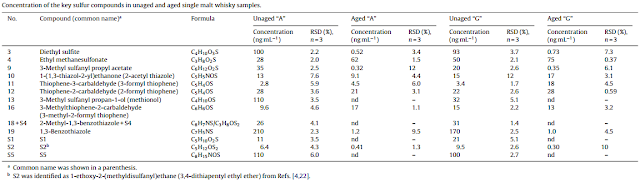
Key sulphur compounds in new-make spirits and single malt whiskies (Masuda & Nishimura 1982)

The individual perception of different sulphury compounds appears to be very different. As experienced tasters rated different sulphur compounds (in a study by Jack FR et al 2008), there was considerable variation between individuals and compound.

Sulphury character of different sulphur compounds, modified from Jack et al 2008


The most perceived MMFDS and 2-thiophene-cis-aldehyde, 4-methyl-thiazole, 4-methyl-5-vinyl-thiazole as sulphury and the mix of all was statistically the most sulphury of them all. At least one taster did rate the sulphury taste less than 1 out of 10 for all but two compounds. Several tasters were non-tasters for some compounds that the others rated highly sulphury. It is to be noted that all but one tasters rated one individual compound more sulphury than the mix of all, so the sulphury taste is not an add-on characteristic but rather a combination. For example 2-pentyl furan distictively suppresses the sulphury character of DMTS, just like salt suppresses a bitter taste (just try a tiny amount of salt in your coffee).
Sulphury character of different sulphur compounds, modified from Jack et al 2008
However, there has been controversy about sulphury casks in the whisky industry. Especially Jim Murray, the author of The Whisky Bible has been worried about sherry cask-derived sulphur-taints. Sulphur is widely used in wine industry to prevent bacterial growth in must and to improve the stability of wine. It is usually used in the form of sulphur dioxide, usually soluted in to a liquid form for ease of use. Sulphur dioxide acts as an antioxidant and antibacterial agent in wines. Excess sulphur dioxide content may intensify some allergic reaction and impart off-notes into wine. Sulphur candles or brimstone sticks have been used to preserve casked wine and to prevent bacterial contamination of casks stored empty.

Fumigation of casks with sulphur has been used probably from the Roman era. The use of sulphur matches and candles for preserving wines and other perishables was common in late 18th century Europe. Wine writer André Jullien describes the fumigation of wine casks in 1825:

"Fumigating wines is impregnating them with sulphurous vapours, obtained by the burning of brimstone matches... aromatics are often mixed with the brimstone... the Strasbourg [violet scented matches] are to be preferred for wine... When old wine runs clear, it is sufficient to burn a bit of match in the cask you are going to fill. To hasten the fermentation of new wine, burn several matches and shake the wine in the vapour... Many vineyards produce wines of a sulphurous taste, which goes off in time" (as cask maturation/storing was common at the time). This practice reduced the oxygen in the cask and prevented lactic bacterial brettanomyces contamination, therefore enhancing the stability and quality of wine.

Sulphur burners are still used
by amateur winemakers.
There are many references from the 1700s and the 1800s describing different cask sulphuring methods. Usually sulphur was introduced into the cask through the bunghole in a wire containing a linen cloth, which had been coated with sulphur. The cloth was burned and the bung closed, resulting in oxygen-deprived cask with some sulphur dioxide and some sulphur trioxide gasses. A fresh cask usually used first for fermentation was considered quite clean, so they were only slightly or not at all sulphured. Sulphur dusting of the vines was used as a cure against oidium (powdery mildew), the first of the fungal diseases from America, in the 1850s.

The effects of sulphur in casks were not completely understood and in 1873 there was a scandal in Britain, as Dr Thudicum wrote that the sulphuring, plastering (adding calciumcarbonite into must) and fortification of sherry was to be considered as adulteration and that the sherry wines were inferior to the French wines and probably dangerous to health. The fact that also the French were sulphuring their casks was not discussed and there were probably some trade-oriented motives behind the argument.

Different types of sulphur used in winemaking
Adding sulphur dioxide into wine has been common from at least the 1890s. It prevents bacterial and wild yeast growth and acts as an antioxidant preventing overoxidation and browning. During early 1900s some wineries used (hugely) excess sulphur dioxide in order to use bigger tanks and less strict oxygen control, but it resulted in sulphur tainted wines with overly "reduced" aromas. Sulphur dioxide content is limited by EU under 160mg/l in red wines, 210mg/l in whites and 400mg/l in sweet wines. Most wineries use concentrations below 100mg/l, but non-sulphured commercial wines are rare as they easily become oxidized. Sulphur dioxide was obtained by burning sulphur candles in the late 19th century, but since the early 1900s it has been mostly used in liquid form or as potassium metabisulphite; Californian wine expert Maynard Amerine stated already in 1970 that no burned sulphur is commonly used in wine making anymore, and there is no evidence that the major sherry cask suppliers or whisky distillers had used sulphur candles for several decades. Theoretically excess sulphur dropped from a candle might be reduced to H2S or mercaptans by yeasts producing sulphury off-notes.

Since 1986 Spain has been a member of EEC and the shipment of sherry has been made very hard by the Denominacion de Origen to encourage bottling in Spain. Bottling of sherry is done almost exclusively in Spain and full sherry casks are no longer imported. The sherry shippers had already started their own bottling plants in Spain in the early 20th century. Pedro Domecq started their bottling operations in Jerez in 1920 and Gonzalez Byass was to follow gradually during the interwar period. Sandeman bottled some of their sherries and ports in location as early as 1880, but the bottling of sherry in England by Sandeman ceased in 1969. Harvey's were the last big shipper to bottle their sherries in England, as they bought a winery in Jerez from MacKenzie in 1970 and since then have been bottling practically all of their sherries in Spain. Therefore since early 1970s many distillers have been maturing whisky in sherry casks made to order in Spain. Both American and Spanish oak casks are coopered and usually the sherry used in seasoning is oloroso, but sometimes lower quality blending sherry called raya, which resembles oloroso. Some bodegas, for example Gonzalez Byass and Pedro Romero trade their old empty solera casks, which are made exclusively of American oak and usually 80-100 years old and probably very different from a typical sherry shipping cask or a seasoned cask. Another quite popular way of producing sherry casks was to rejuvenate old exhausted cask by scraping the inner surface, toasting it again and seasoning it with sherry. Aeriation of whisky, during bottle maturation or in greater extent after the bottle has been opened, usually decreases the highly volatile sulphury notes.

In conclusion, there is good and bad sulphur in whisky. To simply pin one or two sulphur compounds responsible of the good or the bad aromas would be an oversimplification. Similarily the origins of sulphury notes seem to be impossible to track to just one source, such as sulphury cask and there is no evidence of excess use of sulphur candles in the sherry industry during the last decades, in fact quite the opposite. More likely is that there are some bad batches distilled too fast or in too warm climate that are over-sulphury, or maybe a cask has not been properly sulphured and has been contaminated with brettanomyces.

REFERENCES AND FURTHER READING
Harrison, B et al. Impact of copper in different parts of malt whisky pot stills on new make spirit composition and aroma. J Inst Brew, 2001;117(1);106-112
Jack, FR et al. Sensory implications of modifying distillation practice in Scotch malt whisky production. In Distilled Spirits, ed Bryce JH, Piggott JR, Stewart GG. Nottingham Univ Press 2008.
Jack, FR. Understanding Scotch whisky flavour. Food Sci Tech 2003;14;28-30
Jullien, A. Wine merchant's companion and butler's manual. 1825
Labuza, T et al. Maillard reactions in chemistry, food and health. RSC 1994.
Masuda, M and Nishimura, K. Changes in volatile sulfur compounds of whisky during aging. J Food Sci 1982; 47(1); 101-5
Reaich, D. Influence of copper on malt whisky character. In Proceedings of 5th Aviemore Conference on malting, brewing & distilling. 1998
www.practicalwinery.com/janfeb09/page1.htm

Thursday, August 1, 2013

History of the column still


Coffey still
Whisky can be distilled in column or pot stills. Grain whiskies are usually distilled in the faster and more economical column stills, which produce light or almost neutral spirit opposed to the heavier malt whiskies produced usually in pot stills. 

Distilling wine was invented in northern Italy during the 11th century, although the Arabs and the Alexandrians had probably used distillation before that to produce infusions and concotions, perhaps even as early as in the 1st century AD. The early stills were simple pot stills with a collection pot. The apparatus was often made of clay and/or copper, sometimes partly of wood, even of leather. The shape of still was usually onion-like; wide bottom to enable efficient and fast heating and narrower head to enable condensation and collection. Some kind of worm was used from the beginning, but efficient water cooling was probably invented as late as in the 18th century. The knowledge of distillation spread through Europe and Russia during the 14th and 15th centuries and malt spirits were probably distilled in Britain and Ireland at least from the late 15th century. The design of the stills remained quite constant from the 11th to the 19th century, although there were numerous experiments with different shapes. The onion pot still however remained the still of choice until the early 19th century. Heating was provided by a naked flame, often by wood fire in southern Europe, but more often by peat in the north and after the 17th century by coal.

Water-jacketed still was invented in 1526 by Paracelsus (alias Theophrastus Philippus Aureolus Bombastus von Hohenheim the Swiss) and it became known as the Baine Marie or balneum Mariae among the alchemists. The water bath allowed the still to be indirectly heated, thus preventing the wash from burning on the bottom of the still and allowing the distillation of pomace and other thicker washes. The risk of cracking stills, especially made of clay, was also diminished by indirect heating. The fractionating system was invented as early as 1553 by German chemist Philip Ulstadius, but it did not possess any significant advantages for spirit distillers and was used primarily by (al)chemists.

The condenser was improved by a German chemist Christian Ehrenfried Weigel in 1771. He placed the worm into a tube, which was cooled by circulating cold water. The invention was named Liebig condenser. Later an englishman William Grimble invented the tube condenser 1825 and it was later improved and distirbuted widely by the Dutch still-manufacturer Armand Savalle.

The Woulfe bottle
The evolution of the still gained pace during the early years of 19th century, especially in France. An illiterate French workman Edouard Adam from Rouen attended chemistry lectures given by professor Laurent Solimani. Adam understood that the principles of the Woulfe bottle, invented by Angelo Saluzzo and used in chemistry, might also work for alcohol distilling and in 1801 invented and patented the first still to produce alcohol in one operation. In principle, that was the first working column still, although the "column" was placed horizontally and consisted of several chambers or pots. It allowed single distillation for high alcohol spirit, more effective heat exchange and relatively simple fractioning of the spirit. Mr Adam was however not successful in commercializing his invention and several distillers, including Solimani, Bérard, Barré, Brugniére, Pistorius and Carbonel, built either direct copies or similar stills with just minor modifications. The three distilleries built by Adam were not successful and he died poor in 1807.

Nääsi distillery, late 19th century Finland.
Pistorius still on the right, Savalle still at the back
Pistorius improved the Woulfe bottle principle and patented his still in 1817. It had many properties of a modern column still; the wort was fed into the rectifying part of the system and divided by the steam rising from the lower pots into alcohols, feints and the rest was piped to be redistilled in the lower pots. The rectifying plates are unique, but quite efficient allowing good reflux but also thick worts. The Pistorius still was used in central Europe and Scandinavia throughout the 19th century.

Armagnac still
The first truly continuous still was made by Fournier, who used two columns, which were heated alternately and fitted with valves for removing the residues. Professor Solimani introduced indirect steam heating for an modified Adam still in 1814 in his own distillery. French Jean Baptiste Cellier Blumenthal invented the first practical continuous still in 1808 and patented it in 1813. Basically he combined Adam's principle of multiple distilling/rectifying chambers, the early ideas of fractionation by Ulstadius, preheating and the vertical columns and the residue removal of Fournier. The apparatus still had a pot still, but the wine was feeded straight from the top of the column while vapours rose from the pot to the vertical distilling column, which had 9 perforated rectifying plates. Thus the distilling column was cooled with wine, which was simultaneously preheated for the distillation. The first stills were built by Cellier and a Dutch sugar-trader Armand Savalle, later to become a global still-manufacturer. The patent was improved with fractionating plates and draff/residue outlets and sold to Parisian apothecary Louis-Charles Derosne in 1818, who succeeded in commercializing the product. Savalle and his family continued with the original apparatus and sold them to various distilleries around the world. Some of their stills are still in use at rum, brandy and neutral spirit distilleries. Many eau-de-vie, armagnac and bourbon distillers adopted a cross-over between column and pot stills. The wort is boiled in the pot and rectified in single column with a lot of reflux.

Savalle still in Demerara Distillery, Guyana
(www.cocktailsoldfashioned.de)
In England a version of the Cellier Blumenthal still was patented in 1815 by relatively unknown Mr. Dihl, but it did not gain commercial success at the time. In the same year James Miller patented a system for preheating the wash in the worm cooler and in 1818 Joseph Corty described a still with double pots and a Pistorius-like condesenser-reflux-system. So basically all the pieces for working continuous still were available in Britain in the late 1810s. In Ireland the big pot stills ruled, although there were some experiments made with continuous distilling. John Stein at Clonmel distillery developed a triple still, basically just three stills attached to each other and Joseph Shee of Cork had a quadruple pot still, in which the first pot acted as a steam source. In 1822 Irish Andrew Perrier patented his vertical continuous still, which strongly resembled the Fournier and Cellier Blumenthal stills and by 1823 a French immigrant, a veterinary surgeon Jean-Jacques Saintmarc build a variation of the Adam still. The Saintmarc's potato spirit was not a success in England and he advanced into Ireland in 1825 and marketed grain whisky distilled with a continuous column still, but that was considered "too pure". It was until 1828 that the first commercially successful column still was built on the British Isles as Robert Stein, a member of the Stein-Haig distilling family, patented his column still. It had three preheaters and steam boiled in a separate vessel was used to heat the wash, which was intermittently sprayed by pistons into a series of chambers. The chambers were divided by crude cloths (probably haircloths). The cloth permeated ethanol well, but less so water and solubles, therefore acting both as a rectifier and a filter. It enabled large amounts of distillate to be produced in a single run and improved the heat economy compared to the pot stills. The process had to be stopped for discarding the excess oily residue, so it was not exactly continuous operation. Surprisingly the Steins used only malted barley in their Kirkliston distillery for several decades, despite the fact that most of the output was sold for gin manufacturers.

Aeneas Coffey (1780-1852)
The French-born Irishman Aeneas Coffey had retired from excise officers duty in 1824 and bought into Dodder Bank distillery in Dublin. He also managed the South King Street distillery (1828) and the Dock distillery (1834) in Dublin. The first Coffey stills were made of wood and iron and consisted of a single column, but copper plates and metallic columns quickly became the norm, most likely because of the better malleability and spirit quality. By the time Coffey patented his still design in 1830, he had introduced perforated copper plates for rectifying and pipes to remove the residual oils during distillation. During the 1830s the system was divided into two columns as it was easier to manufacture, it had better rectifying qualities as well as better heat economy. Numerous designs for rectifying plates were later introduced, although the most common was the bubble cap design. The Irish distillers trusted their big pot stills and only some Northern Irish distillers experimented with the Coffey stills, first in Derry by Andrew Alexander Watt's Abbey Street Distillery in 1833 and later in Belfast at Avoniel distillery (1882) , The Irish distillery, The Royal Irish distillery (the 1890s) and and at Dundalk (the 1880s?) distillery just south of the present border. As his stills were not selling in Ireland, Coffey moved his business to London. The first Scottish whisky distillery to install Coffey still was Grange in 1834 and during the next few years Inverkeithing, Bonnington and Cambus followed. Aeneas Coffey Jr tried his hand at Lewisham distillery, London in 1840, but was not successful and the Coffeys established themselves as still makers. At first the columns stills were used by rectifiers and gin distillers, but during the mid-1840s the Scottish distillers really started building Coffey stills.

DistilleryStillYear
KirklistonStein1828
Cameron BridgeStein1830
GrangeCoffey1834
InverkeithingCoffey1835
BonningtonCoffey1835
CambusCoffey1836
YokerStein1845
KilbagieCoffey1845
Port DundasCoffey1845
SeggieCoffey1845
GlenochilStein1846
HaddingtonCoffey1846
CroftanrighCoffey1846
KennyhillCoffey1847
SunburyCoffey1849
CarsebridgeCoffey1852
SaucelCoffey1855
GlenmavisCoffey1855
CaledonianCoffey1855
Bo'nessCoffey1876
North BritishCoffey1885
The Scottish patent still whisky distilleries founded in 19th century

The column still was much more efficient compared to the traditional pot still, producing higher proof (usually 86-95% ABV) spirit about ten times more in volume compared to medium sized pot still distillery. Since the malting, heating and maintenance costs were a fraction of those of a malt distillery, the column still grain spirit cost about 50-70% less compared to pot still malt whisky, even if the set-up costs were included. The northern Britons were not used to the light column still whisky and at the beginning large quantities were sold to rectifiers and gin distillers, who spiced the spirit and sold it as gin or imitation brandy or cognac. As shown in the figure below, the English rectifiers and distillers quickly adopted the Coffey still, but the more traditionalist Irish and Scots remained loyal to the pot still at least to some extent.
(Weir 1995)
During the latter part of the 19th century several factors caused the rise of the column still whisky. Branding and advertising became important at about the middle of the 19th century Britain. Several traders begun blending the products of different distilleries and sold them under their own labels. Blending enabled the inclusion of raw grain column still spirits into the mix and on the other hand blended whisky was easier to sell in the big English markets used to lighter non-smoky spirits. The column distillers began to control their pricing, the first price cartel was formed in 1856 and by the 1890's the century the DCL controlled all but most column distilleries and had a virtual monopoly during the 20th century. The tax reform in 1860 raised the taxation of foreign spirits and fortified wines and allowed commercial yeast manufacturing in the distilleries, which became a substantial source of revenue for the grain distillers towards the turn of the century.

REFERENCES AND FURTHER READING:
Barnard A. The whisky distilleries of the United Kingdom. Birlin ltd 1887
Forbes, RJ. Short history of the art of distillation. Brill 1948
House, J. Pride of Perth, Bell's 1976
Kaukoranta, A. Sulfiittispriiteollisuus Suomessa. Polar 1981
Kauppila, O. Rajamäen tehtaat. Painokaari 1988
Laver, J. The house of Haig, Haig 1958
Morewood S. A philosophical and statistical history of the inventions and customs of ancient and modern nations in the manufacture and use of inebriating liquors. Longman 1838.
Nettleton, W. The manufacture of spirits. London 1893
Townsend B. Scotch missed. Angel's share 2000.
Townsend B. The lost distilleries of Ireland, Neil Wilson 1997
Udo M. The Scottish whisky distilleries. Black&White Publishing 2006.
Weir, RB. The history of the Distillers Company 1877-1939, Oxford Univ Press 1995
http://www.cocktailsoldfashioned.de/2011/02/demerara-distillers-limited-guyana-rum/
A modern Coffey still in North British distillery

Wednesday, November 23, 2011

Fermentation flavours


Fermenting in Loch Lomond distillery
Whisky wort fermentation produces ethanol, but also a variety of important flavours. Yeasts produce higher (fusel) alcohols and organic acids, which together form esters. Additionally ketones, sulphur compounds and phenols are formed. Whisky fermentation is quite similar to beer fermentation, but there are couple of important differences; the wort is not boiled, the distiller's yeast is usually propagated aerobically and the fermentations are usually not aeriated or temperature controlled (except the starting temperature). Unboiled wort allows the enzymes to continue their work and break down the oligosaccharides to increase the alcohol yield, but it also enables contamination with bacteriae and wild yeasts. If the yeast used is propagated aerobically, it is faster to start the fermentation and contains more sterols and fatty acids and thus the wort needs less oxidation or rousing.

Yeasts use simple sugars for their growth and energy metabolism. Simplified; when the yeast has oxygen, it produces water and CO₂ from glucose, but in anaerobic conditions it turns glucose into ethanol and CO₂ or alternatively glycerol. To reproduce, the yeast needs fatty acids, sterols and amino acids for its membranes and the organelles inside the cell. Oxygen is often needed in the production of these building materials.

When yeast is pitched into the wort, it secures its energy reserves and if there are enough nutritients, it starts to reproduce by budding. The beefing up-phase is called the lag phase, and it is shorter if the yeast has been aerobically grown as the cells are usually full of nutritients already. The budding phase is called the log phase or the exponential phase, during which yeasts reproduce usually 3-4 times increasing the cell population about ten-fold. As the cells form new organelles and cell membranes, they produce a variety of different organic acids, fats and sterols including various intermediate products, some of which leak out of the cell into the wort. After that the nutritients and oxygen fall short and the cells do not reproduce, but try to produce sufficient energy to survive from the sugars, this is called the stationary phase. As the cells start to die or drop out from the fermentation, lactic acid bacteriae start to grow on the wort producing flavours typical of their metabolism, such as lactic acid and several lactones.
Yeast growth in whisky fermentation (Ramsay & Berry 1983)

The amount of higher alcohols depends on the yeast growth; basically the more the yeast grows, the more higher alcohols are formed. Therefore aeriation of the wort, high nitrogen, and high temperature promote fusel alcohol production. Ale strains usually produce more fusel alcohols than lager strains, partly because of the higher fermentation temperatures. Fusel alcohols themselves are not a desired flavour in the wort - producing usually a sharp, solventy notes - but together with acids they form esters, which are important and desired flavour compounds in whisky as they produce various fruity and flowery notes.
Amino acidFusel alcohol
LeucineIsoamyl alcohol
ValineIsobutanol
IsoleucineActive amyl alcohol
Phenyl2-phenylethanol
Tyrosinep-hydroxyphenylethanol / tyrosol
TryptophanTryptophol
MethionineMethionol
 Table1. Aminoacids metabolise into different fusel alcohols


Ester formation depends on the amount of fusel alcohols and organic acids in the wort, but also on the activity of alcohol acetyltranferase enzymes (ATAase I and II), which in turn depends greatly on the yeast strain. Esters in the fermentation can be classified into two groups: The acetate esters (acetate+alcohol) and the ethyl esters (ethanol+fatty acid). The acetate esters are usually formed in greater amounts, but the ethyl esters can be very aromatic even in low concentrations. Common descriptors for the aromas of esters are listed in the table below. The short chain fatty acid esters (C6, C8) are formed early in the fermentation, the medium chain esters (C10,C12) quite evenly throughout the fermentation and the longer chain esters (C16) mostly at the cell-death phase. Increased cell growth usually results in lower levels of esters, due to lower levels of free fatty acids in the wort, as fats are used to build cell membranes. Organic acids are formed throughout the fermentation and at high levels they produce notes of vinegar, vomit and barnyard. The right proportion of fusel alcohols and free fatty acids or acetate is crucial when producing estery wort and avoiding the solventy off-notes from the excess alcohols and on the other hand the rancid aromas from the excess free fatty acids. An estery, fruity wort can be produced with warm long fermentations, high original gravities, high pitching rates with aerobically grown yeast and low nitrogen barley. Increased glucose levels tend to produce more short chain esters, for example isoamyl acetate with a typical banana aroma. High fermentation temperatures usually produce more acetate esters with mainly fruity aromas, but also medium-long chain ethyl esters, which can give an oily and waxy texture to the flavour.


Ester Name
Odor or occurrence
Allyl hexanoate
pineapple
Benzyl acetate
pear, strawberry, jasmine
Bornyl acetate
pine
Butyl butyrate
pineapple
Ethyl acetate
nail polish remover, model paint, model airplane glue
Ethyl butyrate
banana, pineapple, strawberry
Ethyl hexanoate
pineapple, waxy-green banana
Ethyl cinnamate
cinnamon
Ethyl formate
lemon, rum, strawberry
Ethyl heptanoate
apricot, cherry, grape, raspberry
Ethyl isovalerate
apple
Ethyl lactate
butter, cream
Ethyl nonanoate
grape
Ethyl pentanoate
apple
Geranyl acetate
geranium
Geranyl butyrate
cherry
Geranyl pentanoate
apple
Isobutyl acetate
cherry, raspberry, strawberry
Isobutyl formate
raspberry
Isoamyl acetate
pear, banana (flavoring in Pear drops)
Isopropyl acetate
fruity
Linalyl acetate
lavender, sage
Linalyl butyrate
peach
Linalyl formate
apple, peach
Methyl acetate
glue
Methyl anthranilate
grape, jasmine
Methyl benzoate
fruity, ylang ylang, feijoa
Methyl butyrate (methyl butanoate)
pineapple, apple, strawberry
Methyl cinnamate
strawberry
Methyl pentanoate (methyl valerate)
flowery
Methyl phenylacetate
honey
Methyl salicylate (oil of wintergreen)
Modern root beer, wintergreen
Nonyl caprylate
orange
Octyl acetate
fruity-orange
Octyl butyrate
parsnip
Amyl acetate (pentyl acetate)
apple, banana
Pentyl butyrate (amyl butyrate)
apricot, pear, pineapple
Pentyl hexanoate (amyl caproate)
apple, pineapple
Pentyl pentanoate (amyl valerate)
apple
Propyl acetate
pear
Propyl hexanoate
blackberry, pineapple, cheese, wine
Propyl isobutyrate
rum
Terpenyl butyrate
cherry
 Table2. Common esters and their aromas. 
Diacetyl is an important flavour compound producing slick, buttery mouthfeel from concentrations of about 1ppm and at higher concentrations butterscotch or even cheesy flavours, and is usually considered as an off-note. It arises from the nitrogen metabolism during the exponential phase as the cells convert aminonoacids into ketones (such as diacetyl) and back to different aminoacids, but in the late stationary and the cell-death phases the cells use ketones in their metabolism as the sugars are running low. Brewers and distillers usually allow a diacetyl-rest period after the active fermentation to clear the wort of excess ketones. Too short fermentation time usually results in excess diacetyl. Heating, for example during distilling, increases the formation of diacetyl from other ketones. Diacetyl is quite volatile with a boiling point of 88⁰C and very hard to remove from the spirit even with column distillation.

Sulphur mining in an active volcano, Java (from zmescience.com)
Yeast metabolism produces many sulphur compounds, mostly sulphur dioxide (SO₂, burnt matches). SO₂ is easily reduced to hydrogen sulphide (H₂S, rotten eggs), which is very volatile and easily carried out of the wort if sufficient CO₂ is formed. Slow fermentations due to for example low temperature, low pitching rate, contamination or unhealthy yeast could fail to produce enough CO₂, which leads to high levels of H₂S in the wort. Some highly aromatic sulphur compounds such as dimethylsulphide (DMS) and  -trisulphide (DMTS), dimethylsulphoxide (DMSO), S-methyl methionine (SMM), dithiapenthyls (DTPOH, DTPA) and various mercaptans originate mostly from the malt, but are metabolised by yeast and their concentrations can be either elevated or decreased during fermentation. Methione and cysteine are amino acids with a sulphur chain, which can be broken down during cell growth and energy metabolism. Starved cells can also turn into catabolic state (autophagosytosis), in which they break down their cell organnelles (and amino acids in the process) to produce energy, and this produces excess sulphur. This is probably why anaerobically grown brewer's yeast together with distiller's yeast produces more sulphur compounds than either one used alone. Starved brewer's yeast (cropped from the brewery, not from an aerobic propagation or a lab) produces over twice as much aromatic sulphur compounds than fresh yeast of the same strain. Distiller's yeast used alone produces slightly less aromatic sulphur than a common ale yeast, probably because of its better nutritional state. The aromatic sulphur compounds are not necessarily off-notes, but are in fact needed for full-bodied and complex aromas (in the right proportions, of course).

Phenols in whisky are mostly derived from peat burnt in the maltings, but some very flavour-active phenol compounds can be produced  by yeasts. Wild yeasts produce significant amounts of 4-vinyl guaiacol, which has a very potent phenolic aroma. Phenolic note has been considered an off-note in brewing and therefore the brewers have usually chosen strains that do not have a functioning gene for 4-vinyl guaiacol-production, exceptions include most hefeweisen and rauchbier yeasts and of course the lambics brewed with wild yeasts. Apparently also the commercial distiller's yeasts are lacking the "phenolic off-flavour" genes.

The picture below sums the simple reactions involved in the flavour formation during alcoholic fermentation.
Flavour formation from alcoholic fermentations. (Ramsay 1982)
References and further reading:
Bryce JH et al (ed). Distilled spirits: Production, technology and innovation. Nottingham Univ Press 2008
Piggott JR et al (ed). The science and technology of whiskies. Longman 1989
Querol A, Fleet GH (ed). The Yeast Handbook. Springer-Verlag Berlin 2006
Russell I (ed). Whisky, technology, production and marketing. Academic Press 2003
Walker GM, Hughes PS (ed). Distilled spirits, new horizons: energy, environment and enlightenment. Nottingham Univ Press, 2010
White C, Zainasheff J. Yeast. Brewers Association 2010