Monday, July 11, 2011

Flavour wheels

Classification of odors is a hard task. There are no generally accepted descriptors for odors and there are no measurable and defined primary odors. Cultural differences may be enormous because the smells can be perceived, learned and memorized as objects resembling something, often an another sensation by for example sight or sound or even as feelings or memories. The olfactory sensation is processed quite roughly in the subconscious brain and therefore it is harder to concentrate on details, unlike for example sight or hearing.

Various attempts have been made to classify odors. The western method has mostly tried to describe odors by naming them after familiar objects or groups of objects (lemon, fruity, flowery, spicy etc.). The Asian cultures seem to perceive and classify smells often more aestetically or subjectively (assessed by man or god). In Indian hindu and buddhist traditions the classifications of odors were simply good/bad and even/uneven (although this might also be translated faint/strong). A hindu might further divide odors into more descriptive sweet, pungent, diffusive, compact, smooth, rough and pure wehreas a buddhist might separate root-, stalk-, branch-, leaf-, flower- and fruit-odors. Most meats are often described as bad odourants in India, especially when raw, this is probably due to the strong vegetarian culture present in India.

One of the early written western classifications was made by the Swedish botanist Carl von Linne. His odores medicamentorum (1752) lists seven primary odors: Aromaticos (aromatic), fragrantes (fragrant), ambrocacos (ambrosial, musky), alliaceos (onion, garlic), hircinos (hircine, goaty), tetros (repulsive), naufeofos (nauseous). Zweibakker (1895) added another two odors: ethereal (fruity) and empyrheumatic (burnt). Henning (1915) contructed this into a prism, representing the links between different groups. For examples of cultural variation see the odor classifications of Serer Ndut tribe from Senegal and Sua Indians of Brazil in the tables below. 

Odor Example
Urinous Europeans,horses,dogs,cats,plants used as diuretics,squash leaves
Rotten cadavers, pigs, ducks, camels, creeping plants
Milky/Fishy nursing women,neighbourhood tribes,goats,cows,antelopes,jackals,fish,frogs
Acidic spiritual beings, donkeys, tomatoes, trees, roots
Fragrant Seret Ndut, Bambara (friendly tribe), flowers, limes, peanuts, onions
Table1. The odor classification of Serer Ndut in Senegal.


Odor Example
Bland adult men,small mammals,small birds,fish,innocuous plants
Pungent old men,old women,large mammals,macaw,amphibians,medicinal plants
Strong adult women,children,carnivorous mammals,birds,harmful plants
Table2. The odor classification of Sua Indians in Brazil.


Many odor classifications might seem quite strange for someone from a different culture (although it would be great to see some whisky tasting notes by a Serer Ndut). But as you learn that onion essence is a popular compound of perfume in Africa and consider that fish and milk probably turn sour and rancid in the heat practically instantly, maybe some logic starts to emerge. But the bottom line is that there are no really universal, constant and non-culture related descriptors or classifications for smells.


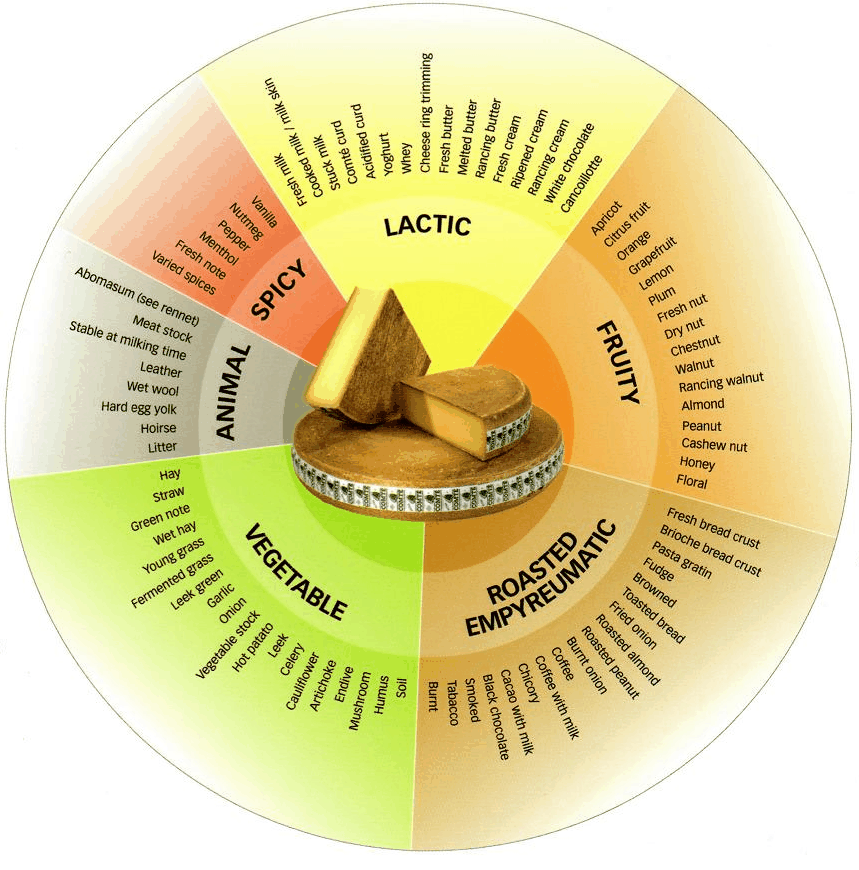
A common method of classification in the late 1900s was a wheel, basically developed from the Linné-system by adding classes and simplificated from the 3D-model of Henning to one (simple circle) or two dimensional (circle with tiers). The flavour wheels have a lot in common as they are descriptive systems constructed by people from similar cultural background (educated Europeans / Americans) and probably because many have most likely been developed from the succesful wine wheel by Ann C. Noble (1990). The wheels detailed according to their use, but basic principle is often quite similar. Most wheels concentrate on the smell, but many have at least some basic taste descriptors included although none seems to list umami; for example an Asian whisky wheel would probably be quite different providing perhaps umami, soy and more than one subcategory of spices. Trigeminal activity (camphor, burning sensation) is quite usually covered in the wheels, but mouthfeel, viscosity and texture are noted surprisingly seldom. Some wheels have apparently been made from the production point of view, such as the Dewar whisky wheel and to some extent the early version of Scotch Whisky Research Institute wheel. Probably the most detailed whisky flavour wheels used are the Revised Scotch Whisky Flavour Wheel for Industrial Purposes and the Whiskymag wheel. Below you'll find some other wheels for beer, chocolate, tequila, olive oil, cigars, cheese, bodyodor and off-odors.

Wine wheel (Ann C Noble)

The Dewar whisky wheel

SWRI wheel


SWRI revised wheel

Whiskymag wheel

Macallan wheel

Coffee wheel

Fragrance wheel by Michael Edwards

Chocolate wheel


Olive oil wheel
Cigar wheel
Comté cheese wheel


REFERENCES AND FURTHER READING:
Classen C et al. Aroma: The cultural history of smell. Routledge, 1994
Lawless HT. Exploration of fragrance categories and ambiguous odors
using multidimensional scaling and cluster analysis. Chem Senses
1989;14:349– 60
von Linné C. Dissertatio medica odores medicamentorum exhibens. 1752
McHugh J. The classification of smells and the order of senses in Indian religious traditions. Numen 2007;54;374-419

Saturday, June 11, 2011

Lavender in whisky. A conspiracy of French women, British brewers, Peruvian distillers and hot condensers?

Lavender
The flowery perfumy notes in whisky have been widely discussed in various forums for years. In short, some whisky drinkers have experienced very strong off-notes of lavender soap in several whiskies. Especially the flowery notes of Bowmore and Glen Garioch distilled in the early 1980s have been noted.

Lavandula angustifolia
Lavender (Lavandula) is a genus of flowering plants common in mediterranean region. There are ~39 species of lavender; the most common are Lavandula angustifolia (English lavender, common lavender, narrow leaf lavender), Lavandula stoechas (French/Spanish lavender, topped lavender), Lavandula dentata (French lavender) and Lavendula latifolia (spike lavender, broad leaf lavender, Portuguese lavender) . To make things complicated the English lavender is not native to England but to western mediterranean; the French lavender (L.dentata) is native to Spain, Canary islands and Madeira. Most of the cultivated French lavender is either L.angustifolia or a more productive hybrid of L.angustifolia and L.latifolia called lavandin (Lavandula x intermedia or L.hybrida).

The odor active compounds in lavender essential oil are primarily terpenes and their oxygenated derivatives. The essential oil of L.angustifolia is the most appreciated, described as lavender, lime tree, coriander and flowers. Lavandin (L.x intermedia) oil is much cheaper, but the odor has more soap, camphor, turpentine, artificial fruit, fat and eucalyptus. L.latifolia essential oil is even harsher with more camphor, menthol and eucalyptus. In fact coriander essential oil is closer to L.angustifolia oil than the oil of L.latifolia. In table below are percentages of odor compounds found in typical essential oils of L.angustifolia, L.latifolia and lavandin (L.x intermedia). Linalool (aka β-linalool, linalyl alcohol, linaloyl oxide, p-linalool, allo-ocimenol, 2,6-dimethyl-2,7-octadien-6-ol, licareol, coriandrol) and its derivatives are responsible for the flowery lavender scent. Often linalool is added to lavandin oil and other perfumes to soften the odor. Up to 80% of perfumed hygiene products (soaps, shampoos, perfumes etc) contain linalool, often added as a fragrance. The odor treshold for linalool is usually very low, about 0,8-7,4 ppb, depending on the stereoisomer structure. Usually oxidation of linalool compounds adds to the odor.


L.angustifoliaL.latifoliaL.x intermedia
linalool31320
linalyl acetate16425
camphor33211
1,8-cineol(eucalyptol)na39na 
Table1. Essential oil compounds from different lavenders. 

Monoterpene metabolism by yeasts (King 2000)
Let's assume that linalool (and/or linalyl acetate) is responsible for the lavender aroma in some whiskies. Why would some distillates contain more linalool than others?

Linalool is produced by various plants, especially by lavender and most herbs such as mints, coriander, laurels and cinnamon. Hops used in beers (Cascade hops especially) are also quite rich in linalool and sometimes hops impart a flowery odor to finished beer, especially if the hops are added after the boiling. Many brewers yeasts also affect the metabolism of monoterpenes (see picture above). Beer is usually boiled in mashing, which diminishes the linalool content considerably via evaporation (This is probably why hopped beer on a frying pan smells of lavender, see Dave's e-pistle). However, in distillery mashing the wort is not boiled and the linalool in a distillery wort would be carried into the distillate if hopped wort was used in distillation (I know, this is just about as likely as the urban legend about scented soap used in distillation).

Another possible source for linalool in wort is yeast or fungi. Distiller's yeast does not usually produce significant amounts of linalool, but brewer's yeast (both lager and ale) and some lactic acid bacteriae (Kluyveromyces lactis) do and additionally there are some mutations of Saccharomyces that produce over ten times more linalool and geraniol than ordinary fermentation yeasts. These yeasts have been used in brandy fermentations and probably in production of aromatized wines such as sweet muscat. Whether this kind of yeast strain might have been used in one or two Scotch whisky distilleries in the 1980s is extremely unlikely, but brewer's yeast has been used in many distilleries along with the distiller's yeast. Linalool concentration of wort increases as the fermentation time gets longer. Too long fermentations with brewer's yeast would probably add considerably to the linalool content of the wort. A sporadic yeast mutation, a contaminant wild yeast strain, excessive lactic bacteria growth (due to prolonged fermentation time) or a fungal infection in wort would also produce too much linalool.

Optimal condenser cooling for maximum linalool and ethanol in Pisco distilling. Continuous line=optimal, dotted line=traditional. IAF=initial aromatic fraction of heart, SNF=second neutral fraction of heart (Osorio et al 2005)

Distillation affects the linalool concentrations of the spirit. It is possible that overheating the still and burning the wash might convert some other terpenes to linalool. The amount of reflux and condenser temperature is probably even more important. To understand a bit more about linalool and distillation we should investigate pisco brandy. Pisco is a wine brandy distilled in Peru and Chile. It is batch distilled from muscat wine in ~1500l copper stills (not too different from Scotch malt whisky stills). The pisco distillers try to produce very floral spirit with lots of monoterpenes, especially linalool, which is considered a quality marker for an aromatic high-end pisco together with geraniol and nerol. Pink muscat and muscat of alexandria grapes are very rich in linalool and therefore used as a component in the wine blend, but usually also cheaper and less fragrant muscat varieties and pedro ximénez grapes are used to increase ethanol-yield. Pisco contains about ten times more linalool than the average cognac. Ester- and aldehyde- concentrations are also quite high resulting to very fragrant, floral and fruity spirit. The distillation practice and especially the cooling of the condenser is critical in producing linalool-rich spirit; usually the heads fraction is distilled without cooling the condenser, apparently to get rid of the methanol and other high volatiles quite fast without losing much linalool. The boiling point of linalool is 199°C, but since it is poorly soluble in water, it distills quite early in the run along with the alcohols. Linalool is rich in the early stages of the heart run, decreasing slightly towards the tails. Cooling the condenser fast after the heads fraction and allowing much less cooling at the middle of the heart run produces more linalool, although towards the end of the spirit run the cooling is increased to prevent the tails (especially octanoic acid) getting into the spirit.

This might support Dave Broom's speculation about the two-part condensers not working properly in the distillation. If there was an inadequate amount of cooling water in circulation of the condenser, the cooling rate and the reflux at the first part of the heart would be fine, but later in the cut the cooling rate would drop too much. This would probably produce more linalool and other monoterpenes, but also early tails. If a distiller in this case would cut the heart early to avoid the tails in the spirit, the resulting heart fraction would probably be very rich in linalool. Alternatively, if the tails cut was made by timing the run or by the ABV% (opposed to smelling), it would probably become very feinty (and floral).
Pisco

The casks might also be to blame. Fungal infection in the caskwood might be a source for monoterpenes, probably in a winery supplying the casks, as spirit (bourbon or scotch) would likely kill most fungi. Muscat wine casks are not a likely option for excess linalool and pisco is not traditionally matured in oak.

So: IF there was some excess linalool in the wash AND IF the condensers were cooled inadequately in the latter part of the spirit run, there MIGHT be excessive linalool in the spirit producing heavy aroma of lavender. The source of linalool might be hops, an  odd yeast strain, brewer's yeast used together with too long fermentation times (my guess) or a fungal infection of the wort. The two-part condensers installed in early 1980s and not working (or used) properly might account for the distillation/cooling part of the problem.

Now, please do not shoot me for this speculation as this is most certainly not science, but merely (mis?-)educated guesswork. Any criticism and conversation on this FWP-phenomenon is very welcome. And for the record: I am apparently not too sensitive to the lavender smell in the Bowmores of 1980s nor in perfumes or flowers. I do get some lavender notes in the 1980s Bowmores but nothing too offensive.
Bowmore spirit still condenser (from WhiskyStory)

REFERENCES AND FURTHER READING
Broom D. Lavender lament. 2005
Colonna-Ceccaldi, B. Use of terpene-producing yeasts in brandy production. Nottingham Univ Press 2010.
Daferera DF, et al. Characterization of essential oils from lamiaceae species by FTRS. J Agric Food Chem 2002;50;5503-5507
Da Porto C, et al. Flavour compounds of Lavandula angustifolia L. to use in food manufacturing. Food Chem 2009;112;1072-1078
Diéguez SC, et al. Approaches to spirit aroma: contribution of some aromatic compounds to the primary aroma in samples of orujo spirits. J Agric Food Chem 2003;51;7385-7390
Ferrari G et al. Determination of key odorant compounds in freshly distilled cognac using GC-O, GC-MS and sensory evaluation. J Agric Food Chem 2004;52;5670-5676
King A, Dickinson JR. Biotransformation of monoterpene alcohols by saccharomyces cerevisiae, torulaspora delbrueckii and kluyveromyces lactis. Yeast 2000;16;499-506
King A, Dickinson JR. Biotransformation of hop aroma terpenoids by ale and lager yeasts. FEMS Yeast Res 2003;3;53-62
Kishimoto T et al. Comparison of the odor-active compounds in unhopped beer and beers hopped with different hop varieties. J Agric Food Chem 2006;54;8855-8861
Lea GH, Piggott JR. Fermented beverage production 2nd ed. Kluwer Acad 2003.
Lillo M et al. Chemical markers for tracking the sensory contribution of production stages in muscat wine distillates. J Food Sci 2005;70;7;432-441
Osorio D et al. Wine distillates: practical operating recipe formulation for stills. J Agric Food Chem 2005;53;6426-6331
Piggott JR, Paterson A (ed). Understanding natural flavors. Blackie academic&professional 1994
Strehle KR et al. Quality control of commercially available essential oils by means of raman spectroscopy. J Agric Food Chem 2006;54;7020-7026
Takoi K et al. Biotransformation of hop-derived monoterpene alcohols by lager yeast and their contribution to the flavor of hopped beer. J Agric Food Chem 2010;58;5050-5058

Sunday, May 29, 2011

Peat Terroir

Arbroath maltings
In 1800's the peat used in maltings was commonly local and the kilning was done in almost every distillery. During the latter part of 1900's and the invention of industrial malting processes the maltings have been concentrated to bigger facilities, such as Diageo's Roseisle, Glen Ord and Port Ellen, Simpson's Tweed Valley, Baird's Abroath and Inverness, Greencore's Glen Esk and Buckie and Edrington's Tamdhu. Several distillery maltings are still operational, but only a few distilleries malt all of their barley on-site (Springbank, Glen Ord, Tamdhu). The use of peat has diminished as more economical fuels have been introduced, but some peat is still used to create smoky flavoured malts. The peat used in Scotch whisky maltings is sourced mostly from the north-east of Scotland, Islay and Orkney.

Peat is formed in waterlogged lands by partial degradation of organic matter. There are some differences between peat compositions based on different climate, vegetation, bog type and cutting depth.

Peatlands can be divided into bogs, fens, marshes ja swamps.  Bogs are formed by heavy rainfall (therefore called ombotrophic) and usually contain more sphagnum moss and less woody vegetation than the other peatland types, which are formed mostly by waterlogging from the ground water (minerotrophic). Fens (aka basin bogs or valley bogs) contain more sedges and grass. Marshes are treeless intermittently waterlogged areas and usually accumulate peat very slowly. Swamps are very minerotrophic and contain large amounts of wood and nutritients. Average peat contains 90% water and 10% dry matter, of which 92% is organic and 8% inorganic (practically ash). Organic matter consists mainly of residues of lignin and different carbohydrates, but there are considerable variations depending on the vegetation and the bog type. Ombotrophic peats are richer in phenols and aromatics, but due to poorer vegetation they lack carbohydrates, lignin and nitrogen. Western Scotland and the islands are especially abundant with blanket bogs. About 10% of Scotland in covered by blanket bogs and 1% by basin bogs.

Peat bog Maltings Location Bog type
Glenmachrie Laphroaig Islay basin
Gartbreck Bowmore Islay basin
Castlehill Port Ellen Islay blanket
Hobbister Hill Highland Park Orkney blanket
St Fergus various Aberdeenshire basin
Tomintoul various Speyside basin
Machrihanish Springbank Campbeltown blanket

The extraction depth is also important as the surface layers are usually rich in carbohydrates and poor in phenols and the deeper layers might have too much harmful nitrogen- and sulphur compounds due to anaerobic fungal and bacterial metabolism. On the other hand some fungi seem to produce vanillins such as acetovanilline from lignin, for some unknown reason especially so in island peats.

Location of peat bogs used in whisky production
Islay peat bogs (from left: Gartbreck, Glenmachrie, Castlehill)
It seems that the most significant factors in peaty aroma are the bog location and the cutting depth. The bog type and the vegetation play some role, but they are not that important for peaty flavour. The peats from Islay, for example, are very similar with each other as the peat from the basin bogs Glenmachrie (Laphroaig) and Gartbreck (Bowmore) cannot be identified by infrared spectroscopy. 

The Castlehill peat for the Port Ellen Maltings somewhat different from the basin bog peats from Islay, probably due to different microbiology of the blanket bog and a greater amount of woody material are therefore more lignin-derivatives and carbohydrates. 

Surprisingly, Hobbister Hill peat from a blanket bog is chemically more similar to the Islay basin bog peats (Gartbreck/Glenmachrie) than the blanket bog Castlehill peat. The local microbiology of peat bog might therefore have a greater impact on the peat composition, influencing both the nitrogenlevels and phenol-concentrations in the peat. Another explanation is that the bog types are overlapping, for example Hobbister Hill bog might have some basin bog properties (standing water bowls) especially in the deeper layers; this might explain the similarity of peats cut from the deeper layers of Hobbister Hill bog with the Islay basin bog peats. 

Tomintoul peat is different from the Island peats; a basin bog, as expected, contains great amounts of carbohydrates, but there is also lots of sphagnum moss, which for some reason does not result in the same amounts of phenols as in the islands. It could be speculated that this is due to different climate, microbiology or variety of Sphagnum in the western islands and the mainland.

St Fergus peat is rich in woody material and therefore rich in lignin derivatives, especially syringyl. There is however a great amount of phenol-compounds in the St Fergus peat, although it is a basin bog and the sphagnum-content is lower than in for example Tomintoul peat. The location of St Fergus bog is closer to the sea than of Tomintoul bog. Maybe the proximity of sea results in greater amounts of phenols in peat? Explanation might be for example lesser temperature fluctuations or differences in microbiology or drainage.

There are no scientific analyses available on Machrihanish (Springbank) peat, but since it is cut from a blanket bog and located near sea in the western Scotland, it probably is closer to the Islay and Orkney peats than the mainland peat.

Some breweries use artificial smoke flavourings in their malting processes, apparently common raw materials are extracts from burnt deciduous trees, such as beech or birch. These are likely to produce more aromas from syringyl, guaiacol and carbohydrates resulting in softer but not as phenolic aroma as from peats. I don't know whether Scotch whisky industry uses smoke flavourings in their maltings, but it is not prohibited in the Scotch whisky regulations. A black alder smoked malt could be an interesting experiment (a free hint for any progressive distillers reading this).

Anyway, there clearly is a peat terroir and even some local variations in the compositions. Also the cutting depth is important and it will be interesting to see wheter the peat composition will change as the limited amounts of peat for example from Islay are utilised and either the cutting depth or the cutting location changes.


REFERENCES AND FURTHER READING:
Bozkurt  S et al. Peat as a potential analogue for the long-term evolution in landfills. Earth Sci Rev 2001; 53; 95-147
Bryce JH et al (ed). Distilled spirits, production, technology and innovation. Nottingham Univ Press, 2008
Da Porto C et al. A study on the composition of distillates obtained from smoked marc. Anal Chim Acta 2006; 563; 396-400
Guillén M et al. Carbohydrate and nitrogenated compounds in liquid smoke flavorings. J Agric Food Chem 2001; 49; 2395-2403 
Guillén M, Manzanos M. Study of the components of a solid smoke flavouring preparation. Food Chem 1996; 55; 3; 251-257
Guillén M, Manzanos M. Characterization of the components of a salty smoke falvouring preparation. Food Chem 1996; 58; 1-2; 97-102
Harrison B, Priest F. Composition of peats in the preparation of malt for scotch whisky production. J Agric Food Chem 2009; 57; 2385-2391
Harrison B et al. Differentation of peats used in the preparation of malt for scotch whisky production. J Inst Brew 2006; 112; 4 ; 333-339
Jefford A. Peat, smoke and spirit. Headline 2004
Jounela-Eriksson P. The aroma composition of distilled beverages and preceived aroma of whisky. Academic Press 1978
Kostyra E, Barylko-Pikielna N. Volatiles composition and flavour profile identity of smoke flavourings. Food Qual Pref 2006; 17; 85-95
Lehtonen M. Phenols in whisky.  Chromatographia 1982; 16; 201-203
Russell I (ed). Whisky, technology, production and marketing. Academic Press 2003
Swan JS, Howie D. Sensory and analytical studies of regional influence on the composition of Scotch malt whisky. Institute of brewing, 1983.
Valaer P. Scotch whisky. Industr Engineer Chem 1940; 32; 7; 935-943
Walker GM, Hughes PS. Distilled spirits, new horizons: energy, environment and enlightenment. Nottingham Univ Press, 2010

Sunday, April 17, 2011

Caramel E150

E150a-d
Spirit caramel (E150) is allowed as a colouring agent in Scotch whisky production. There are four different types of E150, labeled from a to d, or from class I to IV, according to the manufacturing process used. E150a (plain caramel) is "prepared by the controlled heat treatment of carbohydrates (commercially available food grade nutritive sweeteners which are the monomers glucose and fructose and/or polymers thereof, e.g., glucose syrups, sucrose, and/or invert syrups, and dextrose). To promote caramelization, acids, alkalis and salts may be employed" (not ammonium compounds or sulphites). Sulphites are allowed in the production of E150b (caustic suphite caramel), ammonium compounds are allowed in the process for E150c (ammonia caramel) and both suphites and ammonium compounds are allowed in the process for E150d (sulphite ammonia caramel). Common raw materials for caramel colourings are corn syrups, wheat, glucose syrup or sucrose. Additives may include a variety of acids, alkalis and salts. Different raw materials produce different caramels and the use of additives influences the resulting color, viscosity, ionic charge and pH and there are hundreds of different spirit caramels available from several producers.
Caramels from DD Williamson. 570 is their most used spirit caramel.

Caramel samples from Sethness. Typical spirit caramel is 0.075-0.110
Most caramel colourings are very dark in color and are usually used in tiny quantities. Fructose produces the darkest color, probably because it starts to caramellisate in 110ºC, as sucrose, glucose and galactose caramellisate in 160ºC and maltose in 180ºC. Viscosity varies, but in general low viscosity caramels are used in beverages. The ionic charge of caramel is important because of possible flocculation. For example, if negatively charged caramel is added to positively charged beverage, there will be some flocculation or even percipitation. Correctly selected caramel colouring has some emulsifying properties, in other words it helps the oils to mix with the water. In fact, the Coca Cola Company first patented the caramel colouring as an emulsifying agent, not as a colourant. Whisky and most soft drinks are negatively charged, but beer, baked goods and herbal liqueurs have usually a positive charge. E150c is positively charged and used in breweries and never in whisky. E150a has the best stability in high proof alcohols, especially when the raw material has been sucrose. Wheat and corn based syrups are widely used, but they are usually less stable in alcohol. E150a can tolerate up to 75% abv as most E150d is guaranteed to work up to 50% or 60% abv. E150b is used in the presence of tannins, especially in sherries, wines and some brandies and the residue sulphites of E150b probably also help to preserve the wine from excess oxidation. The amount of caramel varies, in spirits it is usually about 0,1-0,5% or about 1-5g/litre as in comparison some 0,4% of E150d is used in cola soft drinks, 0,01-0,3% of E150c in beers and up to 10% of E150d in (cheap) cocoa powders. EU (EFSA) recently lowered the acceptable daily intakes (ADI) for caramels; 300mg/kg/day for E150 and 100mg/kg/day for E150c, so a man weighing 80kg is allowed to consume 24g of caramel color a day. Hopefully not many of us get that from blended whisky, but probably some will get those amounts from cola and bakery stuffs.

Most producers give caramel colors a two year shelf stability guarantee, if stored in room temperature and protected from sunlight. Sunlight fades the caramel colors rapidly, in matter of weeks to months. E150a is the most resistant to fading and it fades evenly in all wavelenghts, as E150d usually fades more of the higher wavelenghts (red fades first).
Loch Dhu, mit farbstoff

The majority of single malts and virtually all the blends are coloured with E150a. According to The Scotch Whisky Regulation in 2009 only "plain caramel" (E150a) is allowed, although the EU laws permit the use of "spirit caramel", which is not exactly defined in law and can be any E150 and so at least some E150b and E150d could have been used in Scotch whiskies.

Toasting a barrel (vinography.com)
Due to the variety of raw materials and additives, the chemical structures of caramels are complex and there are lots of variations even between caramels of the same subgroup. In the production the main reaction is dehydration as water (hydrogen and oxygen) is extracted (boiled) out of the sugars. This results first to sugar monomers as polysaccharides (for example sucrose) are divided into glucose, fructose, galactose, xylose and maltose. As the heating continues, the monosaccharides lose water and react with each other producing big polymers, mainly caramelans (C24H36O18), caramelens (C36H50O25) and caramelins (C125H188O80), which give the caramel most of its color. Additionally some residue sugar may be left in the product and several flavour components are produced, for example different furans, diacetyl, maltol, esters and lactones. Furans are probably the most influential flavour components in most caramels, they are formed especially from fructose or sucrose (containing fructose) in acidic encironment. They also form during the toasting of oak barrels, but the relative amounts of different furans are different as the raw material are either lignin and (hemi)cellulose in oak or simple sugars in caramel. Caramellisation of simple sugars produce less furfural (almond, walnut, grainy) and more 5-hydroxymethylfurfural (butter, musty, waxy, caramel) than caramellisation of oak (there are also significant differences between different oak species, see previous blogs). 5-HMF is not produced if sulphites or ammonium are used in the process (E150b or E150d), but is formed in large quantities in the plain caramel (E150a). 5-HMF is also used as a flavour enhancer in milkpowders, honey, juices and even cigars. Furfural acts as a reactant with various compounds in the spirit; it has some antioxidative properties that slow the oxidation reactions and help to stabilize the color from antocyanins (in especially wine), it also reacts easily with H2S (rotten eggs, nasty sulphur) producing furfurylthiol (strong coffee), decreases the volatile sulphur compund concentrations and potentiates the odor of oaklactone (vanilla,coconut). Some other furans such as hydroxyacetylfuran (sweet), hydroxydimethylfuranone (also known as furaneol, additive in baked bread, coffee and chocolate) and dihydroxydimethylfuranone are also produced. Diacetyl imparts a buttery (butterscotch) flavour and maltol (aka E636) gives freshly baked bread aromas. Esters and lactones (here from sugar, not oak) are usually fruity. Also increased levels of E2-nonenal (cardboard, stale beer) and less hop flavour are also found in caramel coloured beers, but this possibly results from changes in fermentation process and is not studied properly in spirits.

So, caramel does affect the flavour and it is not inert in whisky, but are the quantities used in Scotch whisky industry enough to affect the overall flavour significantly? No reliable scientific fact exists, but my guess is that they probably are significant. Does caramel impair the flavour? It could, but then again in some cases caramel might even improve the taste.

References and further reading:
Abalos D et al. The use of furfural as a metabolic inhibitor for reducing the alcohol content of model wines. Eur Food Res Tech 2011;232;663-669
Blanchard L et al. Formation of furfurylthiol exhibiting a strong coffee aroma during oak barrel fermentation from furfural released by toasted staves. J Agric Food Chem 2001;49;4833-4835
Boscolo M et al. Spectrophotometric determination of caramel content in spirits aged in oak casks. J AOAC Int 2002;85;3;744-750
European Union Directive 95/45
Furukawa Suarez A et al. Impact of colour adjustment on flavour stability of pale lager beers with a range of distinct colouring agents. Food Chem 2011;125;850-859
Laws DRJ, Peppard TL. The stability of flavour constituents in alcoholic beverages. Food Chem 1982;9;131-146
Quesada Granados J et al. Influence of aging factors on the furanic aldehyde contents of matured brandies: aging markers. J Agric Food Chem 1996;44;1378-1381
Ratsimba V et al. Qualitative and quantitative evaluation of mono- and disaccharides in D-fructose, D-glucose and sucrose caramels by gas-liquid chromatography-mass spectrometry di-D-fructose dianhydrides as traces of caramel authenticity. J Chrom A 1999;844;283-293
Rodriguez Dodero MC et  al. Phenolic compounds and furanic derivatives in the characterization and quality control of brandy de Jerez. J Agric Food Chem 2010;58;990;997
Scotch Whisky Regulations. Scotch Whisky Association 2009.
Sousa A et al. Isolation and structural characterization of antocyanin-furfuryl pigments. J Agric Food Chem 2010;58;5664-5669
Tsai PJ et al. Interactive role of color and antioxidant capacity in caramels. Food Res Int 2009;42;380-386
www.caramel.com (DD Williamson)
www.sethness-roquette.com

Saturday, April 9, 2011

Cask sizes

Just a quick table about cask sizes.

Cask

Litres Imperial gallons US gallons

Bourbon barrel 159 (official barrel)

42 size varies 150-220l, commonly 180-200l
US beer barrel 117
31
UK barrel 164 36

Hogshead 250 54

UK ale barrel 146 32

Tun 955 210
"a ton"
Sherry shipping butt 491 108
30 arrobas,56 cases of 0.75l bottles or ½tun
Bota gorda, sherry cask 600

32arrobas
Sherry puncheon 667

40arrobas
Cognac 350

varies 270-450l
Cognac shipping cask 500-600


Bocoy 600-800

Spanish wine cask
Wine barrique 225

Bordeaux barrel
UK wine shipping barrel 119 26.25

Port pipe 528 116
varies 400-800l
Madeira cask 419-437 92-96

Marsala pipe 396 87

Marsala hogshead 200 44

Rum puncheon 410-455 90-100

Kilderkin 82 18
½ UK barrel
Firkin 41 9
Quarter of UK barrel
Bloodtub 34 7,5

Whisky quarter cask 125 27
½ hogshead
Whisky octave 46 10

Whisky puncheon 387-500 85-110
staves from 2 barrels

References:
Calabrese S. Cognac, liquid history. Cassell&Co 2001
González Gordon M. Sherry. Cassell Ltd 1972 
Kilby, K. The cooper and his trade. John Baker Publishers Ltd 1971
Rainbird G. Sherry and the wines of Spain. 1966

Saturday, March 26, 2011

Pot still distillation

Wash still (bladnoch.co.uk)
Scotch malt whisky is distilled typically twice in copper pot stills. The first distillation is carried out in a wash still, usually slightly bigger than the spirit still used in the second run. Copper is used because of its good malleability and heat conduction but also for its catalytic properties and the ability to neutralize some of the sulphur compounds and off-notes. The stills can be heated either directly by burning gas, peat or coal or indirectly by steam coils running inside the still. If direct firing is used, there must be a rummager on the bottom of the still to prevent charring, at least in the wash still. The stills usually have a broad pot and a narrowing swan neck that turns to a lyne arm leading to a condenser, which can be a traditional worm, a shell&tube condenser or a plate heat exchanger. Various shapes of stills are used and it is believed that the bulbs and boiling balls etc increase the copper contact at the right spots to produce better spirit. Some distillers use a purifier in the spirit still, which is a pipe reversing some distillate from the lyne arm back to the swan neck producing more reflux.

Worm-tubs Purifier Direct firing
Balmenach Ardbeg Glenfarclas
Benrinnes Glen Grant Glenfiddich
Cragganmore Glenlossie Macallan
Dalwhinnie Glen Spey Springbank (wash)
GlenGarioch (wash)
Tobermory(wash)
Edradour Strathmill
Glen Elgin Talisker
Glenkinchie Tormore
Mortlach

Oban

Royal Lochnagar

Talisker

Springbank (wash)

 
Basically the first distillation is a simple distillation of volatile compounds (such as alcohols), producing low wines of 20-25% abv from 6-9% abv wort. Wash is usually preheated to prevent excessive temperature differences and charring inside the still. The first distillation is usually deemed complete when the distillate is under 1% abv and about one third of the wort has boiled over to the wash safe. Wash distillation usually takes 5-8 hours to complete, depending on the size, shape, temperature and charge of the still. The residual is called pot ale.

The wash distillation is mixed with the foreshots and the feints from previous spirit distillations and distilled in the spirit still. The second distillation is a fractionated distillation; the most volatile compounds boil first and are called foreshots or heads, the second part is called the middle cut (spirit cut, heart), the third part is feints (tails) and the remaining liquid in the still is called spent lees.

Panek&Boucher 1989
Panek&Boucher 1989
The foreshots consist of the most volatile compounds, such as methanol, acetaldehyde (ethanal), some of the ethyl esters such as ethyl acetate and volatile sulphur compounds (see table of boiling points below). Along with them come some of the residues of the previous distillation, which are not high volatiles but soluble only in higher strenghts of alcohol, for example fatty acids and their esters. These compounds are therefore condensed into the still at the end of previous distillation and as the next distillation starts, they are made soluble again by the high alcohol strenght and swept up to the spirit safe along with the foreshots. The foreshots are either unpleasant in flavour or dangerous to health (or both) and therefore not included in the final spirit but returned to the next distillation. The long-chain fatty acids and other residues from the previous distillation tend to form a cloudy mixture when diluted to 80 sikes proof (45.7% abv).


Boiling point C Odor
acetone 56,5 nail polish remover
glycerol 290 sweet
acetic acid 118 vinegar
aldehydes

acetaldehyde 20,2 pungent fruity, green apple, metallic
furfural 161,7 almonds
alcohols

methanol 65 sweetened ethanol
ethanol 78 ethanol
1-propanol 97 fruity
2-propanol 82,5 fruity
butanol 118 banana, solvent
amyl alcohols 102-138,5 sharp, burning
2-phenyl ethanol 219 floral, rose
esters

ethyl acetate 77,1 pear,sweet
ethyl butyrate 121 pineapple
ethyl formate 54 rum, raspberry
hexyl acetate 171,5 fruit
sulphur compounds

hydrogen suphide -60,3 rotten eggs
sulphur dioxide -10 burnt sulphur
dimethyl sulphide 37 cabbage, vegetables
fatty acids

lauric acid 299 bay oil, soap
palmitic acid 351 waxy, creamy, soapy


The traditional way of making the first cut point is by mixing the foreshots with water in the spirit safe; as the spirit turns clear, the foreshots have mostly passed and the middle cut is collected into the spirit receiver. Some producers use timed foreshot runs and do not bother with the demisting test and therefore are are likely to cut the spirit a bit lower as a precaution and probably getting less of the highly volatile compounds into the spirit. The second cut can be determined by taste, abv or time according to the distillery practice. The feints are then run usually down to 1% abv and added to the next wash.

The feints are the last volatile fraction of spirit distillation. Feinty aromas increase slowly towards the end of distillation, developing from quite pleasant mushroom, cereal and popcorn aromas to leathery tobacco notes and further to ashy, fishy and even cheesy aromas not usually approved in whisky. The feints are usually rich in phenols and smoky aromas important for peaty whiskies. Therefore the second cut point must be determined with care to produce peated but not feinty spirit with off-notes. The feints are usually run quite fast to save time, but this makes some of the fat-solubles to adhere to the still. These compounds (mostly fatty acids) must be purged by an adequately long and slow run of foreshots in the next distillation, otherwise the whisky might become feinty no matter how early the second cut is made.

The spirit cut is usually about 72-65%, but there are considerable differences between distillers. To produce a very light aetheral whisky (richer in high volatiles) the distiller would be likely to use a tall still with a low charge run slowly in low temperatures for maximum reflux, a purifier, an ascending lyne arm, a purifier and a shell&tube condenser for maximum copper contact and cut short foreshots and long feints (earlier second cut) for maximum amount of high volatiles and less of the heavier aromas. To produce a peaty whisky the distiller must try to catch all the phenols from the latter part of the middle cut but also avoid excess feints.

The distillation is not only a simple process of separation, but the heat and the copper contact alter some of the flavour compounds, too.  Heat promotes Maillard reactions producing furfural and sulphur compounds, especially thiophenes and polysulphides, which at low concentrations add a pleasant roasted and complex flavour, but produce pungent and unpleasant cereal and sulphury notes at high concentrations. Heat also promotes aldehyde reduction to alcohols and acids and their conversion further to esters. Lignin-derived components such as coumaric and ferulic acids can evolve to more spicy guiaicols. Acrolein (peppery) can form from bacterial fermentation products in presence heat. Fusel oils, 2-phenethanol (rose, flower) and furfurals (caramel, burnt sugar) are formed in pot-stills, but not significantly in column still distillations and therefore are likely to be generated by heat differences during distillation.

Copper removes most of the sulphury, cereal, feinty and meaty aromas during distillation. Especially the copper contact of the first wash still distillation is important. Total removal of copper contact in the spirit still has surprisingly minimal effect on the mentioned off-notes.

References and further reading:
Adams AB. The distillation of alcohol. J Ind Eng Chem 1912; 8-14
Herstein KM. Chemistry and technology of wines and liquors. Van Nostrand Co 1935
Jounela-Eriksson P. The aroma composition of distilled beverages and preceived aroma of whisky. Academic Press 1978
Lea GH, Piggott JR. Fermented beverage production 2nd ed. Kluwer Acad 2003. 
Monica Lee KY et al. Origins of flavour in whiskies and a revised flavour wheel. J Inst Brew 2001;107;5;287-313
Piggott JR, Paterson A (ed). Understanding natural flavors. Blackie academic&professional 1994
Russell I (ed). Whisky, technology, production and marketing. Academic Press 2003
Udo M: The Scottish Whisky Distilleries. Black & White 2006
Walker GM, Hughes PS (ed). Distilled spirits, new horizons: energy, environment and enlightenment. Nottingham Univ Press, 2010
Webb AD (ed). Chemistry of winemaking. Am Chem Soc 1974