Saturday, February 2, 2013

Bottle maturation (OBE)

Laphroaig 1887
Scotch whisky ages in oak wood casks for a minimum of three years, usually longer. After wood maturation it is usually diluted and colored with caramel E150a prior to bottling. After that the changes of whisky in a closed bottle are not fast or drastic, at least compared to for example the bottle maturation of wines. Some bottle maturation changes or "old bottle effects" are nevertheless possible.

The bottle maturation of wines depends mainly on the closure of the bottle. If there is enough oxygen present, for example through a porous or leaky closure, the wine becomes oxidized. If the closure tight, restricting the oxygen permeation, the wine becomes reduced. Screw caps and cork stoppers are usually the most tightest, synthetic corks are very permeable to oxygen and the permeability of natural corks is somewhere in between, although there are variations, especially among natural corks. The fastest oxidation happens in the beginning of bottle maturation as there is bound to be some residual oxygen in the wine (or spirit), the headspace between the closure and liquid and additionally the porous closures release some air into the bottle. Oxygen ingress in a screw cap sealed bottle is below 1 µL/day, a natural cork sealed bottle gets 2-6 µL/day for the first year and then 0,1-2,0 µL/day depending on the cork quality and a synthetic cork sealed bottle about 6-13 µL/d depending on the material. The main route for the air into the bottle is from between the glass and the cork. Practically all modern commercial wines are protected from excess oxidation by adding sulphur dioxide and sometimes ascorbic acid.
Oxidation affects wines

The oxidation usually decreases the amount of esters and several thiols, resulting in less citrus, grapefruit, boxtree and fruity notes. The amount of H2S (rotten eggs, bad sulphur) increases slightly during bottle maturation, but less so in an oxidative environment. If there are sugars available in the liquid, the amount of furfural (nutty, rancio) usually increases, but furanone (strawberry, fresh pineapple) usually decreases. Unknown reactions produce notes of wet wool, toasted bread and caramel. Most phenols oxidize slowly, usually forming polyphenols, resulting in diminished astringency and probably less peaty whisky over years of bottle storage. An exeption in the phenol group is vanillin, which increases slowly independently of the oxidation/reduction state. Serious over-oxidation in wines creates vinegar and in considerable evaporation of alcohol out of spirit proof liquids.

In the absence of oxygen, the wine is reduced, forming significantly more esters (fruits), higher alcohols (floral, aetheral), abhexon (peach) and sulphur volatiles (struct flint, rubber), especially H2S (rotten eggs), but also thiols and polythiols (petrol, kerosine), apparently from sulphates, sulphites and phenols.

Independently of the oxidation, tannins and antocyanins form bigger molecules, which stabilize the colour and usually turn reddish colours into orange, bricklike hues. Oaklactones tend to partially transform from trans- (spicy, incence) to cis-isomers (coconut, vanillin) in the bottle.
The cork stoppers act as a sorbtive material, especially if they are coated with polyethene and allowed to soak with the liquid. As a result the sulphur odors, especially H2S and small thiols are reduced. On the other hand uncoated corkstoppers are more likely to leak H2S and other volatiles out of the bottle. Screw caps do not have a significant effect on the H2S. A faulty bottle closure or prolonged storage of  opened bottle with a low amount of spirit left leads to evaporation of alcohol and oxidation of the spirit. In that case the filling level is likely to drop and the amount of esters, small thiols and other volatiles to diminish. Bottle breathing, ie leaving the bottle open overnight or half-empty with the cork for months, might therefore cure some sulphur taints, at the cost of reduced fruit and body. 

The glass bottle itself is not completely inert. Especially alkaline high-alcohol solutions (vodka for example) increase the leaching of glass. This happens especially if the bottles are stored for a long time (months) in a humid environment before bottling, allowing water to attach to the inside of the bottle. Bottle glass is composed mainly of silica (SiO2, 75%), sodium oxide (Na2O, 15%), calcium oxide (CaO, 12%) and aluminum salts (2%). First, the water condensed from the humid air causes mainly sodium to leach out of the glass (a damp bottle storage before bottling increases the corrosion) and the increased alkalinity increases the leaching of silica, forming salts of silicic acids. Then ethanol in turn increases the solubility of  inorganic acids. As a result a deposit is created in the bottle, it consists first of sodiumhydroxide (NaOH) and sodiumhydrosilicate (Na2O x SiO2), but it polymerizes into an amorphic gel-like structure (for example H2SiO3 + CaO SiO3 + H2O) consisting in average of CaO (43%), SiO2 (43%) and Na2O (14%). At the process also some metals from the glass structure are leached out. The glass leaching increases the pH of the spirit, for example in one study with vodka the pH increased from 8,85 upto 9,50, which is probably significant for flavour release, too. In the same study the weight of dried crystals was 0,5-2,1 mg per 0,7 litre bottle. As the surface/spirit ratio increases as the bottle size dimishes, the miniature bottles are certainly more prone to impart sediments. As whisky is more acidic than vodka, this is most likely a very slow reaction, happening in older lowgrade and/or miniature bottles during decades rather than months and especially if they have been stored for a while before bottling.

Lagavulin 1875
In a bottle of whisky, the same reactions are likely to happen, although the higher ethanol strength diminishes the oxidation, as ethanol is an oxygen scavanger itself. The oak extracts and the ethanol micelles diminish the extraction of volatiles from the spirit by increasing the surface tension. Most likely the bottle maturation of whisky is more reductive than oxidative, producing more fruity, aetheral, peachy, vanilla, petrol, rubbery and metallic notes and less phenolic, bitter spicy and citrus notes. Rancio flavours might arise from pentose sugars derived from caramel colouring and/or a very extractive charred cask. Some oxidation reactions are bound to happen between the spirit and the air of the bottle headspace, but they are hardly significant. Long chain fatty esters and glass silica can both flocculate in the bottle, especially if the whisky is not filtered and it is diluted and/or colored with caramel before bottling. Light usually increases the speed of reactions, whether reductive or oxidative. In any case, organoleptically significant changes in bottled whisky are likely to occur during decades, if at all.

REFERENCES AND FURTHER READING
Bailly S, et al. Fate of key odorants in sauternes wine through aging. J Agric Food Chem 2009;57;8557-8563
Brajkovich M, et al. Effect of screwcap and cork closures on SO2 levels and aromas in a sauvignon blanc wine. J Agric Food Chem 2005;53;10006-10011
Cutzach I, et al. Influence of storage conditions on the nformation of some volatile compounds in white fortified wines during the aging process. J Agric Food Chem 2000;48;3240-5
Cutzach I, et al. Study of the formation mechanisms of some volatile compounds during the aging of sweet fortified wines. J Agric Food Chem 1999;47;2837-2846
Collin S, et al. Main odorants in Jura flor-sherry wines. J Agric Food Chem 2012;60;380-387
de Aquino FWB, Franco DW. Formation of dextran deposits in Brazilian sugar cane spirits. J Agric Food Chem 2001;59;8249-8255
Godden P, et al. Wine bottle closures. Austr J Grape Wine Res 2008;7;64-105
Guloyan YA, Shelomentseva VF. Study of physicochemical phenomena in evaluation of chemical corrosion of glass. Glass and Ceramics 2000;57(7-8);267-271
Jantzen CM, et al. Durable glass for thounsands of years. Int J Appl Glass Sci 2010;1;38-62
Kochetkova GV, et al. The chemical resistance of decolorized glass bottles to spirits. Glass and Ceramics 1972;29(3);186-189
Lachenmeier DW, et al. Long term stability of thujuno, fenchone and pnocamphone in vintage preban absinthe. J Agric Food Chem 2009;57;2782-5
Kwiatkowski MJ, et al. The impact of closures including screw cap with three different headspace volumes on the composition colour and sensory properties of a cabernet sauvignon wine during two years' storage. Austr J Grape Wine Res 2007;13;81-94
Lavigne V, et al. Changes in the sotolon content of dry white wines during barrel and bottle aging. J Agric Food Chem 2008;56;2688-2693
Lopes P, et al. Impact of storage position on oxygen ingress through different closures into wine bottles. J Agr Food Chem 2006;54;6741-6746
Lopes P, et al. Impact of oxygen dissolved at bottling and transmitted through closures on the composition and sensory properties of a sauvignon blanc wine during bottle storage. J Agric Food Chem 2009;57;10261-10270
Lopes P, et al. Main routes of oxygen ingress through different closures into wine bottles. J Agric Food Chem 2007;55;5167-5170
Nose A, et al. Hydrogen bonding in alcoholic beverages and water-ethanol mixtures. J Agric Food Chem 2005;53;7074-7081
Refsgaard HHF, et al. Light-induced sensory and chemical changes in aromatic bitters. Zeitschrift Lebensmittel-Untersuchnung 1996;203;47-55
Schneider R, et al. Volatile compounds involved in the aroma of sweet fortified wines from Grenache Noir. J Agric Food Chem 1998;46;3230-3237
Silva MA, et al. Scalping of light volatile sulfur compounds by wine closures. J Agric Food Chem 2012;60;10952-10956
Vanbeneden N, et al. Decrease of 4-vinylguaiacol during beer aging and formation of apocynol and vanillin in beer. J Agric Food Chem 2008;56;11983-8

Sunday, January 20, 2013

Alcohol strength

http://scotchaddict.com/wp-content/uploads/2009/02/just-a-drop-of-water-in-scotch.jpgScotch whisky is usually diluted before filled into casks. The usual filling strength for malt whiskies is 63,4-63,5% ABV (111 UK proof) and 68% ABV for grain whiskies. These are industry standards based probably on the history, minimizing evaporation losses and warehousing costs, but also creating an acceptable flavour profiles and uniform products for the blending industry. Bourbon and corn whiskey producers can by law fill at a maximum of 125 US proof (62,5%) and the Irish have commonly filled casks at 71%. Before bottling whisky is usually diluted to 40% or 43%.

Known unusual cask filling strengths are Aberlour 69,1% (121 UK proof), Bruichladdich (undiluted 70-72%), Port Charlotte (undiluted, probably over 70%), Glenrothes (63,5% and "some casks" undiluted about 70%) and Glen Scotia 62,5%. Bladnoch has experimented with higher and lower strengths, but apparently is now filling all the casks at 63,5%. Grain spirits are usually filled at 68%, but North British fills at 62-68% and Girvan at 74% (at least the ones going to Grant's). Most malt distilleries use 63,4-63,5% fills.Since 1848 the strength of whisky warehoused in a distillery was legally from 22 under proof (44,6%) to 25 over proof (71,4%) and the maximum strength of whisky sold out of a distillery was 111 proof, so at least the grain distillers were diluting their new make. Irish whisky was said to be warehoused at 14-16 over proof (65,1-66,3% abv) in 1808 and at the same time Scottish whisky for home consumption was taxed at 107 proof (61,1%). Illicit distillers most likely did not dilute their spirits, but the small stills and wide cuts probably did not produce much higher abv.

Ross states in 1970 that Scottish malt whisky is filled at 11-12 over proof (63,4-64% abv) and Irish pot still at 25 over proof (71,4% abv). The dilution to an uniform strength probably eased the common practice of exchanging cask between the different blenders. During the years of Scottish whisky overproduction in the late 70's and early 80's at least DCL "uncommonly" filled casks at full proof to cut cask- and warehousing costs. In the early 60's there were problems acquiring enough casks and that would probably have had the same effect on filling strengths. It is likely that dilution of malt whiskies down to 63,5% has been used at least for the most part of the 20th century. During the WW I the maximum bottling strength was temporarily (1915-16) adjusted to 35 under proof (37,2% abv). The alcoholic strength was indicated usually in Sykes proof until 1980, after that it has been replaced with alcohol per volume (abv).

Higher filling proof means savings on the casks and warehousing, but the faster alcohol evaporation and slower maturation curves favor dilution before casking. Very high proof spirits mature slower as they extract less color per absolute alcohol and especially less solids from the cask. Below 120-125 US proof (or not-so-coincidentally just below 63,5% abv?) the extraction is more even and efficient. Entry proof has an impact on the flavour profile, too. More alcohol solubles are extracted at high proofs, for example coumarins (often bitter, spicy), aromatic aldehydes (almonds, vanilla...) and terpenols (lapsang souchong, pine, resin...). 
 
Entry proof of whisky and congener extraction (Reazin 1981)
The water solubles such as sugars are extracted better at lower proofs. On the other hand, higher proof alcohol breaks the lignin and hemicellulose a bit faster to increase the amounts of sugars in the spirit.

Extraction of sugars (Reazin 1981)
Tannins, esters and fats are extracted quite evenly despite changes in the ethanol concentration, but there are some important equilibriums and reversible reactions happening in the spirit. Simplified: esters+water <=> acids+alcohol and acetals+water <=> aldehydes+alcohol. The addition of water or evaporation of alcohol results in proportionally less esters (fruit) and acetals (flowery, aetheral) and more acids, aldehydes and higher alcohols.

http://blog.khymos.org/wp-content/2007/06/diluted-whisky-2.jpg
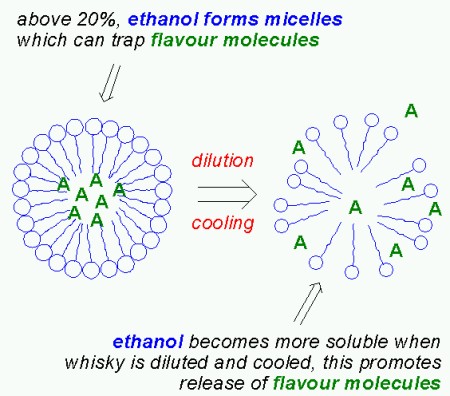
Ethanol micelles (from blog.khymos.org)
On the other hand, ethanol forms micelles trapping hydrophobic compounds at over 23% abv. Addition of water opens up these ethanol micelles and releases some of these hydrophobic compounds but also increases the surface tension of the solution. The short chain esters (fruity, solventy, glue) are usually more volatile and evaporate in proportionally larger amounts than the long chain esters (fruity, soapy). The oak solubles in turn increase the surface tension especially at high ethanol concentrations, decreasing the overall evaporation.

Effect of ethanol concentration on the maturation of cognac (Cantagrel & Galy 2003)

Cutty Sark Scotch 1977 Ad - Water of Loch Katrine
Cutty Sark ad from 1977
It probably makes a difference whether the dilution is made prior the cask filling, just before bottling or in the glass. Theoretically, the dilution before casking might produce a sweeter, cleaner and less fruity and bitter-oaky spirit. The cognac producers usually add water or lower abv spirits just a small amount at the time, probably to avoid sudden changes in ethanol-water equilibrium. Dilution before bottling might have some dimishing effect on the sugars and some volatile off-notes such as glue and acetone, while probably increasing the proportional amount of linalool-oxides and bitter woody off-notes. Dilution in the glass, especially below 23% abv would release more of the hydrophobic aromas, such as esters with fruity, but also solventy and soapy off-notes.

References and further reading
Conner JM, et al. Release of distillate flavour compounds in Scotch malt whisky. J. Sci. Food Agric., 1999; 79; 1015–1020
Conner JM, et al. Agglomeration of ethyl esters in model spirit solutions and malt whiskies. J. Sci. Food Agric., 1994; 66; 45–53
Conner JM, et al. Interactions between ethyl esters and aroma compounds in model spirit solutions. J Agric Food Chem 1994;42;2231-4
Conner JM, et al. Contributions of distillate components to disperse phase structures in model spirit solutions. J Agric Food Chem 1998;46;1292-6
Lea GH, Piggott JR. Fermented beverage production 2nd ed. Kluwer Acad 2003.
Piggott JR, et al. The influence of non-volatile constituents on the extraction of ethyl esters from brandies. J. Sci. Food Agric., 1992; 59: 477–482
Reazin GH. Chemical mechanisms of whiskey maturation. Am J Enol Vitic 1981;32;4;283-9
Ross, J. Whisky. Routledge & Kegan Paul Books 1970
Udo M. The Scottish whisky distilleries. Black&White Publishing 2006.Taylor AJ, Mottram DS. Flavour Science: Recent Developments. Woodhead Publishing 1996.

Sunday, March 18, 2012

Triple distillation in Scotland

Auchentoshan still room
Scotch malt whisky is usually distilled twice in pot stills. There are some exceptions: Auchentoshan and Hazelburn (produced in Springbank distillery) are distilled three times. Benrinnes and Springbank use their own partial triple distillation methods and Mortlach is actually partially quadruple distilled. There have also been some with malt whiskies distilled in Coffey- Stein- or Lomond-stills and recently even a fully quadruple distilled malt spirit from Bruichladdich.


Old Irish pot still at Midleton (wordpress.com)
Triple distillation was and is used extensively in Ireland at least from the late 1800's, probably because of a mixture of malt and grain used in big pot still distillations did not give a sufficiently pure spirit in two simple distillations. In early 1800's a common method in Ireland was to divide the product of the wash distillation into strong and weak low wines and then distill them separatedly into new spirits feints and then re-using the feints from both low wine distillations in the next weak low wines distillation. This is actually modified double distillation, which could have been useful especially if the lower cut point of spirit distillation was to be kept quite high, which in turn would have enabled the production of cleaner and lighter style of spirit. During the 19th century as the Irish pot stills were becoming bigger the simple triple distillation was adopted in several Irish distilleries.

It is a common belief that Scottish Lowland distilleries were also using triple distillation at the time, but actually only four or five of the 31 lowland distilleries toured by Alfred Barnard in 1886 were using some sort of triple distillation. Note that just a few distilleries were producing whisky by only continuous Coffey or Stein stills, the 26 others producing at least some pot still lowland malt whisky. Dundashill produced double, triple and Coffey-still distilled whisky and sold them separatedly for blenders. Clydesdale and Greenock produced only triple distilled whisky as probably did Glentarras, too. Glentarras had one wash still, two spirit stills and one feints still, but there are no spesific descriptions of its distillation method, so it is possible that it was just partially triple distilled. Cameron Bridge produced mainly grain whisky, but also "Pot Still Irish" (grain and malt in pot stills?), "Silent Malt" (malt in Stein still?) and "Flavoured Malt" (malt in pot still?), and it is possible that some of these was/were triple distilled. For example Auchintoshan (now Auchentoshan) was double distilling and Rosebank most probably partially triple distilling in 1886. Hazelburn used triple distillation in Campbeltown, but there are no records of triple distillation in the Highlands or the Speyside at the time.

It is not exactly known, when Auchentoshan turned into triple distilling, nor whether in what extent Rosebank has used double, triple and partial triple distillation regimes during the 1900s. One source (Brian Townsend's Scotch Missed) claims triple distillation was used in Rosebank for decades, but according to Ulf Buxrud and the DCL archives partial triple distillation, much in the lines of Benrinnes, was used in the 20th century. Benrinnes has been using partial triple distillation probably from 1954 and Springbank apparently from the early 1900's. The old Hazelburn distillery was operational from 1837 to 1925. It is not known whether they used triple distillation from the beginning, but the spirit stills were quite unique as they had water jacketed tube condenser systems attached to the neck of the both spirit and feints stills (before the lyne arm) and then after the lyne arm the typical worm condensers of that era. These stills probably had very much reflux and consequently the spirit was probably quite light. The new Hazelburn was distilled first in 1997 at the Springbank distillery with "normal" stills.

Auchentoshan uses a simple triple distillation with a very narrow heart cut in the spirit run (82.5 to 80.0 ABV), which produces very light and aromatic whisky.

The Benrinnes distillation system is described in the picture below. Basically the weak feints from all (wash, feints and spirit still) distillations are redistilled in the low wines still and the first part of that is added to the spirit run. This probably adds to the copper contact for the feints fraction.


In Springbank every fifth wash distillation is double distilled as the other four batches undergo a triple distillation. All the feints are added to the intermediate still. The effect is probably much the same as in the Benrinnes system resulting in more copper contact for the feints.


In Mortlach one wash and spirit still produce simple double distilled malt whisky. The rest of the stills produce about 80% of double distilled spirit and 20% of quadruple distilled whisky. The amount of finished quadruple distilled whisky is probably much less as the latter part of the wash (weak feints) is much weaker in alcohol. The weak feints are distilled three times in a small still called the "Wee Witchie"; the first two distillations are blank runs and only solids are removed in between. The third distillation is fractioned in the normal way and the heart is mixed with the product of the other spirit stills. Because the Wee Witchie is small (7 880 litres compared to 17 000 litre spirit stills 2&3), squat and cooled with worm tubs as the other spirit stills, the copper contact is not substantial, but it is possible that the four distillations might change the properties of the feints fraction in other ways, such as successive heating, which might in turn alter the spirit. It is believed that the meaty aromas often noticed in Mortlach whisky are due to the Wee Witchie and the "Byzantine" distillation system, which has been in use from at least 1971.


Mortlach still room, the Wee Witchie at the back (from whiskymonitor.nl)
REFERENCES AND FURTHER READING:
Barnard A. The whisky distilleries of the United Kingdom. Birlin ltd 1887.
Buxrud U. Rare malts. Quiller Press 2006.
Morewood S. A philosophical and statistical history of the inventions and customs of ancient and modern nations in the manufacture and use of inebriating liquors. Longman 1838.
Townsend B. Scotch missed. Angel's share 2000.
Udo M. The Scottish whisky distilleries. Black&White Publishing 2006.
Weir R. The history of the Distillers Company 1877-1939. Clarendon Press 1995.

Sunday, February 12, 2012

Lactic acid bacteria

Lactic acid bacteria (LAB) are a diverse group of bacteria capable of lactic acid production. They are found for example in cheeses, yoghurts or decomposing plants. They are non-respiratory (anaerobic), but tolerate also aeriated environments and can survive high acid (pH 3-6) and high ethanol concentrations. The Lactobacillales can be divided into different genera, such as Lactobacillus, Leuconostoc, Pediococcus, Lactococcus and Streptococcus etc. Of these the Lactobacillus and in lesser extent the Pediococcus are dominant in distillery environment, although many others survive alongside them. The LAB are present in small quantities in the raw materials, especially the grain, but generally the contamination of wort with LAB comes from the distillery environment (pipes, washbacks etc) and therefore the LAB population in whisky distilleries remains quite stable and the dominant strains of LAB are practically unique in any one distillery.

The yeast dominates the early fermentation and LAB starts to grow significantly after about 36-48 hours as the yeast starts to drop out or die. At the start of the fermentation there are usually various types of LAB in the wort, but many of them die out as the ethanol concentration rises. The first LAB to grow are usually heterofermentative ie they metabolise sugars into lactate, acetate and CO2, the most common species being L.fermentum, L.paracasei and L.brevis. The homofermentative LAB, such as L.acidophilus and L.delbrueckii, producing only lactate from sugars appear later after about 70 hours of fermentation.
Microbes in whisky fermentation, MB-stained=dying cells (Priest 2004)

The heterofermenting LAB can also use pentose sugars, which the Saccharomyces cerevisiae can not ferment, so they are not necessarily competitive. The homofermenters use only hexoses and they always reduce the spirit yield a bit, although they can also use the autolysis products of the dying yeast for their metabolism. The usual amounts of LAB at the start of the fermentation (below 10^6 cells/ml) do not affect the spirit yield, but amounts greater than that could cut the yield up to 20%. The usual amount of LAB in the wort are usually 10^4 to 10^5 per millilitre and rise up to 10^9 at the end of a long fermentation.
Growth of lactic acid bacteria in whisky wort (van Beek 2000)
The effect of LAB on the flavour profile of whisky depends on the species and even the strain of the LAB. Also the availability of metabolites via yeast cell death affects the flavour profile. Probably the most important and common effect of LAB is the increase of lactic and acetic acid, which together with sufficient amount of alcohols leads to increased levels of esters. The lower pH also affects the volatility and activity of various aroma compounds during fermentation and distillation.

The yeast cell death allows the LAB to metabolise the autolysis products, for example the cell membranes containing lots of fatty acids. The LAB hydroxylate these fatty acids into gamma- and delta-lactones, especially gammadecalactone and gammadodecalactone, which produce a heavy sweet and fatty aroma also found in tropical fruits (apricot, peach). The use of brewer's yeast in the fermentation leads to faster yeast cell death and subsequently to higher levels of gammalactones with sweet and fatty notes.

The LAB can alter phenolic aromas as they can decarboxylate cinnamic acids to 4-vinyl guaiacol or 4-vinylphenol and further to 4-ethylphenol. Ferulic acid and p-coumaric acid are common cinnamic acids in malted barley and a typical distiller's yeast (DCL M) and most wild yeasts, but not most brewer's yeasts, can decarboxylate them into 4-vinylguaiacols (smoky, spicy, clove). The LAB has the same decarboxylation enzyme, but they can reduce 4-vinylguaiacol further to 4-ethylphenol (guaiacol, barn-yard, band-aid, brettanomyces), which usually softens the smoky aroma. The smoky aromas are dimished especially if the fermentation is allowed to continue longer.
Amounts of guaiacols in whisky fermentation with DCL M+LAB (Van Beek 2000)


fruity fatty green sweet sour sulphury meaty
L.paracasei +

+


+


L.plantarum +

+


-


L.brevis (-) + (-)

++

++ ++
L.casei + +


L.fermentum + + +


L.acidophilus

+ +


T.delbrueckii (wild yeast) - (+) + + - (-) +/-
Some effects of LAB and wild yeast on the flavour of new-make spirit (Van beek 2002, Priest 2004, Wilson 2008)

The growth of LAB depends heavily on the cleanliness of the distillery. Most of the LAB from the raw materials die during the malting and mashing and the main source for the LAB is from the pipes and the washbacks. Steel washbacks are easier to clean and probably lead to lower and different LAB colonies in a distillery. Long fermentation times increase the LAB growth, especially after 48 hours. Some distilleries have variable fermentation times, for example shorter during the week and longer over the weekend, which tends to produce slightly different wash profiles. Below is a table about different distillery fermentation practices.

Distillery fermentation times and washback materials (Udo 2006)

Variable fermentation times (usually weekdays/weekends)

REFERENCES AND FURTHER READING:
Booysen C et al. Isolation, identification and changes in the composition of lactic acid bacteria during the malting of two different barley cultivars. Int J Food Microb 2002;76;63-73
Bryce JH et al (ed). Distilled spirits: Production, technology and innovation. Nottingham Univ Press 2008
Simpson KL et al. Characterization of lactobacilli from Scotch malt whisky distilleries and description of L.ferintoshensis. Microb 2001;147;1007-1016
Smit G., et al. Flavour formation of lactic acid bacteria and biochemical flavour profiling of cheese products. FEMS Microb rev 2005;29(3);591-610
Udo M. The Scottish Whisky Distilleries. Black & White 2006
van Beek S, Priest FG. Evolution of the lactic acid bacterial community during whisky fermentation. Appl Microb 2002;68(1);297-305
van Beek S, Priest FG. Decarboxylation of substituted cinnamic aceds by lactic acid bacteria isolated during malt whisky fermentation. Appl Envir microb 2000;66(12);5322-5328
Walker GM, Hughes PS (ed). Distilled spirits, new horizons: energy, environment and enlightenment. Nottingham Univ Press, 2010
Wilson NR. The effect of lactic acid bacteria on congener composition and sensory characteristics of Scotch malt whisky. Thesis Heriot-Watt Univ 2008.