Showing posts with label peat. Show all posts

Wednesday, April 16, 2014

Fermentation waters

Glenlivet is one of the few Scottish distilleries using hard water,
but nobody told the AD.
Water is used in several phases of whisky production: steeping, mashing, cooling and dilution. Formerly water mills provided much of the energy needed in many distilleries as well. Distilleries have often been founded into places where water is easily available and it is believed at least in the marketing departments that fresh spring water or picturesque peaty burns play a significant role in the manufacturing process.

The most important attributes of steeping and mashing water are its hardness, pH, overall mineral content and microbiological purity.

Water hardness means the concentration of multivalent cations in the water, ie the amount of ions with a charge of +2 or more (mainly calcium and magnesium) and it is usually expressed as concentration of calcium carbonate (CaCO3) in the water. Soft water is defined as containing under 40-100 mg/l and hard water over 80-200 mg/l of CaCO3, depending on the source.

The pH (pondus hydrogenii) of water means the activity of hydrogen atoms in the water. The pH value describes the acidity of the water in logarithmic scale, ie pH 4 is ten times more acidic than pH 5 and hundred times more acidic than pH 6.

The malt or grain is another source of acidity in the mash. The darker the roast of the malt, the more acidic it gets. Therefore soft alkaline water is often preferred for brewing pale malts and hard water for darker acidic malts. The malts used in whisky production are as pale as possible to ensure the best alcohol yield. The commonly desired pH for mash is about 5-5,5, a lower pH might cause excessive lactic acid bacteria production and a higher pH a slower or incomplete fermentation. Calcium is the most important mineral affecting both the pH and water hardness. Calcium itself does not taste of anything at usual concentrations, but it lowers the pH, increases water hardness and yeast flocculation and might reduce magnesium making the flavour less sour.

Other important ions in the brewing waters are sodium (Na+) and the common anions; sulphate (SO4-2), chloride (Cl-) and carbonate (CO3-2). Sodium softens the water by decreasing the effect of CaCO3 and at higher concentrations (over 50 ppm) makes the water sweet, or even salty (>150 ppm) and sour (>250 ppm). Sulphate enhances bitter, dry and sulphury flavours, complimenting the hoppy aromas of beers and providing antibacterial influence in  both fermentation and bottle-aging, reducing the lactic acid bacteria growth. Chloride enhances malty flavour, but at high concentrations it might give pasty, salty or chlorine aromas. None of Scottish distilleries use chlorinated water for their fermentations.

The local water quality was probably one of the reasons why brewers in Burton-on-Trent and Edinburgh went for bitter highly hopped IPAs (high CaSO4), in Pilzen for light crisp lagers (extremely soft water), in Münich for darker lagers (higher CaCO3), in Dublin for dark stout (high CO3-2, low Na+ and relatively low Ca+2) and in London for dark sweet porter (high CaCO3 and NaCO3).

Ion concentrations in typical brewing waters (Maltman 2003)
All rainwater is soft, it is in the water reservoirs it acquires its hardness. The longer the water spends in rivers, lochs or underground aquifers, the more time it has to gain solubles from the ground. The geology also plays a significant part, as hard granite or quartz is less soluble than limestone or chalk and very different from young basalt. 


SpringBurn/RiverLochWellMains
ArdmoreAberfeldyArdbegAuchroiskDevanha
BalvenieAberlourAuchentoshanGlenlivetDundashill
BenriachAllt-a-bhainneBruichladdichMacallanOban
BenromachAultmoreCambusSt MagdaleneStrathdee
CardhuBalblairCameronbridgeSaucel
ConvalmoreBalmenachCaol IlaStrathisla
CraigellachieBenrinnesPort Dundas

EdradourBladnochMillburn

FettercairnBlair AtholGarnheath

GlenallachieBowmoreGlen Flagler

GlenburngieBraesIslabrae

GlencadamBroraKillyloch

GlendullanBunnahabhainKinclaith

Glen ElginCaledonianNort Port

GlenfarclasCaperdonichPort Ellen

GlenfiddichClynelishProvanmill

Glen GariochCragganmorePulteney

GlenglassaughDaftmillRiechlachan

Glen GrantDailuaineRosebank

GlenkinchieDallas DhuSpringbank

GlenmorangieDalmoreLongrow

Highland ParkDalwhinnieSpringside

LongmornDeanstonStrathclyde

MortlachGlen AlbynTobermory

PittyvaichGlendronach


Royal LochnagarGlen Esk


StrathmillGlengoyne


TamdhuGlenlochy


TamnavulinGlenlossie


TeaninichGlen Mhor


TomintoulGlen Moray


Lochside


Macduff


Mannochmore


Man O'Hoy


Miltonduff


Royal Brackla


Scapa


Speyburn


Talisker


Tomatin


Tormore


Tullibardine


Water sources for mashing, hard waters in bold (Modified from Udo, 2006)

Scotland is divided into various different geological areas basically by several southwest-northeast-lines as illustrated below.

Geological map of Scotland (www.scottishgeology.com)

Speyside and the eastern part of Islay lie on the Dalradian rocks, formed about 570 million years ago and consisting mainly of metamorphosed sedimentary mudstone (schist and quartzite) with some granite hills. The rocks are old and resistant, therefore contributing little to the water, rendering it usually very soft, slightly alkaline and low sulphur. Notable exceptions are Glenlivet and Aberlour, which lie on top of granite-rich soil containing some limestone, rendering the water somewhat harder, especially from wells. 
Geology of River Spey (www.snh.org.uk)
The Moray Firth at the Great Glen Fault there is essentially a river delta with mud and sand carried by the rivers, consisting of especially old red sandstone. The red colour comes mainly from iron, but the porous sandstone is also rich in calcium and magnesium, rendering the water in the Northern Highlands and Orkney significantly harder than in the Speyside. The water of Islay lies somewhere in between.

Typical waters from Scotland (UisgeSource)


Several American distillers believe in hard, low-iron water
However, many distilleries do process the waters they use. Apparently all the distilleries use at least ion-exchange methods for their bottling (dilution) water, but not necessarily for the reduction right after distilling (to bring the new make spirit down to 63.4% abv). None use chlorinated water for mashing or dilution nowadays. In the earlier part of the 20th century local bottling water was used and there were complaints that London water turned the whisky blue and cloudy whereas Speyside water did not, probably due to harder water of London. Although there are several breweries applying reverse osmosis (demineralization) and specifically mineralized (Burtonized) waters, these methods are not used in the distilling industry, or at least they are not made public. Water softening with resins is not used, and it could be detrimental because it tends to increase the sodium levels. Grain distilleries might benefit from hard water, as the calcium induces enzyme activity and lower malt contents and faster fermentations could be possible, although it is not entirely clear whether the mineralization of mashing waters is allowed by the law and the Scotch Whisky Association.

So, fermentation waters affect the quality of mash. The minerals themselves do not significantly distill into the spirit, but they affect the fermentation process before it. Soft water probably produces more faster fermentations and lactic acid bacteria growth generally resulting in heavier spirits, as the harder Highland waters produce cleaner and sweeter spirits. Iron is considered as a fault in brewing water and it is likely to produce less estery, fruity spirits. Zinc might do the same at higher concentrations, but is vital for yeast cells in lower concentrations. Peaty water does not provide enough phenols to render the spirit peaty, but higher amount of organics in the fermentation water does produce more esters and less higher alcohols, probably due to greater bacterial growth and yeast autolysis. Fermentation water quality is important to the quality of whisky, but in a different way it has been marketed.

Effect of brewing water to the spirit sensory quality (Wilson, 2010)


REFERENCES AND FURTHER READING
Cribb, S&J. Whisky on the rocks. Earthwise, 1998
Geikie, A. The Scenery of Scotland viewed in connection with its Physical Geology. Macmillan 1887.
Goldamer, T. Brewer's handbook. Apex, 2008
Maltman, A. Wine, beer and whisky: The role of geology. GeologyToday 2003;19;1;22-29
Palmer, J & Kaminski, C. Water, a comprehensive guide for brewers. Brewers Assoc., 2013
Scottish Natural Heritage. http://www.snh.org.uk/pdfs/consults/spey/speyreport.pdf
Wilson, CA et al. The role of water composition on malt spirit quality. Nottingham Univ Press, 2010

Monday, October 17, 2011

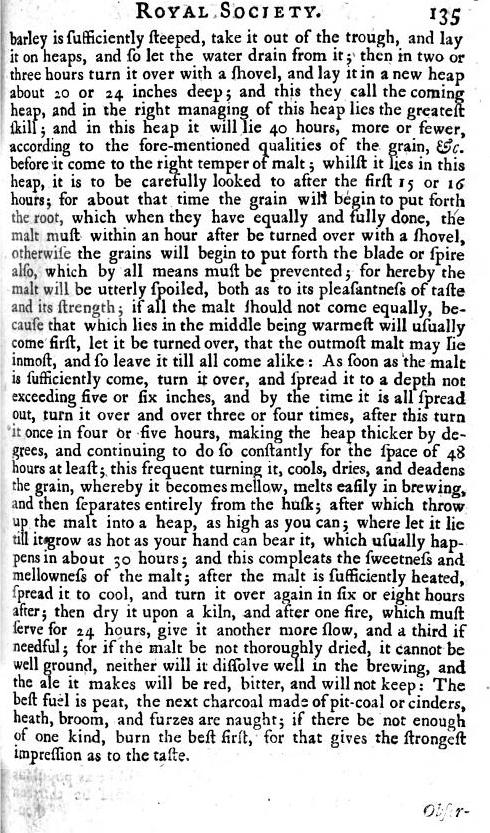
Malting in 1660s

Just found a nice article about malting barley (or bere) by Sir Robert Moray, probably written between 1660-1673 and published in 1739 as a part of The Memoirs of the Royal Society (ed. Mr Baddam). I will try to find something more recent to blog on later...

Sunday, May 29, 2011

Peat Terroir

Arbroath maltings
In 1800's the peat used in maltings was commonly local and the kilning was done in almost every distillery. During the latter part of 1900's and the invention of industrial malting processes the maltings have been concentrated to bigger facilities, such as Diageo's Roseisle, Glen Ord and Port Ellen, Simpson's Tweed Valley, Baird's Abroath and Inverness, Greencore's Glen Esk and Buckie and Edrington's Tamdhu. Several distillery maltings are still operational, but only a few distilleries malt all of their barley on-site (Springbank, Glen Ord, Tamdhu). The use of peat has diminished as more economical fuels have been introduced, but some peat is still used to create smoky flavoured malts. The peat used in Scotch whisky maltings is sourced mostly from the north-east of Scotland, Islay and Orkney.

Peat is formed in waterlogged lands by partial degradation of organic matter. There are some differences between peat compositions based on different climate, vegetation, bog type and cutting depth.

Peatlands can be divided into bogs, fens, marshes ja swamps.  Bogs are formed by heavy rainfall (therefore called ombotrophic) and usually contain more sphagnum moss and less woody vegetation than the other peatland types, which are formed mostly by waterlogging from the ground water (minerotrophic). Fens (aka basin bogs or valley bogs) contain more sedges and grass. Marshes are treeless intermittently waterlogged areas and usually accumulate peat very slowly. Swamps are very minerotrophic and contain large amounts of wood and nutritients. Average peat contains 90% water and 10% dry matter, of which 92% is organic and 8% inorganic (practically ash). Organic matter consists mainly of residues of lignin and different carbohydrates, but there are considerable variations depending on the vegetation and the bog type. Ombotrophic peats are richer in phenols and aromatics, but due to poorer vegetation they lack carbohydrates, lignin and nitrogen. Western Scotland and the islands are especially abundant with blanket bogs. About 10% of Scotland in covered by blanket bogs and 1% by basin bogs.

Peat bog Maltings Location Bog type
Glenmachrie Laphroaig Islay basin
Gartbreck Bowmore Islay basin
Castlehill Port Ellen Islay blanket
Hobbister Hill Highland Park Orkney blanket
St Fergus various Aberdeenshire basin
Tomintoul various Speyside basin
Machrihanish Springbank Campbeltown blanket

The extraction depth is also important as the surface layers are usually rich in carbohydrates and poor in phenols and the deeper layers might have too much harmful nitrogen- and sulphur compounds due to anaerobic fungal and bacterial metabolism. On the other hand some fungi seem to produce vanillins such as acetovanilline from lignin, for some unknown reason especially so in island peats.

Location of peat bogs used in whisky production
Islay peat bogs (from left: Gartbreck, Glenmachrie, Castlehill)
It seems that the most significant factors in peaty aroma are the bog location and the cutting depth. The bog type and the vegetation play some role, but they are not that important for peaty flavour. The peats from Islay, for example, are very similar with each other as the peat from the basin bogs Glenmachrie (Laphroaig) and Gartbreck (Bowmore) cannot be identified by infrared spectroscopy. 

The Castlehill peat for the Port Ellen Maltings somewhat different from the basin bog peats from Islay, probably due to different microbiology of the blanket bog and a greater amount of woody material are therefore more lignin-derivatives and carbohydrates. 

Surprisingly, Hobbister Hill peat from a blanket bog is chemically more similar to the Islay basin bog peats (Gartbreck/Glenmachrie) than the blanket bog Castlehill peat. The local microbiology of peat bog might therefore have a greater impact on the peat composition, influencing both the nitrogenlevels and phenol-concentrations in the peat. Another explanation is that the bog types are overlapping, for example Hobbister Hill bog might have some basin bog properties (standing water bowls) especially in the deeper layers; this might explain the similarity of peats cut from the deeper layers of Hobbister Hill bog with the Islay basin bog peats. 

Tomintoul peat is different from the Island peats; a basin bog, as expected, contains great amounts of carbohydrates, but there is also lots of sphagnum moss, which for some reason does not result in the same amounts of phenols as in the islands. It could be speculated that this is due to different climate, microbiology or variety of Sphagnum in the western islands and the mainland.

St Fergus peat is rich in woody material and therefore rich in lignin derivatives, especially syringyl. There is however a great amount of phenol-compounds in the St Fergus peat, although it is a basin bog and the sphagnum-content is lower than in for example Tomintoul peat. The location of St Fergus bog is closer to the sea than of Tomintoul bog. Maybe the proximity of sea results in greater amounts of phenols in peat? Explanation might be for example lesser temperature fluctuations or differences in microbiology or drainage.

There are no scientific analyses available on Machrihanish (Springbank) peat, but since it is cut from a blanket bog and located near sea in the western Scotland, it probably is closer to the Islay and Orkney peats than the mainland peat.

Some breweries use artificial smoke flavourings in their malting processes, apparently common raw materials are extracts from burnt deciduous trees, such as beech or birch. These are likely to produce more aromas from syringyl, guaiacol and carbohydrates resulting in softer but not as phenolic aroma as from peats. I don't know whether Scotch whisky industry uses smoke flavourings in their maltings, but it is not prohibited in the Scotch whisky regulations. A black alder smoked malt could be an interesting experiment (a free hint for any progressive distillers reading this).

Anyway, there clearly is a peat terroir and even some local variations in the compositions. Also the cutting depth is important and it will be interesting to see wheter the peat composition will change as the limited amounts of peat for example from Islay are utilised and either the cutting depth or the cutting location changes.


REFERENCES AND FURTHER READING:
Bozkurt  S et al. Peat as a potential analogue for the long-term evolution in landfills. Earth Sci Rev 2001; 53; 95-147
Bryce JH et al (ed). Distilled spirits, production, technology and innovation. Nottingham Univ Press, 2008
Da Porto C et al. A study on the composition of distillates obtained from smoked marc. Anal Chim Acta 2006; 563; 396-400
Guillén M et al. Carbohydrate and nitrogenated compounds in liquid smoke flavorings. J Agric Food Chem 2001; 49; 2395-2403 
Guillén M, Manzanos M. Study of the components of a solid smoke flavouring preparation. Food Chem 1996; 55; 3; 251-257
Guillén M, Manzanos M. Characterization of the components of a salty smoke falvouring preparation. Food Chem 1996; 58; 1-2; 97-102
Harrison B, Priest F. Composition of peats in the preparation of malt for scotch whisky production. J Agric Food Chem 2009; 57; 2385-2391
Harrison B et al. Differentation of peats used in the preparation of malt for scotch whisky production. J Inst Brew 2006; 112; 4 ; 333-339
Jefford A. Peat, smoke and spirit. Headline 2004
Jounela-Eriksson P. The aroma composition of distilled beverages and preceived aroma of whisky. Academic Press 1978
Kostyra E, Barylko-Pikielna N. Volatiles composition and flavour profile identity of smoke flavourings. Food Qual Pref 2006; 17; 85-95
Lehtonen M. Phenols in whisky.  Chromatographia 1982; 16; 201-203
Russell I (ed). Whisky, technology, production and marketing. Academic Press 2003
Swan JS, Howie D. Sensory and analytical studies of regional influence on the composition of Scotch malt whisky. Institute of brewing, 1983.
Valaer P. Scotch whisky. Industr Engineer Chem 1940; 32; 7; 935-943
Walker GM, Hughes PS. Distilled spirits, new horizons: energy, environment and enlightenment. Nottingham Univ Press, 2010

Saturday, March 26, 2011

Pot still distillation

Wash still (bladnoch.co.uk)
Scotch malt whisky is distilled typically twice in copper pot stills. The first distillation is carried out in a wash still, usually slightly bigger than the spirit still used in the second run. Copper is used because of its good malleability and heat conduction but also for its catalytic properties and the ability to neutralize some of the sulphur compounds and off-notes. The stills can be heated either directly by burning gas, peat or coal or indirectly by steam coils running inside the still. If direct firing is used, there must be a rummager on the bottom of the still to prevent charring, at least in the wash still. The stills usually have a broad pot and a narrowing swan neck that turns to a lyne arm leading to a condenser, which can be a traditional worm, a shell&tube condenser or a plate heat exchanger. Various shapes of stills are used and it is believed that the bulbs and boiling balls etc increase the copper contact at the right spots to produce better spirit. Some distillers use a purifier in the spirit still, which is a pipe reversing some distillate from the lyne arm back to the swan neck producing more reflux.

Worm-tubs Purifier Direct firing
Balmenach Ardbeg Glenfarclas
Benrinnes Glen Grant Glenfiddich
Cragganmore Glenlossie Macallan
Dalwhinnie Glen Spey Springbank (wash)
GlenGarioch (wash)
Tobermory(wash)
Edradour Strathmill
Glen Elgin Talisker
Glenkinchie Tormore
Mortlach

Oban

Royal Lochnagar

Talisker

Springbank (wash)

 
Basically the first distillation is a simple distillation of volatile compounds (such as alcohols), producing low wines of 20-25% abv from 6-9% abv wort. Wash is usually preheated to prevent excessive temperature differences and charring inside the still. The first distillation is usually deemed complete when the distillate is under 1% abv and about one third of the wort has boiled over to the wash safe. Wash distillation usually takes 5-8 hours to complete, depending on the size, shape, temperature and charge of the still. The residual is called pot ale.

The wash distillation is mixed with the foreshots and the feints from previous spirit distillations and distilled in the spirit still. The second distillation is a fractionated distillation; the most volatile compounds boil first and are called foreshots or heads, the second part is called the middle cut (spirit cut, heart), the third part is feints (tails) and the remaining liquid in the still is called spent lees.

Panek&Boucher 1989
Panek&Boucher 1989
The foreshots consist of the most volatile compounds, such as methanol, acetaldehyde (ethanal), some of the ethyl esters such as ethyl acetate and volatile sulphur compounds (see table of boiling points below). Along with them come some of the residues of the previous distillation, which are not high volatiles but soluble only in higher strenghts of alcohol, for example fatty acids and their esters. These compounds are therefore condensed into the still at the end of previous distillation and as the next distillation starts, they are made soluble again by the high alcohol strenght and swept up to the spirit safe along with the foreshots. The foreshots are either unpleasant in flavour or dangerous to health (or both) and therefore not included in the final spirit but returned to the next distillation. The long-chain fatty acids and other residues from the previous distillation tend to form a cloudy mixture when diluted to 80 sikes proof (45.7% abv).


Boiling point C Odor
acetone 56,5 nail polish remover
glycerol 290 sweet
acetic acid 118 vinegar
aldehydes

acetaldehyde 20,2 pungent fruity, green apple, metallic
furfural 161,7 almonds
alcohols

methanol 65 sweetened ethanol
ethanol 78 ethanol
1-propanol 97 fruity
2-propanol 82,5 fruity
butanol 118 banana, solvent
amyl alcohols 102-138,5 sharp, burning
2-phenyl ethanol 219 floral, rose
esters

ethyl acetate 77,1 pear,sweet
ethyl butyrate 121 pineapple
ethyl formate 54 rum, raspberry
hexyl acetate 171,5 fruit
sulphur compounds

hydrogen suphide -60,3 rotten eggs
sulphur dioxide -10 burnt sulphur
dimethyl sulphide 37 cabbage, vegetables
fatty acids

lauric acid 299 bay oil, soap
palmitic acid 351 waxy, creamy, soapy


The traditional way of making the first cut point is by mixing the foreshots with water in the spirit safe; as the spirit turns clear, the foreshots have mostly passed and the middle cut is collected into the spirit receiver. Some producers use timed foreshot runs and do not bother with the demisting test and therefore are are likely to cut the spirit a bit lower as a precaution and probably getting less of the highly volatile compounds into the spirit. The second cut can be determined by taste, abv or time according to the distillery practice. The feints are then run usually down to 1% abv and added to the next wash.

The feints are the last volatile fraction of spirit distillation. Feinty aromas increase slowly towards the end of distillation, developing from quite pleasant mushroom, cereal and popcorn aromas to leathery tobacco notes and further to ashy, fishy and even cheesy aromas not usually approved in whisky. The feints are usually rich in phenols and smoky aromas important for peaty whiskies. Therefore the second cut point must be determined with care to produce peated but not feinty spirit with off-notes. The feints are usually run quite fast to save time, but this makes some of the fat-solubles to adhere to the still. These compounds (mostly fatty acids) must be purged by an adequately long and slow run of foreshots in the next distillation, otherwise the whisky might become feinty no matter how early the second cut is made.

The spirit cut is usually about 72-65%, but there are considerable differences between distillers. To produce a very light aetheral whisky (richer in high volatiles) the distiller would be likely to use a tall still with a low charge run slowly in low temperatures for maximum reflux, a purifier, an ascending lyne arm, a purifier and a shell&tube condenser for maximum copper contact and cut short foreshots and long feints (earlier second cut) for maximum amount of high volatiles and less of the heavier aromas. To produce a peaty whisky the distiller must try to catch all the phenols from the latter part of the middle cut but also avoid excess feints.

The distillation is not only a simple process of separation, but the heat and the copper contact alter some of the flavour compounds, too.  Heat promotes Maillard reactions producing furfural and sulphur compounds, especially thiophenes and polysulphides, which at low concentrations add a pleasant roasted and complex flavour, but produce pungent and unpleasant cereal and sulphury notes at high concentrations. Heat also promotes aldehyde reduction to alcohols and acids and their conversion further to esters. Lignin-derived components such as coumaric and ferulic acids can evolve to more spicy guiaicols. Acrolein (peppery) can form from bacterial fermentation products in presence heat. Fusel oils, 2-phenethanol (rose, flower) and furfurals (caramel, burnt sugar) are formed in pot-stills, but not significantly in column still distillations and therefore are likely to be generated by heat differences during distillation.

Copper removes most of the sulphury, cereal, feinty and meaty aromas during distillation. Especially the copper contact of the first wash still distillation is important. Total removal of copper contact in the spirit still has surprisingly minimal effect on the mentioned off-notes.

References and further reading:
Adams AB. The distillation of alcohol. J Ind Eng Chem 1912; 8-14
Herstein KM. Chemistry and technology of wines and liquors. Van Nostrand Co 1935
Jounela-Eriksson P. The aroma composition of distilled beverages and preceived aroma of whisky. Academic Press 1978
Lea GH, Piggott JR. Fermented beverage production 2nd ed. Kluwer Acad 2003. 
Monica Lee KY et al. Origins of flavour in whiskies and a revised flavour wheel. J Inst Brew 2001;107;5;287-313
Piggott JR, Paterson A (ed). Understanding natural flavors. Blackie academic&professional 1994
Russell I (ed). Whisky, technology, production and marketing. Academic Press 2003
Udo M: The Scottish Whisky Distilleries. Black & White 2006
Walker GM, Hughes PS (ed). Distilled spirits, new horizons: energy, environment and enlightenment. Nottingham Univ Press, 2010
Webb AD (ed). Chemistry of winemaking. Am Chem Soc 1974

Sunday, February 13, 2011

Peat

Pagoda-roof of a kiln
Heat is needed in kilning to dry the malts. Peat has been traditionally used as fuel for kilning in Scotland, especially in the areas where coal was not easily available, such as the islands, Campbeltown and nothern highlands. During the 20th century more affordable coal, gas and oil became more available and gradually the use of peat in kilning dimished. In 1940 it was common to use 25-50% peat for Lowland malts, 50-75% peat for Highland malts and usually 100% peat for Islay and Campbeltown malts. The rest of the fuel was usually coal or anthracite. Nowadays the Islay, Orkney and Campbeltown distilleries are famous for their peated malts, but also some mainland distilleries have experimented with peated malts.

Sphagnum bog
According to Encyclopedia Britannica peat is spongy material formed by the partial decomposition of organic matter in wetlands. Usually peat consist of decomposed Sphagnum and low growing plants such as heather and different sedges (cotton grass, rushes, grasses). Wetlands can be formed by heavy rainfall or by a water basin filled by ground water. Scottish peatlands are usually formed by heavy rainfall and therefore contain more sphagnum moss and heather and less any woody vegetation. The surface layer of a peat bog is thin and aeriated moss and the deeper layers below 50cm are usually waterlogged. As the moss grows the deeper layers decompose. Because of the waterlogging there is less oxygen available and thus the decomposition of organic matter is slow and incomplete. The growing moss on top creates pressure on the deeper layers, producing thicker peat especially below the waterlevel.
 
Heather (calluna vulgaris)
Peatland plants consist mainly of cellulose, hemicellulose and lignin. The lignin in grasses contains all the monolignols; coniferyl, sinapyl and p-coumaryl-alcohols, as lignin in heather is mostly coniferyl-sinapyl-type (see previous blog). Sphagnum is very different in structure consisting of a sort of polyphenolic network. Sphagnum moss is therefore richer in p-hydroxyl-phenols instead of the usual lignin-derived compounds. Therefore burnt sphagnum releases more simple phenols and burnt wood more syringol and guaiacol-derivatives with slightly different smoky aromas. Wooden stemmed plants with more cellulose and hemicellulose decompose into simpler carbohydrates. Surface layer has proportionally more carbohydrates and less phenols and deeper layers have increased levels of potentially harmful nitrogen compounds and hydrogen sulphide (aroma of rotten eggs). Nitrogen compounds are probably produced by a range of fungi. Hydrogen sulphide is generated by bacteria in anaerobic conditions, usually below the waterlevel, from other sulphur compounds.

Anthracite coal
The smoky flavour of a peat reek is supposedly coming from simple phenols, such as phenol, its alcohol-derivatives and creosols, and to some extent from guaiacols, furans and pyrans. Syringyl-compounds are not thought to be of major significance in producing smoky aromas. Different carbonyl-compounds seem to soften the phenolic aromas. Without the carbonyls and guaiacols the phenols can taste ashy, sharp and hard, whereas together they produce aromas of smoked meat, savory "maggi" and burnt sugar. Large amounts of nitrogenated compounds give higher levels of pyridines and result in astringent, green and rubbery flavours. In addition the nitrosamines produced by the nitrogen oxides in malt are carcinogenic. The formation of nitrosamines can be blocked by sulphur oxides, which can be produced by burning sulphur-containing coal or rock sulphur with peat or by adding gaseous suphur dioxide to non-sulphurous gas. Paradoxally the rubbery, unpleasant "sulphury" odor (from nitrogenated compounds) in a whisky can result from not using enough sulphurous fuel in kilning. Also the right temperature in firing is important as more smoke and lignin-derived aromas are extracted and less nitrogen released if the peat burns without flames in relatively low temperatures.

Peat layers
There are considerable differences between peats from different origins. Islay peat is usually richer in phenols, guaiacol, vanillic compounds and nitrogens but poorer in carbohydrates than the peat from the mainland . This is probably because of the greater amount of Sphagnum and lesser amount of wooden stemmed plants in Islay bogs. Wooden plants, especially decideous plants contain grater amounts of syringol-based aromas compared to phenol-rich Sphagnum and relatively guaiacol-rich bog plants. Orkney peats are of an intermediate type as they contain more carbohydrates than Islay peats and more phenols than mainland peats from Tomintoul. The extraction depth is also important, as especially in Orkney there are great differences in peat composition as surface peat is closer to the mainland peat and deeper layers resemble Islay peat. The best extraction depth seems to be just above the water level near the surface. This is probably because of greater amount of carbohydrates and lesser amount of nitrosamines and hydrogen sulphide in the surface layer. The drying of peats and the controlling of burning temperatures are also easier if the peat is not too thick.

The middle cut (from bruichladdich.com)
Malt adsorbs the smoky flavours best when hand dry (15-30% moisture), therefore peat must be burned in the early stages of kilning. Also the grinding and composition of the malts affects the aroma, as the husks are more prone to absorb the phenols. Usually the malt is specified by measuring the phenol-content with high performance liquid chromatography (HPLC); lightly peated malt has <5 ppm phenols, medium peated 5-15 ppm, heavily peated 15-50 ppm and some experimental peated malts have well over 100 ppm phenols. The taste tresholds for different phenolic compounds vary greatly, for example 3 µg/l for guaiacol, 10-68 µg/l for creosols and 7100 µg/l for phenol. The phenol content and the strength of the smoky aroma in the spirit is usually much lower than in the malts and little lower than in the wort, but it depends heavily on the distillation practice. The foreshots contain barely any smoky flavour, the middle cut is also quite subtle, but the last part of the cut is very smoky, about six-fold compared to the middle cut and about the same intensity as the wort. The tails (feints) has about third of the phenols in the last cut and twice of that in the middle cut. To produce heavily smoked malt it seems important to continue the middle cut as long as possible bearing in mind that too much feints produces unwanted off-flavours. None of the distillers have (yet) used only the last cut to produce very smoky spirit. In the table below are some phenol contents and middle cut alcohol contents. Possibly the more intense smoky flavour of the southern Islay whiskies (Ardbeg, Laphroaig, Lagavulin) is partly due to their longer middle cuts.

Lagavulin 1969 (from Whisky Exchange blog)
Phenols decrease during maturation, but the exact mechanism has not been described. It is estimated that 25 ppm phenol content in a new make becomes 10 ppm after 10 years, 8 ppm after 15 years and 6 ppm after 30years of cask maturation. Altough the synergetic nature of oak derived compounds (guaiacol, vanillin etc) can enhance the peaty flavours, it usually softens and diminishes during aging.


Phenol-levels of malts and new-makes in different distilleries and the ABV of the middle cut. (modified from Misako Udo: The Scottish Whisky Distilleries)
DISTILLERYMALT PHENOLS (ppm)NEW MAKE PHENOLS (ppm)MIDDLE CUT ABV
Ardbeg54 (42-70)24-2673-62.5
Bowmore20-258-1074-61.5
Bruichladdich3-4
76-64
Port Charlotte4020-25

Octomore129 (in 2003)46 (in 2003)
Brora7-40

Bunnahabhain1-2 (peated malt 38)

72-64
Caol Ila30-3512-1375-65
Highland Park35-40 (and unpeated malt used together)270 and then 2h40min
Lagavulin35-4016-1872-59
Laphroaig40-452572-60.5
Springbank

7-8 (formerly 15-20)68-63
Longrow55

Old Ballantruan (Tomintoul)55


REFERENCES, FURTHER READING:

Bozkurt  S et al. Peat as a potential analogue for the long-term evolution in landfills. Earth Sci Rev 2001; 53; 95-147
Bryce JH et al (ed). Distilled spirits, production, technology and innovation. Nottingham Univ Press, 2008
Da Porto C et al. A study on the composition of distillates obtained from smoked marc. Anal Chim Acta 2006; 563; 396-400
Guillén M et al. Carbohydrate and nitrogenated compounds in liquid smoke flavorings. J Agric Food Chem 2001; 49; 2395-2403 
Guillén M, Manzanos M. Study of the components of a solid smoke flavouring preparation. Food Chem 1996; 55; 3; 251-257
Guillén M, Manzanos M. Characterization of the components of a salty smoke falvouring preparation. Food Chem 1996; 58; 1-2; 97-102
Harrison B, Priest F. Composition of peats in the preparation of malt for scotch whisky production. J Agric Food Chem 2009; 57; 2385-2391
Harrison B et al. Differentation of peats used in the preparation of malt for scotch whisky production. J Inst Brew 2006; 112; 4 ; 333-339
Jefford A. Peat, smoke and spirit. Headline 2004 
Kostyra E, Barylko-Pikielna N. Volatiles composition and flavour profile identity of smoke flavourings. Food Qual Pref 2006; 17; 85-95
Lehtonen M. Phenols in whisky.  Chromatographia 1982; 16; 201-203
Russell I (ed). Whisky, technology, production and marketing. Academic Press 2003
Smith GD, Wallace G. Ardbeg, a peaty provenance. GW Publishing 2008  
Udo M: The Scottish Whisky Distilleries. Black & White 2006
Valaer P. Scotch whisky. Industr Engineer Chem 1940; 32; 7; 935-943
Voigt J et al. New highly aromatic products and distillates from smoked malt. In Distilled Spirits, Nottingham Univ Press 2010
Walker GM, Hughes PS. Distilled spirits, new horizons: energy, environment and enlightenment. Nottingham Univ Press, 2010