Showing posts with label cask. Show all posts

Saturday, December 10, 2016

Sugars in whisky

There are small amounts of sugar in all whiskies. Scottish whiskies have some sugars dissolved from the oak cask and often some from optional caramel colouring (E150a). Total amount of sugars is quite low, usually well below 1 g/l, but in certain cases it is quite possible to reach a few grams per liter. The sweet aromas of whisky matured in refill bourbon or new oak casks mostly come from sweet aromatic vanillin and fruity esters, not from the sugars. However, sugars can have a significant role in the case of casks previously used for sweet wine or sweetened spirit.

Typical composition of a liquid E150a colouring
Sugar gets to whisky from the oak cask used in maturation and its possible previous contents, especially sweet wine, and often from optional caramel colouring. New make spirit does not contain significant amounts of any sugars and it is not legal to add sweeteners to Scottish whisky, Irish whisky or bourbon, unlike to most rums, other American whiskies, Canadian whiskies, cognac, armagnac, vodka and so on. However, caramel colouring is an allowed additive in Scotch whisky. The E150a colouring used in whiskies consists of mostly of water (30-50%), carbohydrates (50-70%) and ash (0-4%), depending on the manufacturer. The colour comes mostly from furans and furfurals, mainly 5-hydroxymethylfurfural (5-HMF). The carbohydrate composition varies a lot, but usually the amount of simple sugars (mono- and disaccharides) is about 10-20% of the total volume and about 20-40% of the total carbohydrates. Caramel colouring as such is not sweet but rather bitter, although it probably enchances the perception of vanillin and some other sweet notes while supressing some sulphury notes. The amount of caramel added to whisky is usually well below 1 g/l, but there is no legal upper limit, although 2g/l of E150a (0,2-0,4 g/l simple sugars) would render the whisky very dark. In one independent study the highest caramel solids amount found in a Scotch whisky was 0.97-1.10 g/l (simple sugars ~0.2-0.4 g/l) depending on the analysis method (I suspect L*******g, but no names) and the average amount was 0.278 g/l caramel (from 0.01 to 1.10 g/l). According to Valaer in 1940 there was a legal maximum of one pint of liquid caramel per barrel of whisky permitted by the British Customs and Excise Regulations (0.15% or about 1.5 g/l).
Caramel content of various whiskies (Boscolo et al 2002)

Another source of sugars in whisky is wood. Oak is composed of three main macromolecules; cellulose is a long-chain D-glucose-fiber. Hemicellulose is a mesh-like branched chain of 5-carbon sugars (xylose, arabinose, galactose, ribose, rhamnose) and glucose. Lignin is a complex matrix of polypropane and polyphenols. Cellulose breaks down very slowly in alcohol-water solution extracting very small amounts of glucose to whisky. Most sugars extracted from the cask come from hemicellulose, hence most of them are 5-carbon sugars. Arabinose, xylose and rhamnose taste about half as sweet as glucose, where as fructose is almost twice as sweet compared to glucose.

About 100 mg/l of solids (including sugars) is extracted from new charred oak casks during the first year of bourbon maturation and after 1-3 years typically significantly less and only as little as 4 mg/l/year extraction has been reported from old refill casks used for example for cognac (or Scotch) maturation. A toasted cask extracts considerably more sugars compared to a charred cask, but typically about 150-250 mg/l/year is reached for the first year(s) of maturation. For comparison, a 40 years old brandy matured in a toasted oak cask had 2 g/l sugars (averaging 50 mg/l/year), while a 30 years old cognac (probably mostly matured in a refill casks) had only 0.5 g/l (17 mg/l/year).

Sugars dissolve in water better than in ethanol, so for example 55% ethanol-water solution can extract almost two times more sugars from the wood compared to 70% abv solution. The difference between 40% abv and 15% abv seems to be just about significant, so the alcohol strength is probably important only for high proof spirits. High entry proof is likely to significantly diminish the sugar extraction. Toasting and especially charring of the oak lowers the amount of extractable sugars, converting them to for example furfurals ("caramel"). On the other hand, charring contributes to sweetness by increasing the formation, extraction and perception of other sweet-tasting compounds, especially vanillin.
Analysis of different spirits by GC-MS (Savchuk 2001) Note the high levels of vanillin from new charred casks.
Probably the most important factor considering the amount of sugars in Scotch is the previous content of the cask. The most usual type of cask, the ex-bourbon cask would impart minimal amounts of sugars, often well under 50 mg/l/year and overall well below 1 g/l even during a long maturation, usually in the range of few hundreds of milligrams per liter. The charred American oak cask used for bourbon is quite low on sugars to start with and the bourbon will extract a major part of the available sugars. A toasted cask previously used for cognac, armagnac, brandy of other non-sugared spirit could extract slightly more, but most likely still not over amounts 1 g/l during refill maturation.

Venezuelan rum, 40 g/l sugars
Rum can, and often does, contain added sugar or other sweeteners. Most sweetened rums are sugared at the bottling phase, but sometimes sugar (or molasses, cane juice, fruit etc) has been added already into the cask and some of that sugar is bound to get into a ex-rum refill Scotch. Up to 40 g/l sugar contents are commonly reported in rum (100 g/l in spiced rums), but the amount of sugar added directly to cask is likely to be in the range of 5-20 g/l.

Pedro Ximenez sherry,
 470 g/l sugars
Significant amounts of sugar can be extracted from a sweet wine cask. Sherry is by far the most used ex-wine cask in the Scottish whisky industry. Most sherries, such as fino, manzanilla, amontillado, palo cortado and most olorosos, are dry wines (0-5 g/l sugars) and add only little sugars to the cask, some might even extract more than impart. Most sweet blended sherries (cream, dulce, sweet olorosos) are often blended with sweet must prior to bottling, not in maturation casks. The sweetness perceived in the olorosos often comes from high amounts of glycerol, not as much from sugars. A notable exception is Pedro Ximenez wine, which nowadays is vinified almost exclusively in Montilla-Moriles. It is a sweet wine produced from late harvested dried PX grapes and it typically contains by law over 212 g/l sugars. It is quite sweet even compared to other sweet wines, such as port (usually 100-150 g/l), Sauternes (100-200 g/l), Tokaji (60-500 g/l) or icewine (180-320 g/l).

The Scotch whisky industry has preferred sweet sherries for seasoning of their whisky casks from the 19th century and while most modern sherries are quite dry, most ex-sherry whisky casks were used for (or seasoned with) sweet sherries. In the 1800s and the early 1900s sweet(ened) sherries were imported to Britain in shipping casks. Britain was a major importer of sherry and emptied shipping casks were often used for maturation of Scotch whisky. By the late 19th century sherry casks were used extensively in Scotland and the first attempts to rejuvenate or season used casks were made in the 1890s. After the sherry casks were used for Scotch whisky maturation, they were seasoned with sweet sherry or paxarette, sometimes using pressure to soak the wood with the wine. By the early 20th century the use of sherry casks was quite wide spread, for example in the late 1920s a big whisky blender Johnnie Walker matured all of their whiskies in sherry casks or sherry-treated casks.
Aberlour 18yo
sugars <2 g/l

Shipping casks were mostly Spanish coopered lightly toasted American oak (Quercus alba) butts or puncheons (often called bocoyes in Spain). In 1972 Manuel González Gordon stated that "in recent years some Spanish oak has been used, due principally to the difficulties of importing American timber, but its greater density and hardness and lower porosity make it less suitable than the American wood". In the 19th century and the early 20th century they were often used for fermentation prior to shipping. Oak influence was not that detrimental for sherry during fermentation period and the fermentation process was believed to extract some of the excess tannins and bitterness from the wood prior the use in a solera or shipping.

The fermentation phase added plenty of sugars to the oak. For example, a typical 1980s (arguably Spanish oak, but at least Spanish coopered oak) shipping cask previously used for fermentation extracted 2.25 g/l sugars to whisky during only 6 years of maturation (375 mg/l/year). On the other hand an American ammonia-treated cask without a previous fermentation use would extract 770 mg/l (154 mg/l/year) sugars from a fino-seasoned cask and even less 655 mg/l (133g/l/year) from a similar oloroso cask. According to the table below, the previous use as a fermentation cask is very significant in the terms of sugar extraction.
JM Philp 1989
Ardbeg Dark Cove
4 g/l sugars
The most important factor considering the sugar extraction is probably the sweetest liquid to occupy the cask previously. According to Manuel González Gordon "large solera butts which have been used for years in a solera sometimes gain up to 25 kilos" in weight. In case of fermenting must or sweet wine, the refill cask can extract at least up to about 400 mg/l/year sugars. A typical sherry treatment used for Scotch whisky casks used in the 1890-1970s was made with about 35 litres of paxarette or sweet sherry per hogshead, but even with a relatively high pressure only a small part of the wine was absorbed into the cask. If we presume that as much as 5 litres of paxarette (375 g/l sugars) was absorbed into a hogshead and half of its sugars (just a figure from top of my hat) was extracted to the whisky, it would have resulted into 1875 g/ 220 litres = about 4.3 g/l of sugars, with a hypothetical gram or two from the cask itself could theoretically bring the sugar content up to 6 g/l during a very long maturation, say an average of 300 mg/l/year for 20 years. If were take a purely fictional solera butt used for an extremely sweet PX-wine (400 g/l) with 25 kg of PX wine absorbed into the cask and then used for whisky maturation, it could mean 10 kg of sugars in the cask and with a purely fictional extraction of about half of the sugars would result roughly to the amount of 9 g/l sugars into the whisky in an extreme(ly long) maturation from an extreme cask. It is probably safe to say that most spirits with over 10 g/l sugars contain additives and most spirits with over 2 g/l were matured in ex-sweet wine casks. Nowadays the sherry casks used in the whisky maturation are no longer used for fermentation or exposed to high-pressure paxarette/PX-treatment. The seasoning sherries are probably mostly medium oloroso/raya sherries with a sugar content in the range of 0-100 g/l, so a typical sugar extraction from that kind of cask could be in the range of 100-300 mg/l/year and diminishing through maturation, resulting to a maximum of a few g/l sugars into a modern whisky even during decades in a cask.

REFERENCES AND FURTHER READING:
Alañón ME et al. Monosaccharide anhydrides, new markers of toasted oak wood used for ageing wines and distillates. Food Chem 2010;119;505-512
Blanco Gomis D et al. Evolution of sugars in cider brandy aged in oak barrels, a contribution to its characterization. J Agric Food Chem 2003;51;923-926
Boscolo M et al. Spectrophotometric determination of caramel content in spirits aged in oak casks. J AOAC Int 2002;85(3);744-750
Boudet AM et al. Biochemistry and molecular biology of lignification. New Phytol 199;129;203-236
Clyne J et al. The effect of cask charring on Scotch whisky maturation. Int J Food Sci Tech 1993;28;69-81
González Gordon M, Sherry. Cassell Ltd 1972
Haldane FF. Casks; their manufacture and treatment. J Inst Brew 1906;12(7);688-711
Hills, P. Appreciating whisky. Collins 2000
Kansallisarkisto, Helsinki. http://www.arkisto.fi/en/the-national-archives-service/arkistolaitoksen-vaiheet-2 
Liebmann AJ & Rosenblatt M. Changes in whisky while maturing. Ind Eng Chem 1943;35(9);994-1002
Martínez Montero C. Estudio de parámetros alternativos como indicatores del envejecimiento y de la calidad del brandy de Jerez. Thesis, Universidad de Cádiz, 2006
Martínez Montero C et al. Sugar contents of brandy de Jerez during aging. J Agric Food Chem 2005;53;1058-1064
Mosedale, JR. Effects of oak wood on the maturation of alcoholic beverages with particular reference to whisky. Forestry 1995; 68; 3; 203-230
Mosedale JR & Puech JL. Wood maturation of distilled beverages. Trends Food Sci Tech 1998;9;95-101
Piggott JR et al. Effects on scotch whisky composition and flavour of maturation in oak casks with varying histories. Int J Food Sci Tech 1993;28;303-318
Piggott, JR et al(ed). The Science and technology of whiskies. Longman 1989
Read J. Sherry and the sherry bodegas. Sotheby's 1988
Savchuk SA et al. Application of Chromatography and Spectometry to the Authentication of Alcoholic Beverages. J Anal Chem 2001;56(3);246-264
Tolman LM & Trescot TC. A study of the methods for the determination of esters, aldehydes and furfural in whisky. J Am Chem Soc 1906;28(11);1619-1630
Tsai PJ et al. Interactive role of color and antioxidant capacity in caramels. Food Res Int 2009;42;380-386
Valaer P & Frazier WH. Changes in whisky stored for four years. Ind Eng Chem 1936;Jan;92-105
Valaer P. Scotch whisky. Ind Eng Chem 1940;32(7);935-943
Valaer P. Foreign and domestic Rum. Ind Eng Chem 1937;Sep;988-1001
Williams JF. Rapid determination of alcohol in distilled spirits and of color in whisky. Ind Eng Chem 1926;Aug;841-843

Saturday, February 1, 2014

Bengt Thorbjörnson in Scotland, 1929

Bengt Thorbjörnson (1891-1975) was a Swedish chemical engineer. After graduating from Kungliga Tekniska Högskolan of Stockholm he worked in sulphite factory in Bergvik (1916-1917), which manufactured sulphite spirits as a side product from 1911 at least until 1917. In 1917 he moved to Kramfors to work in a cellulose factory (1917-24) also producing industrial spirits as a side product. After a short spell at a margarin factory in Kalmar (1924-26) and a visit to Nashwalk Pulp & Paper Co in USA (1924-1925) he was appointed as the chief chemical engineer for Vin & Sprit AB (Wine & Spirit). He continued to work for the biggest Swedish alcohol producer for 30 years until 1957.


Bengt Thorbjörnson on the left
 Thorbjörnson toured Scottish whisky retailers and distillers in 1929-1930. The main object was to investigate whether it was profitable to start whisky production in Sweden. After the tour the Finnish alcohol monopoly consulted Thorbjörnson on the same subject and the record of the Scottish tour is still available in Swedish from the Kansallisarkisto (The National Archive) of Helsinki. Thorbjörnson visited the warehouses of W.H. Chaplin, John Walker & Son and The Distillers Company, as  well as the distilleries in Caledonian, Mortlach, Cardow (Cardhu), Glen-Mhor, Glen Albyn and Adelphi.

He preferred the Highland malts and considered the Campbeltown malts were "lacking midtaste". The factors most affecting the flavour of whisky according to his studies were: 1) Water, which should be low in calcium. The water of River Spey was good as it ran through soil rich in granite and sand. 2) Climate, which should be quite cold but even to allow long stable distilling times. 3) Amount of peat used in drying the malt. 4) Bacteriae flora, as the local bacteriae influenced the quality of the brew. 5) Experience of staff. 


The first place to visit was the wine and spirit retailer W.H.Chaplin & Co in London, who were at the time the sole representatives of the popular Long John brand. Their warehouse at Tower Hill consisted of 10 floors, of which 3 were underground. Huge glazed concrete cisterns (136 000 l) were used to vat and cold-chill-filter port wine. The whisky was vatted on demand in smaller concrete vats of size about 22 000 litres from different casks and different distilleries. According to other sources, Ben Nevis was the leading malt for Long John.


At John Walker & Son Thorbjörnson was hosted by the manager Sir Alexander Walker. At the time their Johnnie Walker blend was the most sold whisky brand in the world. Only sherry casks were used at the time. About 20% of them were new casks seasoned with sherry and the rest were refill casks rejuvenated with a small amount (about 35 litres) of sweet dark sherry for six weeks during which they were turned regularly. After the sherry-seasoning they are treated with pressure to impregnate more sherry into the wood. The sherry in the cask was then poured off and used several times for other casks. The pressure treatment had been developed by WP Lowrie in late 19th century and at the time of Thorbjörnson's visit it was used by many other blenders and distilleries as well. The Walkers had recently shifted to mainly hogshead size casks to ensure even quality. At the present time the Johnnie Walker recipe consisted of 10 parts Highland malt (Mortlach, Benrinnes, Ord, Cardow, Glenlossie, Dailuaine, Aultmore, Coleburn or Clynelish), 2 parts of Islay malt (Talisker (classified as Islay!), Caol Ila or Lagavulin) and 2 parts of Lowland malt (Rosebank or Glenkinchie). The blended malt was then again blended with grain whisky (mostly Caledonian) and the malt content varied between 40-60%. Long John blend consisted of 65% grain, 15% Lowland malt, 15% Highland malt and 5% Islay malts.


Caledonian distillery in 1966 (scotlandsplaces.gov.uk)
Caledonian grain distillery produced 40 000 gallons per week, which equalled 9 000 000 litres 50% abv- spirit per year. Maize was the most common cereal, but wheat and barley were sometimes used, too. About 30% of the mash came from barley malt dried over coal fire to gain diastase power. The maize flour was pressure cooked to prevent bacterial contamination. Brewers' yeast from Edinburgh was used to ferment in covered washbacks of 225 000 litres capacity (Cardow used pressed yeast). Carbon dioxide was collected and sold to mineral water producers. Column distillation with 20 plates in the analyser and 40 plates in the rectifier was used to produce new make spirit of 67 degrees over proof (95,3% ABV). The spirit was cut with water to 11 over proof (63,4% abv) for maturation. Draff was given for free to farmers. At the Adelphi grain distillery weekly production was 36 000 gallons/week and the only significant differences were the cooking of maize (not pressurised in Adelphi) and the fermentation time (72h in Adelphi, 96h in Caledonian). About 125 men were employed in each.

Mortlach produced high quality Highland malt with "quite old-fashioned means". A total of 24 men were employed to produce 8 000 gallons per week. Production was bigger than at the Invergordon distilleries, as Glen-Mhor and Glen Albyn managed only 2 500-3 000 gallons per week each. Distillation was carried out from September to end of May and the spring production was considered to be of the best quality. Mostly foreign barley was used and floor malted on site. Two kilns were used to dry malt for 50 hours in up to 77C after 9 days of germination. About 18 kg peat for every 120 kg of coal was used in kilning. Fermentation time in seven 60 000 gallon washbacks varied between 46-56 hours. After each fermentation the washbacks were washed with lime and peat was burned on the bottom of the washback to avoid bacterial contamination. The spirit was double distilled (no mention of the Wee Witchie or even partial triple distillation) to a very high proof of 45 over proof (82,8% abv) and reduced to standard 63,4% before maturation. Rummagers for wash still and direct firing with coal for both stills were used. 


Thorbjörnson calculated that the blending and maturation was cheaper in big English warehouses compared to the Swedish Reymersholm or Slottet warehouses. He also thought that the flavours came mostly from the malt whiskies and therefore the malt content of the Swedish blends (Crown Blend and Black Label) should be increased. On the other hand Scotch grain whisky could be replaced with cheaper domestic neutral potato spirit to cut costs. He also made a a costs-analysis for building a Swedish malt distillery with a 500 000 litres capacity per 6 months, which apparently never came to be.


References and further reading:

Kansallisarkisto, Helsinki. http://www.arkisto.fi/en/the-national-archives-service/arkistolaitoksen-vaiheet-2
Koch B. Från idé till produkt. Svenska Uppfinnarföreningen, 1963.
Morrice, P. Schweppes guide to Scotch. Alphabooks 1983
Spiller, B. Cardhu. John Walker & Sons, 1985.

Sunday, January 5, 2014

Sulphur

Sulphur candle
Sulphury notes are a controversial part of whisky aroma. Individual differences in perceiving the sulphury flavours seem to be great and easily arguable. Sulphur in its natural S8-form is quite stable with an odor of matchsticks. Most organic sulphur compounds however have usually very low perception tresholds and pungent odors. Organic sulphur compounds have been associated with meaty, burnt, rubbery, rotten aromas, but also some unexpected aromas such as grapefruit. Often low levels of sulphur are associated with mature, rancio, complex and meaty notes in whisky.

Sulphur in the whisky is mostly sourced from the aminoacids of the grains used in fermentation. The barley used in the whisky production are usually spring varieties and typically very low in protein and thus low on sulphury aminoacids (cysteine, methionine), too. However the yeasts metabolise the available aminoacids and in the process produce a variety of organic sulphur compounds. Typical byproduct of anaerobic sulphur metabolism is hydrogen sulphide (H2S), which has a strong unpleasant odor of rotten eggs and can further metabolise into thiols and other organic sulphur compounds. Excess amounts of yeast or the use of brewer's yeast or long fermentation times tend to increase the autolysis of yeasts and therefore add to the sulphur content of the wash. The lactic acid bacteriae can produce sulphury compounds, especially Lactobacillus brevis tends to impart a sulphury aroma.

Some sulphur is used during the kilning process, especially if peat is used to dry the grains. The anaerobic bacteriae in a peat bog produce sulphury compounds and obnoxious nitrosamines and by burning some sulphur with the peat the off-notes (and toxins) can be converted mainly to sulphur oxides, which do not spoil the grain.

The copper used in the distillation stills reduces the sulphury content of the whisky most likely by acting as a catalyst in processes resulting in insoluble copper sulphates. On the other hand copper has been associated with an increase in some sulphur compounds in the spirit, such as dimethylsulphate (DMS). Low copper contact (small/squat stills), fast distillation and high temperatures increase sulphury notes on new make spirit. Direct heating probably increases sulphury notes as there is bound to be some burning of grains at the bottom of the still and temperature variations between different parts of the still.

Cask maturation significantly reduces the amount of most sulphur compounds in the whisky, even so that in a recent study all of the dimethyl sulphide (DMS), 3-methylthiolpropylacetate, dihydro-2-methyl-3(2H)-thiophene and ethyl-3-methylthiol-propanoate had disappered after 3 years of oak maturation. Most organic sulphur compounds such as DMS decrease gradually during aging. This is most likely due to evaporation and to a lesser degree to oxidation or reactions with the carbon layer of the charred cask.
Key sulphur compounds in new-make spirits and single malt whiskies (Masuda & Nishimura 1982)

The individual perception of different sulphury compounds appears to be very different. As experienced tasters rated different sulphur compounds (in a study by Jack FR et al 2008), there was considerable variation between individuals and compound.

Sulphury character of different sulphur compounds, modified from Jack et al 2008


The most perceived MMFDS and 2-thiophene-cis-aldehyde, 4-methyl-thiazole, 4-methyl-5-vinyl-thiazole as sulphury and the mix of all was statistically the most sulphury of them all. At least one taster did rate the sulphury taste less than 1 out of 10 for all but two compounds. Several tasters were non-tasters for some compounds that the others rated highly sulphury. It is to be noted that all but one tasters rated one individual compound more sulphury than the mix of all, so the sulphury taste is not an add-on characteristic but rather a combination. For example 2-pentyl furan distictively suppresses the sulphury character of DMTS, just like salt suppresses a bitter taste (just try a tiny amount of salt in your coffee).
Sulphury character of different sulphur compounds, modified from Jack et al 2008
However, there has been controversy about sulphury casks in the whisky industry. Especially Jim Murray, the author of The Whisky Bible has been worried about sherry cask-derived sulphur-taints. Sulphur is widely used in wine industry to prevent bacterial growth in must and to improve the stability of wine. It is usually used in the form of sulphur dioxide, usually soluted in to a liquid form for ease of use. Sulphur dioxide acts as an antioxidant and antibacterial agent in wines. Excess sulphur dioxide content may intensify some allergic reaction and impart off-notes into wine. Sulphur candles or brimstone sticks have been used to preserve casked wine and to prevent bacterial contamination of casks stored empty.

Fumigation of casks with sulphur has been used probably from the Roman era. The use of sulphur matches and candles for preserving wines and other perishables was common in late 18th century Europe. Wine writer André Jullien describes the fumigation of wine casks in 1825:

"Fumigating wines is impregnating them with sulphurous vapours, obtained by the burning of brimstone matches... aromatics are often mixed with the brimstone... the Strasbourg [violet scented matches] are to be preferred for wine... When old wine runs clear, it is sufficient to burn a bit of match in the cask you are going to fill. To hasten the fermentation of new wine, burn several matches and shake the wine in the vapour... Many vineyards produce wines of a sulphurous taste, which goes off in time" (as cask maturation/storing was common at the time). This practice reduced the oxygen in the cask and prevented lactic bacterial brettanomyces contamination, therefore enhancing the stability and quality of wine.

Sulphur burners are still used
by amateur winemakers.
There are many references from the 1700s and the 1800s describing different cask sulphuring methods. Usually sulphur was introduced into the cask through the bunghole in a wire containing a linen cloth, which had been coated with sulphur. The cloth was burned and the bung closed, resulting in oxygen-deprived cask with some sulphur dioxide and some sulphur trioxide gasses. A fresh cask usually used first for fermentation was considered quite clean, so they were only slightly or not at all sulphured. Sulphur dusting of the vines was used as a cure against oidium (powdery mildew), the first of the fungal diseases from America, in the 1850s.

The effects of sulphur in casks were not completely understood and in 1873 there was a scandal in Britain, as Dr Thudicum wrote that the sulphuring, plastering (adding calciumcarbonite into must) and fortification of sherry was to be considered as adulteration and that the sherry wines were inferior to the French wines and probably dangerous to health. The fact that also the French were sulphuring their casks was not discussed and there were probably some trade-oriented motives behind the argument.

Different types of sulphur used in winemaking
Adding sulphur dioxide into wine has been common from at least the 1890s. It prevents bacterial and wild yeast growth and acts as an antioxidant preventing overoxidation and browning. During early 1900s some wineries used (hugely) excess sulphur dioxide in order to use bigger tanks and less strict oxygen control, but it resulted in sulphur tainted wines with overly "reduced" aromas. Sulphur dioxide content is limited by EU under 160mg/l in red wines, 210mg/l in whites and 400mg/l in sweet wines. Most wineries use concentrations below 100mg/l, but non-sulphured commercial wines are rare as they easily become oxidized. Sulphur dioxide was obtained by burning sulphur candles in the late 19th century, but since the early 1900s it has been mostly used in liquid form or as potassium metabisulphite; Californian wine expert Maynard Amerine stated already in 1970 that no burned sulphur is commonly used in wine making anymore, and there is no evidence that the major sherry cask suppliers or whisky distillers had used sulphur candles for several decades. Theoretically excess sulphur dropped from a candle might be reduced to H2S or mercaptans by yeasts producing sulphury off-notes.

Since 1986 Spain has been a member of EEC and the shipment of sherry has been made very hard by the Denominacion de Origen to encourage bottling in Spain. Bottling of sherry is done almost exclusively in Spain and full sherry casks are no longer imported. The sherry shippers had already started their own bottling plants in Spain in the early 20th century. Pedro Domecq started their bottling operations in Jerez in 1920 and Gonzalez Byass was to follow gradually during the interwar period. Sandeman bottled some of their sherries and ports in location as early as 1880, but the bottling of sherry in England by Sandeman ceased in 1969. Harvey's were the last big shipper to bottle their sherries in England, as they bought a winery in Jerez from MacKenzie in 1970 and since then have been bottling practically all of their sherries in Spain. Therefore since early 1970s many distillers have been maturing whisky in sherry casks made to order in Spain. Both American and Spanish oak casks are coopered and usually the sherry used in seasoning is oloroso, but sometimes lower quality blending sherry called raya, which resembles oloroso. Some bodegas, for example Gonzalez Byass and Pedro Romero trade their old empty solera casks, which are made exclusively of American oak and usually 80-100 years old and probably very different from a typical sherry shipping cask or a seasoned cask. Another quite popular way of producing sherry casks was to rejuvenate old exhausted cask by scraping the inner surface, toasting it again and seasoning it with sherry. Aeriation of whisky, during bottle maturation or in greater extent after the bottle has been opened, usually decreases the highly volatile sulphury notes.

In conclusion, there is good and bad sulphur in whisky. To simply pin one or two sulphur compounds responsible of the good or the bad aromas would be an oversimplification. Similarily the origins of sulphury notes seem to be impossible to track to just one source, such as sulphury cask and there is no evidence of excess use of sulphur candles in the sherry industry during the last decades, in fact quite the opposite. More likely is that there are some bad batches distilled too fast or in too warm climate that are over-sulphury, or maybe a cask has not been properly sulphured and has been contaminated with brettanomyces.

REFERENCES AND FURTHER READING
Harrison, B et al. Impact of copper in different parts of malt whisky pot stills on new make spirit composition and aroma. J Inst Brew, 2001;117(1);106-112
Jack, FR et al. Sensory implications of modifying distillation practice in Scotch malt whisky production. In Distilled Spirits, ed Bryce JH, Piggott JR, Stewart GG. Nottingham Univ Press 2008.
Jack, FR. Understanding Scotch whisky flavour. Food Sci Tech 2003;14;28-30
Jullien, A. Wine merchant's companion and butler's manual. 1825
Labuza, T et al. Maillard reactions in chemistry, food and health. RSC 1994.
Masuda, M and Nishimura, K. Changes in volatile sulfur compounds of whisky during aging. J Food Sci 1982; 47(1); 101-5
Reaich, D. Influence of copper on malt whisky character. In Proceedings of 5th Aviemore Conference on malting, brewing & distilling. 1998
www.practicalwinery.com/janfeb09/page1.htm

Sunday, January 20, 2013

Alcohol strength

http://scotchaddict.com/wp-content/uploads/2009/02/just-a-drop-of-water-in-scotch.jpgScotch whisky is usually diluted before filled into casks. The usual filling strength for malt whiskies is 63,4-63,5% ABV (111 UK proof) and 68% ABV for grain whiskies. These are industry standards based probably on the history, minimizing evaporation losses and warehousing costs, but also creating an acceptable flavour profiles and uniform products for the blending industry. Bourbon and corn whiskey producers can by law fill at a maximum of 125 US proof (62,5%) and the Irish have commonly filled casks at 71%. Before bottling whisky is usually diluted to 40% or 43%.

Known unusual cask filling strengths are Aberlour 69,1% (121 UK proof), Bruichladdich (undiluted 70-72%), Port Charlotte (undiluted, probably over 70%), Glenrothes (63,5% and "some casks" undiluted about 70%) and Glen Scotia 62,5%. Bladnoch has experimented with higher and lower strengths, but apparently is now filling all the casks at 63,5%. Grain spirits are usually filled at 68%, but North British fills at 62-68% and Girvan at 74% (at least the ones going to Grant's). Most malt distilleries use 63,4-63,5% fills.Since 1848 the strength of whisky warehoused in a distillery was legally from 22 under proof (44,6%) to 25 over proof (71,4%) and the maximum strength of whisky sold out of a distillery was 111 proof, so at least the grain distillers were diluting their new make. Irish whisky was said to be warehoused at 14-16 over proof (65,1-66,3% abv) in 1808 and at the same time Scottish whisky for home consumption was taxed at 107 proof (61,1%). Illicit distillers most likely did not dilute their spirits, but the small stills and wide cuts probably did not produce much higher abv.

Ross states in 1970 that Scottish malt whisky is filled at 11-12 over proof (63,4-64% abv) and Irish pot still at 25 over proof (71,4% abv). The dilution to an uniform strength probably eased the common practice of exchanging cask between the different blenders. During the years of Scottish whisky overproduction in the late 70's and early 80's at least DCL "uncommonly" filled casks at full proof to cut cask- and warehousing costs. In the early 60's there were problems acquiring enough casks and that would probably have had the same effect on filling strengths. It is likely that dilution of malt whiskies down to 63,5% has been used at least for the most part of the 20th century. During the WW I the maximum bottling strength was temporarily (1915-16) adjusted to 35 under proof (37,2% abv). The alcoholic strength was indicated usually in Sykes proof until 1980, after that it has been replaced with alcohol per volume (abv).

Higher filling proof means savings on the casks and warehousing, but the faster alcohol evaporation and slower maturation curves favor dilution before casking. Very high proof spirits mature slower as they extract less color per absolute alcohol and especially less solids from the cask. Below 120-125 US proof (or not-so-coincidentally just below 63,5% abv?) the extraction is more even and efficient. Entry proof has an impact on the flavour profile, too. More alcohol solubles are extracted at high proofs, for example coumarins (often bitter, spicy), aromatic aldehydes (almonds, vanilla...) and terpenols (lapsang souchong, pine, resin...). 
 
Entry proof of whisky and congener extraction (Reazin 1981)
The water solubles such as sugars are extracted better at lower proofs. On the other hand, higher proof alcohol breaks the lignin and hemicellulose a bit faster to increase the amounts of sugars in the spirit.

Extraction of sugars (Reazin 1981)
Tannins, esters and fats are extracted quite evenly despite changes in the ethanol concentration, but there are some important equilibriums and reversible reactions happening in the spirit. Simplified: esters+water <=> acids+alcohol and acetals+water <=> aldehydes+alcohol. The addition of water or evaporation of alcohol results in proportionally less esters (fruit) and acetals (flowery, aetheral) and more acids, aldehydes and higher alcohols.

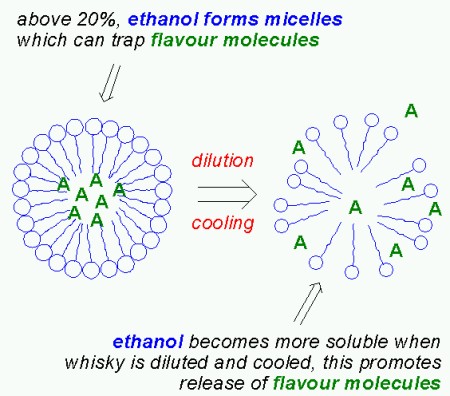
http://blog.khymos.org/wp-content/2007/06/diluted-whisky-2.jpg
Ethanol micelles (from blog.khymos.org)
On the other hand, ethanol forms micelles trapping hydrophobic compounds at over 23% abv. Addition of water opens up these ethanol micelles and releases some of these hydrophobic compounds but also increases the surface tension of the solution. The short chain esters (fruity, solventy, glue) are usually more volatile and evaporate in proportionally larger amounts than the long chain esters (fruity, soapy). The oak solubles in turn increase the surface tension especially at high ethanol concentrations, decreasing the overall evaporation.

Effect of ethanol concentration on the maturation of cognac (Cantagrel & Galy 2003)

Cutty Sark Scotch 1977 Ad - Water of Loch Katrine
Cutty Sark ad from 1977
It probably makes a difference whether the dilution is made prior the cask filling, just before bottling or in the glass. Theoretically, the dilution before casking might produce a sweeter, cleaner and less fruity and bitter-oaky spirit. The cognac producers usually add water or lower abv spirits just a small amount at the time, probably to avoid sudden changes in ethanol-water equilibrium. Dilution before bottling might have some dimishing effect on the sugars and some volatile off-notes such as glue and acetone, while probably increasing the proportional amount of linalool-oxides and bitter woody off-notes. Dilution in the glass, especially below 23% abv would release more of the hydrophobic aromas, such as esters with fruity, but also solventy and soapy off-notes.

References and further reading
Conner JM, et al. Release of distillate flavour compounds in Scotch malt whisky. J. Sci. Food Agric., 1999; 79; 1015–1020
Conner JM, et al. Agglomeration of ethyl esters in model spirit solutions and malt whiskies. J. Sci. Food Agric., 1994; 66; 45–53
Conner JM, et al. Interactions between ethyl esters and aroma compounds in model spirit solutions. J Agric Food Chem 1994;42;2231-4
Conner JM, et al. Contributions of distillate components to disperse phase structures in model spirit solutions. J Agric Food Chem 1998;46;1292-6
Lea GH, Piggott JR. Fermented beverage production 2nd ed. Kluwer Acad 2003.
Piggott JR, et al. The influence of non-volatile constituents on the extraction of ethyl esters from brandies. J. Sci. Food Agric., 1992; 59: 477–482
Reazin GH. Chemical mechanisms of whiskey maturation. Am J Enol Vitic 1981;32;4;283-9
Ross, J. Whisky. Routledge & Kegan Paul Books 1970
Udo M. The Scottish whisky distilleries. Black&White Publishing 2006.Taylor AJ, Mottram DS. Flavour Science: Recent Developments. Woodhead Publishing 1996.

Saturday, April 9, 2011

Cask sizes

Just a quick table about cask sizes.

Cask

Litres Imperial gallons US gallons

Bourbon barrel 159 (official barrel)

42 size varies 150-220l, commonly 180-200l
US beer barrel 117
31
UK barrel 164 36

Hogshead 250 54

UK ale barrel 146 32

Tun 955 210
"a ton"
Sherry shipping butt 491 108
30 arrobas,56 cases of 0.75l bottles or ½tun
Bota gorda, sherry cask 600

32arrobas
Sherry puncheon 667

40arrobas
Cognac 350

varies 270-450l
Cognac shipping cask 500-600


Bocoy 600-800

Spanish wine cask
Wine barrique 225

Bordeaux barrel
UK wine shipping barrel 119 26.25

Port pipe 528 116
varies 400-800l
Madeira cask 419-437 92-96

Marsala pipe 396 87

Marsala hogshead 200 44

Rum puncheon 410-455 90-100

Kilderkin 82 18
½ UK barrel
Firkin 41 9
Quarter of UK barrel
Bloodtub 34 7,5

Whisky quarter cask 125 27
½ hogshead
Whisky octave 46 10

Whisky puncheon 387-500 85-110
staves from 2 barrels

References:
Calabrese S. Cognac, liquid history. Cassell&Co 2001
González Gordon M. Sherry. Cassell Ltd 1972 
Kilby, K. The cooper and his trade. John Baker Publishers Ltd 1971
Rainbird G. Sherry and the wines of Spain. 1966

Saturday, March 5, 2011

Rejuvenation

Scotch whiskies are predominantly matured in ex-bourbon casks. The previous filling with bourbon extracts much of the flavours, but there is still a lot left for the refills, too. The water-soluble extracts seem to exhaust faster than the lignin-derivatives or the lipid-solubles, although the filling strenght does influence extraction rates. For example oaklactones and soluble oaktannins, especially ellagitannins are largely depleted during the bourbon fill and the first Scotch fill. By extending the maturation period it is possible to create whiskies with considarable oak flavours, although the proportions of flavour compounds tend to differ from the first fill maturations (see table 1 below).


Table1. Extracts from ex-bourbon casks used for Scotch malt whisky. From left: 1st, 2nd and 3rd/more refill (modified from Piggott&Conner 2003)´


Lignin does break down in presence of alcohols, but most of the linkages are resistant to ethanol. Therefore lignin does not degrade completely even in the presence of high filling strenghts during long maturation, but the release of monoligninderivatives tends to slow down considerably leading to an exhausted cask. The relative absence of guaiacol ja syringyl compounds is thought to be a good marker for cask exhaustion. The guaiacol concentrations are probably quite similar to those of ferulic acid concentrations shown in table 1 and the amount of syringic acid is likely to represent the amount of total syringyl compounds (for information on lignin construction see previous blog 15.2.2011).

Exhausted casks can be rejuvenated by scraping the inside of the cask, removing the used wood and bringing new wood in contact with the spirit. Untoasted wood however gives green and raw aromas and scraped casks are usually toasted or charred again. Recharring might impart too much colour and change the aromas towards bourbon-style whiskies and therefore retoasting in apparently preferred in Scottish cooperages. Regenerated recharred casks differ considerably from ex-bourbon casks used for the first fillings with Scotch. In table 2 are presented the sensory profiles of 3 year old grain whiskies matured in refill bourbon casks compared to decharred recharred exhausted ex-bourbon casks. The recharred casks seem to produce more sweet and woody notes as refill casks tend to bring out the drier woody notes. In terms of flavour compounds the recharring promotes fast lignin breakdown and caramellisation of hemicellulose thus extracting considerably more guaiacols, isoeugenol and vanillin commonly associated with new wood barrels. Surpisingly the concentrations of oaklactones are only slightly greater in recharred casks compared to refills. Perhaps oaklactones are already extracted from the deeper layers of the wood exceeding the scraping depth in rejuvenation and the recharring affects primarily wood layers that are already poor in oaklactones. Another possible explanation is the lack of seasoning of rejuvenated casks after the scraping which might lead more green wood notes and less oaklactones. A recharred cask with more guaiacol and vanilla extractives is more likely to promote smoky and sweet flavours of the spirit than a refill cask, although the sweet notes differ from those of the first fills as they are probably caused more by caramellisation products and vanilla than oaklactones. The charred layer is likely to remove some of the off-flavours, especially some sulphury aromas, but as seen in table 2 toasting also considerably reduces suphury aromas, so the filtration by active carbon layer might not be the only explanation for this.

A common practice during the 20th century was to season the rejuvenated casks as well as some of the new casks with pajarete to create a sherry-cask profile. The first intentional wine-treatments were made in 1880s and the last larger scale treatments in the whisky industry were terminated prbably during the 1980s.
A recent develepment has been a treatment of exhausted casks with salt catalyst before recharring or retoasting; this "curing" increases the extraction from rejuvenated casks (tables 2&3 below). The salt solution probably increases the heat influence in deeper layers of wood especially during medium heating (toasting). It is also likely that salt increases the solubility of extractives into spirit, although the precise mechanism is not yet described.


Tables 2 and 3. Sensory profiles of 3 year old Scotch grain whiskies matured in different ex-bourbon casks (brutal modification from Reid KJG et al 2008, sorry...)
Rejuvenated casks are not particulary appreciated by malt whisky aficionados, but they probably are of good use in maturing young grain whiskies as they remove effectively some of the common off-notes associated with new make spirits. Also lighter style malt whiskies might benefit from a subtler cask influence lacking especially the overly sweet oaky notes.

REFERENCES
Boudet AM et al. Biochemistry and molecular biology of lignification. New Phytol 1995; 129; 203-236 
Conner JM et al. Changes in wood extractives from oak cask staves through maturation of scotch malt whisky. J Sci Food Agric 1993;62;169-174
Clyne J et al. The effect of cask charring on scotch whisky maturation. Int J Food Sci Tech 1993;28;69-81
Lea GH, Piggott JR. Fermented beverage production 2nd ed. Kluwer Acad 2003.
Mosedale, JR. Effects of oak wood on the maturation of alcoholic beverages with particular reference to whisky. Forestry 1995; 68; 3; 203-230
Piggott JR, Conner M. Whiskies. In Fermented beverage production. Kluwer Acad 2003.
Piggott JR et al. Effects on scotch whisky composition and flavour of maturation in oak casks with varying histories. Int J Food Sci Tech 1993;28;303-318
Reid KJG et al. Understanding and enhancing cask performance. The Scotch Whisky Research Institute 2008.
Russell I (ed). Whisky, technology, production and marketing. Academic Press 2003.
Viriot C et al. Ellagitannins and lignins in aging spirits in oak barrels. J Agric Food Chem 1993; 41; 1872-1879

Sunday, February 27, 2011

Cask variations

A range of different casks are used in Scotch whisky maturation. Before 1990 the casks were allowed to be of any wood, although only an odd chestnut cask has probably been used as most casks were made of oak. Now all casks have to be made of oak wood. Most casks are refill casks from bourbon industry made of Q.alba and to a lesser extent casks previously used to mature sherry (mostly Q.alba, sometimes Q.robur), port (Q.alba, Q.robur, Q.pyrenaica), wine (mostly Q.petraea), rum (mostly Q.alba) or even cognac (Q.robur). The first filling extracts much of the flavour compounds from the oak as most of free solubles are extracted during the first year of maturation. Spirits with higher filling strenghts reach deeper into the wood and extract more alcohol-soluble congeners, such as lactones, lipids, fatty acids, lignin-derivatives, phenolic acids and aromatic aldehydes. Lower strenght beverages and even fortificated wines extract more water-soluble components, such as tannins, glycerol and sugars. Esters are extracted practically evenly despite different ethanol concentrations. The breakdown of lignin continues as maturation is prolonged and more extractives are available at a considerably slower rate, higher alcohol-strenghts increasing the ligninolysis.

The high lactone-content explains the heavy sweet coconut aroma of bourbons, but the aroma is toned down in the refill casks as the lactones are largely depleted in the first fill with spirit. Wine extracts lactones too; a six month wine maturation decreases the extraction of oak lactones to about 30-40% in the second fill. The average oaklactone concentration in a new Q.petraea cask is about the same as in a wine-refill Q.alba and a bourbon-refill Q.alba is very likely to be much poorer in oaklactones. Trans-oaklactones extract themselves more easily during the first fill, so the cis-trans ratio is likely to be greater in refill casks, producing more spicy than sweet oak flavours. Q.robur is usually very poor in oaklactones even in a new wood cask, but Q.crispula (Japanese oak) is very rich in oaklactones, especially the cis-isomer, giving rise to spicy incence oak aromas, which are often further fortified with a sherry-treatment before filling in the whisky. Toasting increases the amount of lactones and although heavy charring diminishes the lactone-concentrations, the increased permeability through charred wood usually increases the total extraction into the spirit.


Spicy tannins and vanillins are typical for Q.robur and Q.crispula, but their concentrations in Q.petraea seem to vary considerably, although some of the "odd" single results might be explained by hybridization with Q.robur or other oak species. Seasoning of the staves is preferred in Europe instead of kilning, probably due to more astringent and tanninic taste profiles of the European oaks compared to Q.alba. Tannins soften during seasoning by the effects of rain, bacteria, yeasts and oxidation. Vanillin, eugenol, furfural and cis-oaklactone are reported to decrease in colder climate and increase in hot climate seasoning, but this may be also partly explained by different microbes present in Australia compared to those in France and the USA.

Smoky and spicy guaiacols are created from lignin in toasting/charring and through ethanol-induced lignification during maturation. Higher temperatures increase the guaiacol-concentrations which are likely to enchance the smoky flavours in whisky. Especially 4-vinylguaiacol is very soluble in spirits and is usually depleted fast in the first fill. Guaiacols can be generated through ligninolysis and extracted into refills too at a slightly slower rate. Furfurals (caramel, burnt sugar) are also created by heating and quite rapidly extracted in the first fill.

The colours extracted from the oaks are different, as Q.alba and Q.crispula are usually red, Q.petraea is usually lighter, almost pink in colour and Q.robur extracts a strong yellow colour. Again, charring decreases the colour extractives in the surface layer but because of the increased permeability it usually adds to the typical red/orange colour typical of bourbon.

The East European Q.robur is usually a bit closer to Q.alba in terms of the flavour compounds as it contains usually more oaklactones, eugenols and vanillin but less tannins than Q.robur from France or Spain.


The cask absorbs some of the spirit or wine used in the first fill. A large bodega butt can gain up to 25kg in weight during several decades of solera maturation and it is very likely that such cask would impart quite a lot of sherry aromas to a refill spirit regardless of the oak species used. A barrel sized cask (usually 180l) soaks about 9 litres of 50% abv whisky during a bourbon maturation. A typical wine cask is used for 5 years and several refills and is likely to absorb several litres of wine. Some of the liquid used in the first fill are bound to enter the refill whisky, but the magnitude is not known. Recharring the cask before a refill burns most of the alcohols and probably flavours previously absorbed by the wood, but re- or decharring is apparently not an usual practice for first (scotch) fill bourbon casks. Rinsing of a cask is not likely to remove significant amounts of the previous liquid soaked into the wood. If a cask has been used in fermentation of wine, it is likely to lose some weight, probably because of the wood degradation by the yeasts. It is believed that the fermentation yeasts remove some of the bitter tannins and other undesired aromas from a wine cask, although not much wine is fermented in casks anymore.

The size of the cask affects the result too, larger casks having less wood surface and headspace per spirit volume. Spirit in smaller casks mature faster but suffer from greater oxidation per volume. Smaller casks impart probably more sugars, glycerol, eugenol and galloyl esters but less lignin-derivatives, vanillin and ellagitannins and this may result in relatively sweet and spicy aroma profile different from the profiles of the larger casks.

In conclusion, the new wood casks impart the most sweet oak, coconut, caramel and smoky aromas as the refills tend to be drier, subtler but still quite tanninic. The cask maturation is very rapid in first fill casks during the first months as the maturation in refills is usually more linear and predictable, although significantly slower. Different oaks have very different tasteprofiles and the strenght and the aromas of the first filling does affect the refill maturation of whisky. Seasoning softens the astringent aromas as kilning increases the sweet aromas but does not affect so much the tannins. Below is a table showing the main differences between the species considering whisky maturation.


Q.alba
Q.robur
Q.petraea
Q.crispula
ring width
+++
+++
+
?
oaklactones
+++
+
+(++)
+++
-cis
(+)
(+)
++
+++
-trans
+++
+
+
++
eugenol
+(+)
++
+
?
vanillin
+(+)
++
+(++)
+++
furfural
+
+++
++
+++
tannins
(+)
+++
+
++(+)
roburins
(+)
+++
+
?
phenolics
+
+++
++
?
colour
red
yellow
pink
red
tyloses
+++
+
++
(+)


seasoning
kilning
toasting
charring
oaklactones
+
(+)
++
+++
eugenol
-
+
+++
++(+)
vanillin
++
+
+++
++(+)
furfural
++
+
-(+)
+
tannins
---
-
---
-
roburins
---
-
--
-
guaiacols
(-)
(+)
++
++
colour
-
(+)
+
++

References:
Cutzach I et al. Identification of volatile compounds with a toasty aroma in heated oak used in barrelmaking. J agric food chem 1997;45;2217-2224
Doussot F, De Jeso B, Quideau S, Pardon P. Extractives content in cooperage oak wood during natural seasoning and toasting; influence of tree species, geographic location and single-tree effects. J Agric Food Chem 2002; 50; 5955-5961
Gallagher et al. Whisky losses during aging. Ind Eng Chem 1942; 8; 992-995
Garde-Cerdàn T et al. Effects of composition, storage time, geographic origin and oak type on the accumulation of some volatile oak compounds and ethylphenols in wines. Food Chem 2010; 122; 1076-1082
González Gordon M, Sherry. Cassell Ltd 1972
Gomez Plaza E et al. The effect of successive uses of oak barrels on the extraction of oak related volatile compounds from wine. Int J Food Sci Tech 2004;39;1069-1078
Gougeon RD et al. Expressing Forest Origins in the Chemical Composition of Cooperage Oak Woods and Corresponding Wines by Using FTICR-MS. Chem. Eur. J. 2009, 15, 600 – 611
Gougeon RD et al. The chemodiversity of wines can reveal a metabologeography expression of cooperage oak wood. PNAS 2009; 106; 23; 9174-9179 Mangas J et al. Volatiles in distillates of cider aged in american oak wood. J Agric Chem 1996; 44; 268-273
Martinez J et al. Effect of the seasoning method on the chemical composition of oak heartwood to cooperage. J agric food chem 2008;56;3089-3096
Monica Lee KY, Paterson A, Piggott JR. Origins of flavour in whiskies and a revised flavour wheel. Review. J instit brew 2001; 107; 5; 287-313
Mosedale JR, Puech JL. Wood maturation of distilled beverages. Trends in Food Sci Technol 1998; 9; 95-101
Mosedale, JR. Effects of oak wood on the maturation of alcoholic beverages with particular reference to whisky. Forestry 1995; 68; 3; 203-230
Mosedale, JR. Variation of the flavour and extractives of european oak wood from two french forests. J Sci Food Agric 1996; 70; 273-287
Mosedale JR, Charrier B, Crouch N, Janin G, Savill PS. Variation in the composition and content of ellagitannins in the heartwood of european oaks. Ann Sci For 1996; 53; 1005-1018
Perez Coello MS et al. Analysis of volatile components of oak wood. J Chromatograph 1997;778;427-434
Prida A, Puech JL. Influence of geographical origin and botanical species on the content of extractives in american, french and east european oak woods. J Agric Food Chem 2006;54;8115-8126
Prida A, Ducousso A, Petit RJ, Nepveu G, Puech JL. Variation in wood volatile compounds in a mixed oak stand: strong species and spatial differentiation in whisky-lactone content. Ann For Sci 2007; 64; 313-320
Prida A et al. Relation between chemical composition of oak wood used in cooperage and sensory perception of model extracts. J Sci Food Agric 2009;89;765-773
Spillman PJ, Sefton MA, Gawel R. The effect of oak wood source, location of seasoning and coopering on the composition of volatile compounds in oak-matured wines. Aust J Grape Wine Res 2004; 10; 216-226
Viriot C et al. Ellagitannins and lignins in aging of spirits in oak barrels. J Agric Food Chem 1993;41;1872-2879
Withers SJ et al. Comparison of Scotch malt whisky maturation in oak miniature casks and american standard barrels. J Inst Brew 1995;101;359-364