Showing posts with label caramel. Show all posts

Saturday, December 10, 2016

Sugars in whisky

There are small amounts of sugar in all whiskies. Scottish whiskies have some sugars dissolved from the oak cask and often some from optional caramel colouring (E150a). Total amount of sugars is quite low, usually well below 1 g/l, but in certain cases it is quite possible to reach a few grams per liter. The sweet aromas of whisky matured in refill bourbon or new oak casks mostly come from sweet aromatic vanillin and fruity esters, not from the sugars. However, sugars can have a significant role in the case of casks previously used for sweet wine or sweetened spirit.

Typical composition of a liquid E150a colouring
Sugar gets to whisky from the oak cask used in maturation and its possible previous contents, especially sweet wine, and often from optional caramel colouring. New make spirit does not contain significant amounts of any sugars and it is not legal to add sweeteners to Scottish whisky, Irish whisky or bourbon, unlike to most rums, other American whiskies, Canadian whiskies, cognac, armagnac, vodka and so on. However, caramel colouring is an allowed additive in Scotch whisky. The E150a colouring used in whiskies consists of mostly of water (30-50%), carbohydrates (50-70%) and ash (0-4%), depending on the manufacturer. The colour comes mostly from furans and furfurals, mainly 5-hydroxymethylfurfural (5-HMF). The carbohydrate composition varies a lot, but usually the amount of simple sugars (mono- and disaccharides) is about 10-20% of the total volume and about 20-40% of the total carbohydrates. Caramel colouring as such is not sweet but rather bitter, although it probably enchances the perception of vanillin and some other sweet notes while supressing some sulphury notes. The amount of caramel added to whisky is usually well below 1 g/l, but there is no legal upper limit, although 2g/l of E150a (0,2-0,4 g/l simple sugars) would render the whisky very dark. In one independent study the highest caramel solids amount found in a Scotch whisky was 0.97-1.10 g/l (simple sugars ~0.2-0.4 g/l) depending on the analysis method (I suspect L*******g, but no names) and the average amount was 0.278 g/l caramel (from 0.01 to 1.10 g/l). According to Valaer in 1940 there was a legal maximum of one pint of liquid caramel per barrel of whisky permitted by the British Customs and Excise Regulations (0.15% or about 1.5 g/l).
Caramel content of various whiskies (Boscolo et al 2002)

Another source of sugars in whisky is wood. Oak is composed of three main macromolecules; cellulose is a long-chain D-glucose-fiber. Hemicellulose is a mesh-like branched chain of 5-carbon sugars (xylose, arabinose, galactose, ribose, rhamnose) and glucose. Lignin is a complex matrix of polypropane and polyphenols. Cellulose breaks down very slowly in alcohol-water solution extracting very small amounts of glucose to whisky. Most sugars extracted from the cask come from hemicellulose, hence most of them are 5-carbon sugars. Arabinose, xylose and rhamnose taste about half as sweet as glucose, where as fructose is almost twice as sweet compared to glucose.

About 100 mg/l of solids (including sugars) is extracted from new charred oak casks during the first year of bourbon maturation and after 1-3 years typically significantly less and only as little as 4 mg/l/year extraction has been reported from old refill casks used for example for cognac (or Scotch) maturation. A toasted cask extracts considerably more sugars compared to a charred cask, but typically about 150-250 mg/l/year is reached for the first year(s) of maturation. For comparison, a 40 years old brandy matured in a toasted oak cask had 2 g/l sugars (averaging 50 mg/l/year), while a 30 years old cognac (probably mostly matured in a refill casks) had only 0.5 g/l (17 mg/l/year).

Sugars dissolve in water better than in ethanol, so for example 55% ethanol-water solution can extract almost two times more sugars from the wood compared to 70% abv solution. The difference between 40% abv and 15% abv seems to be just about significant, so the alcohol strength is probably important only for high proof spirits. High entry proof is likely to significantly diminish the sugar extraction. Toasting and especially charring of the oak lowers the amount of extractable sugars, converting them to for example furfurals ("caramel"). On the other hand, charring contributes to sweetness by increasing the formation, extraction and perception of other sweet-tasting compounds, especially vanillin.
Analysis of different spirits by GC-MS (Savchuk 2001) Note the high levels of vanillin from new charred casks.
Probably the most important factor considering the amount of sugars in Scotch is the previous content of the cask. The most usual type of cask, the ex-bourbon cask would impart minimal amounts of sugars, often well under 50 mg/l/year and overall well below 1 g/l even during a long maturation, usually in the range of few hundreds of milligrams per liter. The charred American oak cask used for bourbon is quite low on sugars to start with and the bourbon will extract a major part of the available sugars. A toasted cask previously used for cognac, armagnac, brandy of other non-sugared spirit could extract slightly more, but most likely still not over amounts 1 g/l during refill maturation.

Venezuelan rum, 40 g/l sugars
Rum can, and often does, contain added sugar or other sweeteners. Most sweetened rums are sugared at the bottling phase, but sometimes sugar (or molasses, cane juice, fruit etc) has been added already into the cask and some of that sugar is bound to get into a ex-rum refill Scotch. Up to 40 g/l sugar contents are commonly reported in rum (100 g/l in spiced rums), but the amount of sugar added directly to cask is likely to be in the range of 5-20 g/l.

Pedro Ximenez sherry,
 470 g/l sugars
Significant amounts of sugar can be extracted from a sweet wine cask. Sherry is by far the most used ex-wine cask in the Scottish whisky industry. Most sherries, such as fino, manzanilla, amontillado, palo cortado and most olorosos, are dry wines (0-5 g/l sugars) and add only little sugars to the cask, some might even extract more than impart. Most sweet blended sherries (cream, dulce, sweet olorosos) are often blended with sweet must prior to bottling, not in maturation casks. The sweetness perceived in the olorosos often comes from high amounts of glycerol, not as much from sugars. A notable exception is Pedro Ximenez wine, which nowadays is vinified almost exclusively in Montilla-Moriles. It is a sweet wine produced from late harvested dried PX grapes and it typically contains by law over 212 g/l sugars. It is quite sweet even compared to other sweet wines, such as port (usually 100-150 g/l), Sauternes (100-200 g/l), Tokaji (60-500 g/l) or icewine (180-320 g/l).

The Scotch whisky industry has preferred sweet sherries for seasoning of their whisky casks from the 19th century and while most modern sherries are quite dry, most ex-sherry whisky casks were used for (or seasoned with) sweet sherries. In the 1800s and the early 1900s sweet(ened) sherries were imported to Britain in shipping casks. Britain was a major importer of sherry and emptied shipping casks were often used for maturation of Scotch whisky. By the late 19th century sherry casks were used extensively in Scotland and the first attempts to rejuvenate or season used casks were made in the 1890s. After the sherry casks were used for Scotch whisky maturation, they were seasoned with sweet sherry or paxarette, sometimes using pressure to soak the wood with the wine. By the early 20th century the use of sherry casks was quite wide spread, for example in the late 1920s a big whisky blender Johnnie Walker matured all of their whiskies in sherry casks or sherry-treated casks.
Aberlour 18yo
sugars <2 g/l

Shipping casks were mostly Spanish coopered lightly toasted American oak (Quercus alba) butts or puncheons (often called bocoyes in Spain). In 1972 Manuel González Gordon stated that "in recent years some Spanish oak has been used, due principally to the difficulties of importing American timber, but its greater density and hardness and lower porosity make it less suitable than the American wood". In the 19th century and the early 20th century they were often used for fermentation prior to shipping. Oak influence was not that detrimental for sherry during fermentation period and the fermentation process was believed to extract some of the excess tannins and bitterness from the wood prior the use in a solera or shipping.

The fermentation phase added plenty of sugars to the oak. For example, a typical 1980s (arguably Spanish oak, but at least Spanish coopered oak) shipping cask previously used for fermentation extracted 2.25 g/l sugars to whisky during only 6 years of maturation (375 mg/l/year). On the other hand an American ammonia-treated cask without a previous fermentation use would extract 770 mg/l (154 mg/l/year) sugars from a fino-seasoned cask and even less 655 mg/l (133g/l/year) from a similar oloroso cask. According to the table below, the previous use as a fermentation cask is very significant in the terms of sugar extraction.
JM Philp 1989
Ardbeg Dark Cove
4 g/l sugars
The most important factor considering the sugar extraction is probably the sweetest liquid to occupy the cask previously. According to Manuel González Gordon "large solera butts which have been used for years in a solera sometimes gain up to 25 kilos" in weight. In case of fermenting must or sweet wine, the refill cask can extract at least up to about 400 mg/l/year sugars. A typical sherry treatment used for Scotch whisky casks used in the 1890-1970s was made with about 35 litres of paxarette or sweet sherry per hogshead, but even with a relatively high pressure only a small part of the wine was absorbed into the cask. If we presume that as much as 5 litres of paxarette (375 g/l sugars) was absorbed into a hogshead and half of its sugars (just a figure from top of my hat) was extracted to the whisky, it would have resulted into 1875 g/ 220 litres = about 4.3 g/l of sugars, with a hypothetical gram or two from the cask itself could theoretically bring the sugar content up to 6 g/l during a very long maturation, say an average of 300 mg/l/year for 20 years. If were take a purely fictional solera butt used for an extremely sweet PX-wine (400 g/l) with 25 kg of PX wine absorbed into the cask and then used for whisky maturation, it could mean 10 kg of sugars in the cask and with a purely fictional extraction of about half of the sugars would result roughly to the amount of 9 g/l sugars into the whisky in an extreme(ly long) maturation from an extreme cask. It is probably safe to say that most spirits with over 10 g/l sugars contain additives and most spirits with over 2 g/l were matured in ex-sweet wine casks. Nowadays the sherry casks used in the whisky maturation are no longer used for fermentation or exposed to high-pressure paxarette/PX-treatment. The seasoning sherries are probably mostly medium oloroso/raya sherries with a sugar content in the range of 0-100 g/l, so a typical sugar extraction from that kind of cask could be in the range of 100-300 mg/l/year and diminishing through maturation, resulting to a maximum of a few g/l sugars into a modern whisky even during decades in a cask.

REFERENCES AND FURTHER READING:
Alañón ME et al. Monosaccharide anhydrides, new markers of toasted oak wood used for ageing wines and distillates. Food Chem 2010;119;505-512
Blanco Gomis D et al. Evolution of sugars in cider brandy aged in oak barrels, a contribution to its characterization. J Agric Food Chem 2003;51;923-926
Boscolo M et al. Spectrophotometric determination of caramel content in spirits aged in oak casks. J AOAC Int 2002;85(3);744-750
Boudet AM et al. Biochemistry and molecular biology of lignification. New Phytol 199;129;203-236
Clyne J et al. The effect of cask charring on Scotch whisky maturation. Int J Food Sci Tech 1993;28;69-81
González Gordon M, Sherry. Cassell Ltd 1972
Haldane FF. Casks; their manufacture and treatment. J Inst Brew 1906;12(7);688-711
Hills, P. Appreciating whisky. Collins 2000
Kansallisarkisto, Helsinki. http://www.arkisto.fi/en/the-national-archives-service/arkistolaitoksen-vaiheet-2 
Liebmann AJ & Rosenblatt M. Changes in whisky while maturing. Ind Eng Chem 1943;35(9);994-1002
Martínez Montero C. Estudio de parámetros alternativos como indicatores del envejecimiento y de la calidad del brandy de Jerez. Thesis, Universidad de Cádiz, 2006
Martínez Montero C et al. Sugar contents of brandy de Jerez during aging. J Agric Food Chem 2005;53;1058-1064
Mosedale, JR. Effects of oak wood on the maturation of alcoholic beverages with particular reference to whisky. Forestry 1995; 68; 3; 203-230
Mosedale JR & Puech JL. Wood maturation of distilled beverages. Trends Food Sci Tech 1998;9;95-101
Piggott JR et al. Effects on scotch whisky composition and flavour of maturation in oak casks with varying histories. Int J Food Sci Tech 1993;28;303-318
Piggott, JR et al(ed). The Science and technology of whiskies. Longman 1989
Read J. Sherry and the sherry bodegas. Sotheby's 1988
Savchuk SA et al. Application of Chromatography and Spectometry to the Authentication of Alcoholic Beverages. J Anal Chem 2001;56(3);246-264
Tolman LM & Trescot TC. A study of the methods for the determination of esters, aldehydes and furfural in whisky. J Am Chem Soc 1906;28(11);1619-1630
Tsai PJ et al. Interactive role of color and antioxidant capacity in caramels. Food Res Int 2009;42;380-386
Valaer P & Frazier WH. Changes in whisky stored for four years. Ind Eng Chem 1936;Jan;92-105
Valaer P. Scotch whisky. Ind Eng Chem 1940;32(7);935-943
Valaer P. Foreign and domestic Rum. Ind Eng Chem 1937;Sep;988-1001
Williams JF. Rapid determination of alcohol in distilled spirits and of color in whisky. Ind Eng Chem 1926;Aug;841-843

Sunday, March 3, 2013

Pajarete and the wine treatment


Foto de  Subida al cerro Pajarete para visitar las ruinas del castillo de Matrera.
The ruins of Torre Pajarete
Castillo de Matrera, Villamartin, Andalucia, Spain
Foto www.laspain.com
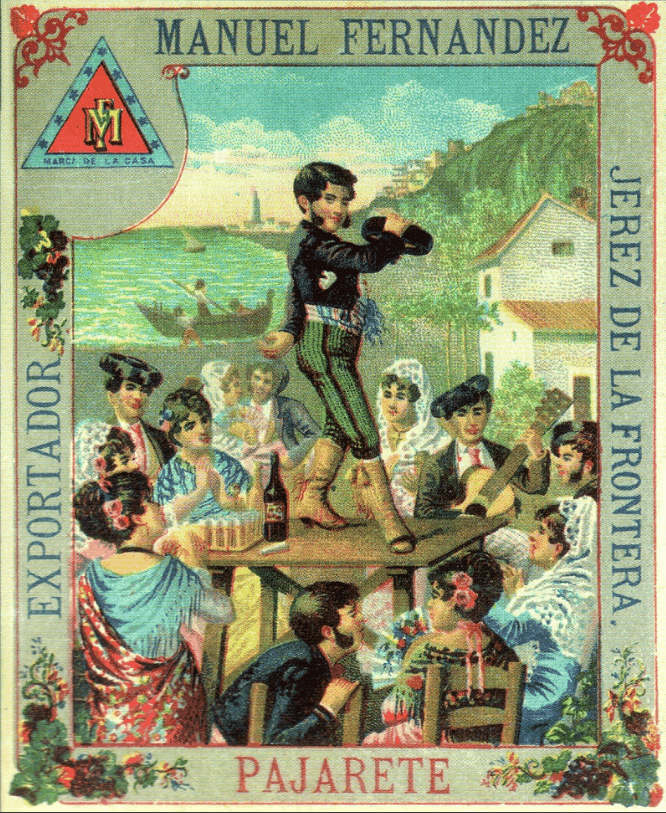
Originally pajarete (paxarete, paxaret, paxarette, pacharetti) meant the Paxarete vineyards of Cartusian Convent of San Hieronomo near Jerez de la Frontera, probably east towards Villamartin and Prado del Rey. The vineyards were planted with sweet grape varieties Millar and Pedro Ximénez grapes along with some Moscatel and Palomino. After phylloxera there is no evidence of the dark and sweet Millar variety. Sherry wines called abocado, vino seco and paxarete were made in the monastery. The first grapes to ripen were picked first and set on esparto grass mats to dry. Palomino (Listán) was picked last and pressed usually on the same or the following day. The harvest lasted for 1-3 weeks allowing the Millar, PX and Moscatel grapes to dry longer, usually about 10 days. As a result the early ripening grapes became raisined and produced natural sweet wine of 8-15% abv and about 300-400 g/l of residual sugar, which was often fortified with brandy de Jerez. Abocado was a dry oloroso style oxidized sherry (sometimes sweetened with Palomino Dulce) and Vino Seco (or Fino Seco) a dry fino/amontillado wine, both of which could be still referred as (dry) Paxarete wines in the 19th century. Similar sweet wines were made in Rota from dried Tinta grapes producing bitter-sweet dark Tintilla de Rota. Color de Macetilla or Mistela was an oloroso, which had been fortified before it fermented completely, leaving it sweet, in the style of port wines. Another similar product was mosto apagado, which was done by adding sweet mosto into the wine producing partially fermented sweet wine and usually used only in blending of sweeter sherry styles. Dulce was made by fermenting must from (mostly palomino) grapes in a cask that contained brandy; the higher alcohol stopped the fermentation before all the sugar was used, producing sweet high-alcohol white wine.
Pedro Ximénez grapes dried on grass mats

The sweet paxarete was valued highly in Spain, but in the early 19th century Britain sweet sherries were considered more of a ladies drink, men preferring drier fortified wines, beer and spirits. During the 1830s the sherry trade boomed the first time and in 1838 there were 43 registered shippers of sherry. Paxarete was one of the most expensive types, costing up to 7 times more than the cheapest real Jerez sherry (probably raya) and usually a bit more than a good aged amontillado or fino. Sherry trade reached its peak of the 19th century in the 1870s as the French strugled with vine diseases. At the same time the branding and marketing of wines by the shippers really began, which made it easier to blend different wines to be sold as sherry, including those from different regions. Blending wines with mosto (grape juice), brandy, sugar and colourings was very common and not just in the sherry business. As dried grapes were easier to transport, some paxarete was often made from grapes imported from other areas. Málaga and Montilla became major producers of pajarete sherry in the late 19th century.

Malaga Pajarete-malagaviinietikettejä; Turun Kivipaino
Malaga Pajarete from 1968,
Imported by the Finnish church
for sacramental wine
During the latter part of 19th century the English taste shifted towards lighter drier wines, partly because of the taxation and the flood of French wine into the market after 1860 as the customs embargo was dropped. Paxarete was still imported regularly and it was one of the most esteemed "malmsey" wines in Victorian Britain. Sherry barrels were used for whisky maturation probably from the early 19th century and as the blending and branding became common towards the end of the century. Sherry casks, and most likely also sherry as an additive, were used to give body to especially the lighter and younger grain spirits. Oxidized and sweet sherries such as pajaretes, olorosos, rayas and cream sherries were preferred because they gave the darkest colour and an agreeable flavour.

Pajarete was not a legally defined until 1999, so some producers from for example Málaga and California were selling pajarete/paxarete wines of their own, sometimes consisting of Pedro Ximénez wine, but quite commonly of caramel coloured, sweetened, oxidized and fortified wines. A notable imitation sherry was the very affordable Hamburg sherry, which consisted of potato spirit, caramel and spices. It was was banned in 1870 due to "health reasons". Most big sherry shippers had their own paxarete, PX or dulce brands; The Brown Bang Sherry (Sandeman), Gran Orden PX (Garvey's), Pio IX (Pedro Domecq), Delage Dulce, Osborne Paxarete and MacKenzie's Pajarete Solera. Some producers turned their raya wines (lower quality olorosos) into paxarete by maturing them outside in the sunshine, producing more cooked and concentrated wine. Vino de color, arrope or sanchoco were commonly used in blending of paxarete and cream sherries. Vino de color is any wine cooked and sometimes additionally sweetened with mosto. Sancocho is very sweet and concentrated wine boiled to one third of the original volume and arrope is thick syrup boiled to one fifth of the original volume. The tradition of boiling wines into syrups probably comes from the Moors, as they did not drink wine for religious reasons.
Arrope syrup
In the USA the boiled sweet fortified wine was classified as "Spanish-type blending sherry" by law in 1949 and manufactured mostly in California spesifically and exclusively for the whisky industry. The blending sherry was often sweetened with sugar or caramel, cooked to a reduction and infused with oak chips. It was not taxed nor was it possible to sell it as wine for consumers. Málaga and Montilla became the biggest producers of PX Pajarete wines in the 20th century Europe and Chile has its own DO Valle de Huasco producing pajarete wine. Cyprus made numerous bulk imitation sherries; the popular Cyprus Cream sherry was even sweeter than the natural paxaretes, probably due to added sugar. Imitation sherries were often colored with vino de color or caramel and fortified with industrial alcohol. The imitation sherries really stormed into the British market in the 1950s mainly in the lower price segment by agressive pricing.

Pajarete from Tarragona,
made of Moscatel and Garnacha
In 1999 Pajarete became a protected wine variety of DO Málaga and defined as "wine liquor, or natural sweet wine with a total sugar content of 45-140g/l produced without the addition of syrup [arrope], being aged and amber to dark amber in colour.". The Málaga pajarete is usually be made of Moscatel, but some Pedro Ximénez is also used. The pajarete style wines from Jerez are nowadays called PX, Pedro Ximénez, Moscatel or Dulce sherries and most of them are made according to the original soleo method.

Pajarete probably evolved from high quality sweet natural dessert wine to the blended, sweet(ened) and fortified bulk wine in the early 20th century. An affordable sweet brown sherry wine was just what the Scotch distillers were looking for, as it made possible the fast rejuvenation of whisky casks and enabled faster maturation.

WP Lowrie?
William Phaup Lowrie (1831-1916) pioneered the whisky cask management in the late 19h century. Lowrie was a merchant for both Port Ellen whiskies and González Gordon sherries, a cooper and later a co-founder of Glentauchers distillery. He was supposedly the first blender to use (sherry) wine finishes for whisky and the first cooper to import American pre-cut staves for UK cooperages. The brewers had used steam washers for new casks for decades. The process was automated already in the 1870s and it was common to use salt, hydrochloride acid, bisulphate or bicarbonate soda as additives when rinsing beer casks prior to refills. WP Lowrie introduced the steam pressure treatment to whisky industry primarily to test the integrity of casks in 1888, but soon after the steam was used also to remove harsh tannins from the fresh wood and to impregnate the wood with wine.

The wine-treatment of new casks became common in early 20th century and in 1929 it was reported that all of the new casks to be used for Johnnie Walker whiskies were seasoned with approximately 35 litres of sweet dark sherry per hogshead for 6 weeks. The casks were stored in an individual warehouse and turned regularly for even distribution of sherry into the wood. After the seasoning the casks were lightly pressurised ("with 0,2kg pressure", probably per one square inch?) and after that the remaining sherry was poured out. About 20% of the casks were said to be new, all of which apparently were UK-coopered wine-treated hogsheads made from import oak staves from the US or the Baltic. Older UK-coopered puncheons and Spanish-coopered butts were still being used as refill casks at the time.

The use of wine-treatment was introduced to save coopering costs and to ensure the availability of fresh casks as the sherry shippers had already started their own bottling plants in Spain in the early 20th century and the availability of home-emptied sherry casks was insufficient for whisky industry. Pedro Domecq started their bottling operations in Jerez in 1920 and González Byass were to follow gradually during the interwar period. Despite that, only 20 percent of sherry imports were in bottles during 1926-1940. Sandeman bottled some of their sherries and ports in location as early as 1880, but the bottling of sherry in UK by Sandeman ceased in 1969. Harvey's were the last big shipper to bottle all their sherries in England, as they bought a winery in Jerez from MacKenzie in 1970 and since then have been bottling all their sherries in Spain. In 1983 most (54.4%) of the sherries exported were bottled in Spain. The markets of EEC were easier to reach from Spain than from UK, especially after the preferential trade agreement with Spain and the EEC in 1970 and Spain's accession into EEC in 1986. Bottling of sherry is nowadays done almost exclusively (96.5% in 2000) in Spain and full sherry casks are no longer imported.

Harvey's bottling hall in the 1960s
As imported sherry casks became scarce due to the second World War in the 1940s and especially due to the increased bottling of sherry in Spain during the 1960s and early 1970s, the distillers rejuvenated the exhausted casks with pajarete. According to Philp in 1989 "a typical cooperage procedure was to add 500ml Paxarete per hogshead or 1 litre per butt, pressurise at 48 kPa / 7 psig for 10 minutes and then disgorge any absorbed paxarete.". Until 1972 the DCL also coopered their own sherry casks, which were made of American oak to a size of a puncheon (~558 l), wine-treated with paxarete and then used primarily for grain whiskies before used for malt whiskies. The American ex-bourbon barrels often received the same treatment; first fill with grain whisky, then after wine-treatment refilled with malt whisky.

Whether the Scotch distillers used real natural pajarete wine or sweetened imitations or even arrope or sancocho for seasoning is not clear, most likely they were not too fussy about the right provenance or traditional production methods concerning their "blending sherry". The typical seasoning paxarete of the 1980s was rich in tannins, esters and especially acids. A chemical analysis of different sherries by Philp in 1989 indicates that paxarette used at that point was very likely boiled and/or sweetened with arrope or sancocho as it contained 3,2 times more sugars (375 g/l), 5,7 times more tannins (4,7 g/l), 3,6 times more esters (278 g/l) and 6,9 times more acids (22 g/l) than an ordinary sweetened oloroso. In comparison the current version of Harvey's Bristol Cream has only 3,1 g/l acids and 130 g/l sugars and the naturally very sweet Don Guido 20yo PX sherry from Williams & Humbert has only 4,5 g/l acids despite of whopping 400 g/l sugars.

Photo: Albert Watson
As the Spanish sherry producers shifted from the traditional cask fermentations to use of modern steel tanks, the properties of casks changed. Fermentation was thought to remove many unwanted flavours from the fresh wood, especially bitter and sulphury off-notes. A special Gomez treatment was invented in the 1960s to simulate the effects of fermentation in the cask. It consisted of steaming the cask with ammonium hydroxide steam at 55 kPa (8 psig) for 60 minutes, which stripped much of the tannins and colour from the inner surface of the cask. This produced very neutral casks suitable for especially fino sherry maturation, but when subsequently used in Scotland they tended to produce light-coloured and slow maturing whiskies. The Gomez treatment was used from about 1965, but during the 1970s most of the Scotch distillers stopped buying these casks and began ordering their own spesified casks for whisky maturation. The casks were used for fermentations and maturation of sherries in Spain before they were shipped usually as empty standing casks to Scotland. According to the distiller's order, both American (Quercus alba) and Spanish (Q.robur) oak were used, as well as fino and oloroso sherries.

According to a rumour the Scotch Whisky Association banned the use of paxarete in the late 1980s or early 1990s, but there is no official evidence of that. The Scotch Whisky Order from 1990 bans the use of additives other than water and caramel E150a, so the blending of whisky with sherry wine including pajarete was indeed banned at that point. PX sherry casks are still quite often used especially for single malt production, but the use of sherry concentrates and high pressures in rejuvenation and seasoning has apparently ceased or at least diminished greatly. Philip Hills wrote in 2000: "wine-treatment of worn-out casks has been widely used to simulate the effects of new sherry wood... a sweet dark sherry such as pedro ximenes [sic] is introduced and the cask is pressurised in order to force the potion into the wood. For many years, a potion called paxarette was used, which combined sweet dark sherry with other flavourings and colourants... the results are not impressive: whisky from a treated cask of this sort smells slightly sulphurous and sweet, but that is all. Of the lovely aromatic flavours of a true sherry-cask maturation, there is no trace.". It is likely that the wine-treatment was dropped because of the poor results rather than an SWA order. Below is a comparison of different cask types and maturation temperatures.

Philp 1989
Oloroso and raya sherries are probably the most common seasoning sherries used nowadays, seasoning times varying from months to couple of years. Cask fermentations are rarely done in the Scotch-bound casks. The sherry bodega casks used for maturation of commercial sherries in solera systems are discarded usually after 80-100 years and sometimes  used for Scotch maturation after recoopering.

REFERENCES AND FURTHER READING:
Conner JM et al. Changes in wood extractives from oak cask staves through maturation of scotch malt whisky. J Sci Food Agric 1993;62;169-174
Crawfowd, A. Bristol wine trade. Historical association 1984
Glasgow Herald 27.5.1969
González Gordon M, Sherry. Cassell Ltd 1972
Halley, N. Sandeman: two hundred years of port and sherry. Granta 1990
Harrison, G. Bristol Cream. Batsford 1955
Hills, P. Appreciating whisky. Collins 2000
Hotelli- ja Ravintolamuseon arkisto, Helsinki.
Jeffs, Sherry. 1970
Lea GH, Piggott JR. Fermented beverage production 2nd ed. Kluwer Acad 2003
Morewood, S. A philosophical and statistical history of inventions and customs of ancient and modern nations in the manufacture and use of inebriating liquors
Mosedale, JR. Effects of oak wood on the maturation of alcoholic beverages with particular reference to whisky. Forestry 1995; 68; 3; 203-230
Mosedale JR & Puech JL. Wood maturation of distilled beverages. Trends Food Sci Tech 1998;9;95-101
Piggott JR et al. Effects on scotch whisky composition and flavour of maturation in oak casks with varying histories. Int J Food Sci Tech 1993;28;303-318
Piggott, JR et al(ed). The Science and technology of whiskies. Longman 1989
Read J. Sherry and the sherry bodegas. Sotheby's 1988
Reid KJG et al. Understanding and enhancing cask performance. The Scotch Whisky Research Institute 2008.
Sykes WJ, Ling AR. The principles and practice of brewing. Griffin 1907
Wright HE. A handy book for brewers being a practical guide to the art of brewing and malting, embracing the conclusions of modern research which bear upon the practice of brewing. Lockwood & Son 1897

Saturday, February 2, 2013

Bottle maturation (OBE)

Laphroaig 1887
Scotch whisky ages in oak wood casks for a minimum of three years, usually longer. After wood maturation it is usually diluted and colored with caramel E150a prior to bottling. After that the changes of whisky in a closed bottle are not fast or drastic, at least compared to for example the bottle maturation of wines. Some bottle maturation changes or "old bottle effects" are nevertheless possible.

The bottle maturation of wines depends mainly on the closure of the bottle. If there is enough oxygen present, for example through a porous or leaky closure, the wine becomes oxidized. If the closure tight, restricting the oxygen permeation, the wine becomes reduced. Screw caps and cork stoppers are usually the most tightest, synthetic corks are very permeable to oxygen and the permeability of natural corks is somewhere in between, although there are variations, especially among natural corks. The fastest oxidation happens in the beginning of bottle maturation as there is bound to be some residual oxygen in the wine (or spirit), the headspace between the closure and liquid and additionally the porous closures release some air into the bottle. Oxygen ingress in a screw cap sealed bottle is below 1 µL/day, a natural cork sealed bottle gets 2-6 µL/day for the first year and then 0,1-2,0 µL/day depending on the cork quality and a synthetic cork sealed bottle about 6-13 µL/d depending on the material. The main route for the air into the bottle is from between the glass and the cork. Practically all modern commercial wines are protected from excess oxidation by adding sulphur dioxide and sometimes ascorbic acid.
Oxidation affects wines

The oxidation usually decreases the amount of esters and several thiols, resulting in less citrus, grapefruit, boxtree and fruity notes. The amount of H2S (rotten eggs, bad sulphur) increases slightly during bottle maturation, but less so in an oxidative environment. If there are sugars available in the liquid, the amount of furfural (nutty, rancio) usually increases, but furanone (strawberry, fresh pineapple) usually decreases. Unknown reactions produce notes of wet wool, toasted bread and caramel. Most phenols oxidize slowly, usually forming polyphenols, resulting in diminished astringency and probably less peaty whisky over years of bottle storage. An exeption in the phenol group is vanillin, which increases slowly independently of the oxidation/reduction state. Serious over-oxidation in wines creates vinegar and in considerable evaporation of alcohol out of spirit proof liquids.

In the absence of oxygen, the wine is reduced, forming significantly more esters (fruits), higher alcohols (floral, aetheral), abhexon (peach) and sulphur volatiles (struct flint, rubber), especially H2S (rotten eggs), but also thiols and polythiols (petrol, kerosine), apparently from sulphates, sulphites and phenols.

Independently of the oxidation, tannins and antocyanins form bigger molecules, which stabilize the colour and usually turn reddish colours into orange, bricklike hues. Oaklactones tend to partially transform from trans- (spicy, incence) to cis-isomers (coconut, vanillin) in the bottle.
The cork stoppers act as a sorbtive material, especially if they are coated with polyethene and allowed to soak with the liquid. As a result the sulphur odors, especially H2S and small thiols are reduced. On the other hand uncoated corkstoppers are more likely to leak H2S and other volatiles out of the bottle. Screw caps do not have a significant effect on the H2S. A faulty bottle closure or prolonged storage of  opened bottle with a low amount of spirit left leads to evaporation of alcohol and oxidation of the spirit. In that case the filling level is likely to drop and the amount of esters, small thiols and other volatiles to diminish. Bottle breathing, ie leaving the bottle open overnight or half-empty with the cork for months, might therefore cure some sulphur taints, at the cost of reduced fruit and body. 

The glass bottle itself is not completely inert. Especially alkaline high-alcohol solutions (vodka for example) increase the leaching of glass. This happens especially if the bottles are stored for a long time (months) in a humid environment before bottling, allowing water to attach to the inside of the bottle. Bottle glass is composed mainly of silica (SiO2, 75%), sodium oxide (Na2O, 15%), calcium oxide (CaO, 12%) and aluminum salts (2%). First, the water condensed from the humid air causes mainly sodium to leach out of the glass (a damp bottle storage before bottling increases the corrosion) and the increased alkalinity increases the leaching of silica, forming salts of silicic acids. Then ethanol in turn increases the solubility of  inorganic acids. As a result a deposit is created in the bottle, it consists first of sodiumhydroxide (NaOH) and sodiumhydrosilicate (Na2O x SiO2), but it polymerizes into an amorphic gel-like structure (for example H2SiO3 + CaO SiO3 + H2O) consisting in average of CaO (43%), SiO2 (43%) and Na2O (14%). At the process also some metals from the glass structure are leached out. The glass leaching increases the pH of the spirit, for example in one study with vodka the pH increased from 8,85 upto 9,50, which is probably significant for flavour release, too. In the same study the weight of dried crystals was 0,5-2,1 mg per 0,7 litre bottle. As the surface/spirit ratio increases as the bottle size dimishes, the miniature bottles are certainly more prone to impart sediments. As whisky is more acidic than vodka, this is most likely a very slow reaction, happening in older lowgrade and/or miniature bottles during decades rather than months and especially if they have been stored for a while before bottling.

Lagavulin 1875
In a bottle of whisky, the same reactions are likely to happen, although the higher ethanol strength diminishes the oxidation, as ethanol is an oxygen scavanger itself. The oak extracts and the ethanol micelles diminish the extraction of volatiles from the spirit by increasing the surface tension. Most likely the bottle maturation of whisky is more reductive than oxidative, producing more fruity, aetheral, peachy, vanilla, petrol, rubbery and metallic notes and less phenolic, bitter spicy and citrus notes. Rancio flavours might arise from pentose sugars derived from caramel colouring and/or a very extractive charred cask. Some oxidation reactions are bound to happen between the spirit and the air of the bottle headspace, but they are hardly significant. Long chain fatty esters and glass silica can both flocculate in the bottle, especially if the whisky is not filtered and it is diluted and/or colored with caramel before bottling. Light usually increases the speed of reactions, whether reductive or oxidative. In any case, organoleptically significant changes in bottled whisky are likely to occur during decades, if at all.

REFERENCES AND FURTHER READING
Bailly S, et al. Fate of key odorants in sauternes wine through aging. J Agric Food Chem 2009;57;8557-8563
Brajkovich M, et al. Effect of screwcap and cork closures on SO2 levels and aromas in a sauvignon blanc wine. J Agric Food Chem 2005;53;10006-10011
Cutzach I, et al. Influence of storage conditions on the nformation of some volatile compounds in white fortified wines during the aging process. J Agric Food Chem 2000;48;3240-5
Cutzach I, et al. Study of the formation mechanisms of some volatile compounds during the aging of sweet fortified wines. J Agric Food Chem 1999;47;2837-2846
Collin S, et al. Main odorants in Jura flor-sherry wines. J Agric Food Chem 2012;60;380-387
de Aquino FWB, Franco DW. Formation of dextran deposits in Brazilian sugar cane spirits. J Agric Food Chem 2001;59;8249-8255
Godden P, et al. Wine bottle closures. Austr J Grape Wine Res 2008;7;64-105
Guloyan YA, Shelomentseva VF. Study of physicochemical phenomena in evaluation of chemical corrosion of glass. Glass and Ceramics 2000;57(7-8);267-271
Jantzen CM, et al. Durable glass for thounsands of years. Int J Appl Glass Sci 2010;1;38-62
Kochetkova GV, et al. The chemical resistance of decolorized glass bottles to spirits. Glass and Ceramics 1972;29(3);186-189
Lachenmeier DW, et al. Long term stability of thujuno, fenchone and pnocamphone in vintage preban absinthe. J Agric Food Chem 2009;57;2782-5
Kwiatkowski MJ, et al. The impact of closures including screw cap with three different headspace volumes on the composition colour and sensory properties of a cabernet sauvignon wine during two years' storage. Austr J Grape Wine Res 2007;13;81-94
Lavigne V, et al. Changes in the sotolon content of dry white wines during barrel and bottle aging. J Agric Food Chem 2008;56;2688-2693
Lopes P, et al. Impact of storage position on oxygen ingress through different closures into wine bottles. J Agr Food Chem 2006;54;6741-6746
Lopes P, et al. Impact of oxygen dissolved at bottling and transmitted through closures on the composition and sensory properties of a sauvignon blanc wine during bottle storage. J Agric Food Chem 2009;57;10261-10270
Lopes P, et al. Main routes of oxygen ingress through different closures into wine bottles. J Agric Food Chem 2007;55;5167-5170
Nose A, et al. Hydrogen bonding in alcoholic beverages and water-ethanol mixtures. J Agric Food Chem 2005;53;7074-7081
Refsgaard HHF, et al. Light-induced sensory and chemical changes in aromatic bitters. Zeitschrift Lebensmittel-Untersuchnung 1996;203;47-55
Schneider R, et al. Volatile compounds involved in the aroma of sweet fortified wines from Grenache Noir. J Agric Food Chem 1998;46;3230-3237
Silva MA, et al. Scalping of light volatile sulfur compounds by wine closures. J Agric Food Chem 2012;60;10952-10956
Vanbeneden N, et al. Decrease of 4-vinylguaiacol during beer aging and formation of apocynol and vanillin in beer. J Agric Food Chem 2008;56;11983-8

Tuesday, August 30, 2011

Analysis of Michael Jackson's tasting notes

Michael Jackson
Michael Jackson (27.3.1942-30.8.2007) was the most influential beer and whisky writer of his time. He pioneered the writing of whisky tasting notes and also wrote many ground-breaking books on whisky manufacture and drinking culture. In the first edition of his most famous book, The Malt Whisky Companion (1989), he assessed 250 whiskies from 120 distilleries, a huge effort at the time. Based on his work Lapointe and Legendre (1994) studied the similarity of different whiskies. A total of 68 descriptors used five or more times in the book for describing basic malt whiskies aged circa 10 years were included in a matrix analysis to produce the dendrogram below to examine the similarities of different distilleries. Colour, nose, body, palate and finish descriptors were included. Some of the connections are quite expected, but for an average Scotch enthusiasist some are at the first glance somewhat compelling. That is probably because the descriptors are not scaled in any way and therefore the smoky notes in for example Aberfeldy and Glenugie are statistically just as strong as the smoky notes in Laphroaig. Also the amount of colouring, the cask-types and the maturation time of whiskies compared vary considerably. Anyway, despite these shortcomings, there is a highly significant correlation between the tasting notes and the geographic locations of the distilleries, especially in the 12 subgroups named from A to L. IMHO the dendrogram works pretty well in terms of grouping different styles of Scotch whiskies as well and at least is an eye-opener for some unpredicted similarities.
Lapointe 1994

The most common descriptors for each group are listed in the table below:


color nose body palate finish
A full gold fruity, salty medium oily, salty, sherry dry
B amber sweet, sherry medium, smooth dry, sweet long
C pale gold sweet, salty medium to full, oily sweet, spicy big, long, spicy
D pale gold fruity, grassy oily sweet, fruity sweet, quick
E pale wyne, gold fruity, peaty light sweet, spicy fruity
F gold aromatic medium, smooth, light sweet sweet
G gold, full gold grassy smooth, light grassy dry
H white wyne, pale sweet smooth, light sweet, dry, fruity, smoky dry, light
I gold, full gold dry, peaty medium, light, firm dry, smoky, sweet salty
J full gold dry, peaty, sherry light to medium, round sweet dry
K gold, full gold sweet, dry, peaty medium to full sweet, dry dry, long
L full gold aromatic, peaty medium sweet, smoky smoky


...and the best whiskies of each subgroup are listed here:

average best in basic malts pts best in book (1st ed) pts
A 75,3 Laphroaig 10 86 Laphroaig 15 89
B 80,0 Highland Park 12 90 Macallan 25 95
C 78,5 Talisker 10 90 Talisker 10 90
D 69,5 Auchentoshan 10 85 Auchentoshan 18 86
E 74,8 Bladnoch 8 85 Bladnoch GM1975 86
F 76,5 Springbank Cad15 88 Springbank Cad21 92
G 79,1 Cragganmore 12 90 Cragganmore 12 90
H 69,2 Bruichladdich 10 76 Glenfiddich 30 86
I 79,9 Longrow 14 90 Lagavulin 16 95
J 72,8 Linkwood 12 83 Linkwood GM25 87
K 74,0 Dallas Dhu GM1971 85 Dallas Dhu GM1971 85
L 73,3 Lochnagar 12 80 Lochnagar NAS 83

An interesting fact in MJ's tasting notes is that there is a significant correlation between colour, body, palate and nose, but the finish notes do not correlate with the classification derived from the other descriptions. As expected the correlation between the nose and the palate is extremely strong, but there is also a very strong correlation between the colour and the body (texture) of whisky, which might support the hypothesis that added caramel colouring affects the body (or mouthfeel) of whiskies.

Legendre 2004


REFERENCES AND FURTHER READING:
Jackson M: The whole bibliography.
Lapointe FJ, Legendre P. A classification of pure malt Scotch whiskies. Appl Statist 1994;43;1;237-257
Legendre P, Lapointe FJ. Assessing congruence among distance matrices: single-malt Scotch whiskies revisited. Aust N Z J Stat 2004;46;615-629
Mantel N. The detection of disease clustering and a generalized regression approach. Cancer Res 1967;27;209-220
Sokal RR, Rohlf FJ. The comparison of dendrograms by objective methods. Taxon, 1962;11;33-40
Ward JH. Hierarchical grouping to optimize an objective function. J Am Statist Ass 1963;58;236-244