Showing posts with label water. Show all posts

Wednesday, April 16, 2014

Fermentation waters

Glenlivet is one of the few Scottish distilleries using hard water,
but nobody told the AD.
Water is used in several phases of whisky production: steeping, mashing, cooling and dilution. Formerly water mills provided much of the energy needed in many distilleries as well. Distilleries have often been founded into places where water is easily available and it is believed at least in the marketing departments that fresh spring water or picturesque peaty burns play a significant role in the manufacturing process.

The most important attributes of steeping and mashing water are its hardness, pH, overall mineral content and microbiological purity.

Water hardness means the concentration of multivalent cations in the water, ie the amount of ions with a charge of +2 or more (mainly calcium and magnesium) and it is usually expressed as concentration of calcium carbonate (CaCO3) in the water. Soft water is defined as containing under 40-100 mg/l and hard water over 80-200 mg/l of CaCO3, depending on the source.

The pH (pondus hydrogenii) of water means the activity of hydrogen atoms in the water. The pH value describes the acidity of the water in logarithmic scale, ie pH 4 is ten times more acidic than pH 5 and hundred times more acidic than pH 6.

The malt or grain is another source of acidity in the mash. The darker the roast of the malt, the more acidic it gets. Therefore soft alkaline water is often preferred for brewing pale malts and hard water for darker acidic malts. The malts used in whisky production are as pale as possible to ensure the best alcohol yield. The commonly desired pH for mash is about 5-5,5, a lower pH might cause excessive lactic acid bacteria production and a higher pH a slower or incomplete fermentation. Calcium is the most important mineral affecting both the pH and water hardness. Calcium itself does not taste of anything at usual concentrations, but it lowers the pH, increases water hardness and yeast flocculation and might reduce magnesium making the flavour less sour.

Other important ions in the brewing waters are sodium (Na+) and the common anions; sulphate (SO4-2), chloride (Cl-) and carbonate (CO3-2). Sodium softens the water by decreasing the effect of CaCO3 and at higher concentrations (over 50 ppm) makes the water sweet, or even salty (>150 ppm) and sour (>250 ppm). Sulphate enhances bitter, dry and sulphury flavours, complimenting the hoppy aromas of beers and providing antibacterial influence in  both fermentation and bottle-aging, reducing the lactic acid bacteria growth. Chloride enhances malty flavour, but at high concentrations it might give pasty, salty or chlorine aromas. None of Scottish distilleries use chlorinated water for their fermentations.

The local water quality was probably one of the reasons why brewers in Burton-on-Trent and Edinburgh went for bitter highly hopped IPAs (high CaSO4), in Pilzen for light crisp lagers (extremely soft water), in Münich for darker lagers (higher CaCO3), in Dublin for dark stout (high CO3-2, low Na+ and relatively low Ca+2) and in London for dark sweet porter (high CaCO3 and NaCO3).

Ion concentrations in typical brewing waters (Maltman 2003)
All rainwater is soft, it is in the water reservoirs it acquires its hardness. The longer the water spends in rivers, lochs or underground aquifers, the more time it has to gain solubles from the ground. The geology also plays a significant part, as hard granite or quartz is less soluble than limestone or chalk and very different from young basalt. 


SpringBurn/RiverLochWellMains
ArdmoreAberfeldyArdbegAuchroiskDevanha
BalvenieAberlourAuchentoshanGlenlivetDundashill
BenriachAllt-a-bhainneBruichladdichMacallanOban
BenromachAultmoreCambusSt MagdaleneStrathdee
CardhuBalblairCameronbridgeSaucel
ConvalmoreBalmenachCaol IlaStrathisla
CraigellachieBenrinnesPort Dundas

EdradourBladnochMillburn

FettercairnBlair AtholGarnheath

GlenallachieBowmoreGlen Flagler

GlenburngieBraesIslabrae

GlencadamBroraKillyloch

GlendullanBunnahabhainKinclaith

Glen ElginCaledonianNort Port

GlenfarclasCaperdonichPort Ellen

GlenfiddichClynelishProvanmill

Glen GariochCragganmorePulteney

GlenglassaughDaftmillRiechlachan

Glen GrantDailuaineRosebank

GlenkinchieDallas DhuSpringbank

GlenmorangieDalmoreLongrow

Highland ParkDalwhinnieSpringside

LongmornDeanstonStrathclyde

MortlachGlen AlbynTobermory

PittyvaichGlendronach


Royal LochnagarGlen Esk


StrathmillGlengoyne


TamdhuGlenlochy


TamnavulinGlenlossie


TeaninichGlen Mhor


TomintoulGlen Moray


Lochside


Macduff


Mannochmore


Man O'Hoy


Miltonduff


Royal Brackla


Scapa


Speyburn


Talisker


Tomatin


Tormore


Tullibardine


Water sources for mashing, hard waters in bold (Modified from Udo, 2006)

Scotland is divided into various different geological areas basically by several southwest-northeast-lines as illustrated below.

Geological map of Scotland (www.scottishgeology.com)

Speyside and the eastern part of Islay lie on the Dalradian rocks, formed about 570 million years ago and consisting mainly of metamorphosed sedimentary mudstone (schist and quartzite) with some granite hills. The rocks are old and resistant, therefore contributing little to the water, rendering it usually very soft, slightly alkaline and low sulphur. Notable exceptions are Glenlivet and Aberlour, which lie on top of granite-rich soil containing some limestone, rendering the water somewhat harder, especially from wells. 
Geology of River Spey (www.snh.org.uk)
The Moray Firth at the Great Glen Fault there is essentially a river delta with mud and sand carried by the rivers, consisting of especially old red sandstone. The red colour comes mainly from iron, but the porous sandstone is also rich in calcium and magnesium, rendering the water in the Northern Highlands and Orkney significantly harder than in the Speyside. The water of Islay lies somewhere in between.

Typical waters from Scotland (UisgeSource)


Several American distillers believe in hard, low-iron water
However, many distilleries do process the waters they use. Apparently all the distilleries use at least ion-exchange methods for their bottling (dilution) water, but not necessarily for the reduction right after distilling (to bring the new make spirit down to 63.4% abv). None use chlorinated water for mashing or dilution nowadays. In the earlier part of the 20th century local bottling water was used and there were complaints that London water turned the whisky blue and cloudy whereas Speyside water did not, probably due to harder water of London. Although there are several breweries applying reverse osmosis (demineralization) and specifically mineralized (Burtonized) waters, these methods are not used in the distilling industry, or at least they are not made public. Water softening with resins is not used, and it could be detrimental because it tends to increase the sodium levels. Grain distilleries might benefit from hard water, as the calcium induces enzyme activity and lower malt contents and faster fermentations could be possible, although it is not entirely clear whether the mineralization of mashing waters is allowed by the law and the Scotch Whisky Association.

So, fermentation waters affect the quality of mash. The minerals themselves do not significantly distill into the spirit, but they affect the fermentation process before it. Soft water probably produces more faster fermentations and lactic acid bacteria growth generally resulting in heavier spirits, as the harder Highland waters produce cleaner and sweeter spirits. Iron is considered as a fault in brewing water and it is likely to produce less estery, fruity spirits. Zinc might do the same at higher concentrations, but is vital for yeast cells in lower concentrations. Peaty water does not provide enough phenols to render the spirit peaty, but higher amount of organics in the fermentation water does produce more esters and less higher alcohols, probably due to greater bacterial growth and yeast autolysis. Fermentation water quality is important to the quality of whisky, but in a different way it has been marketed.

Effect of brewing water to the spirit sensory quality (Wilson, 2010)


REFERENCES AND FURTHER READING
Cribb, S&J. Whisky on the rocks. Earthwise, 1998
Geikie, A. The Scenery of Scotland viewed in connection with its Physical Geology. Macmillan 1887.
Goldamer, T. Brewer's handbook. Apex, 2008
Maltman, A. Wine, beer and whisky: The role of geology. GeologyToday 2003;19;1;22-29
Palmer, J & Kaminski, C. Water, a comprehensive guide for brewers. Brewers Assoc., 2013
Scottish Natural Heritage. http://www.snh.org.uk/pdfs/consults/spey/speyreport.pdf
Wilson, CA et al. The role of water composition on malt spirit quality. Nottingham Univ Press, 2010

Saturday, February 2, 2013

Bottle maturation (OBE)

Laphroaig 1887
Scotch whisky ages in oak wood casks for a minimum of three years, usually longer. After wood maturation it is usually diluted and colored with caramel E150a prior to bottling. After that the changes of whisky in a closed bottle are not fast or drastic, at least compared to for example the bottle maturation of wines. Some bottle maturation changes or "old bottle effects" are nevertheless possible.

The bottle maturation of wines depends mainly on the closure of the bottle. If there is enough oxygen present, for example through a porous or leaky closure, the wine becomes oxidized. If the closure tight, restricting the oxygen permeation, the wine becomes reduced. Screw caps and cork stoppers are usually the most tightest, synthetic corks are very permeable to oxygen and the permeability of natural corks is somewhere in between, although there are variations, especially among natural corks. The fastest oxidation happens in the beginning of bottle maturation as there is bound to be some residual oxygen in the wine (or spirit), the headspace between the closure and liquid and additionally the porous closures release some air into the bottle. Oxygen ingress in a screw cap sealed bottle is below 1 µL/day, a natural cork sealed bottle gets 2-6 µL/day for the first year and then 0,1-2,0 µL/day depending on the cork quality and a synthetic cork sealed bottle about 6-13 µL/d depending on the material. The main route for the air into the bottle is from between the glass and the cork. Practically all modern commercial wines are protected from excess oxidation by adding sulphur dioxide and sometimes ascorbic acid.
Oxidation affects wines

The oxidation usually decreases the amount of esters and several thiols, resulting in less citrus, grapefruit, boxtree and fruity notes. The amount of H2S (rotten eggs, bad sulphur) increases slightly during bottle maturation, but less so in an oxidative environment. If there are sugars available in the liquid, the amount of furfural (nutty, rancio) usually increases, but furanone (strawberry, fresh pineapple) usually decreases. Unknown reactions produce notes of wet wool, toasted bread and caramel. Most phenols oxidize slowly, usually forming polyphenols, resulting in diminished astringency and probably less peaty whisky over years of bottle storage. An exeption in the phenol group is vanillin, which increases slowly independently of the oxidation/reduction state. Serious over-oxidation in wines creates vinegar and in considerable evaporation of alcohol out of spirit proof liquids.

In the absence of oxygen, the wine is reduced, forming significantly more esters (fruits), higher alcohols (floral, aetheral), abhexon (peach) and sulphur volatiles (struct flint, rubber), especially H2S (rotten eggs), but also thiols and polythiols (petrol, kerosine), apparently from sulphates, sulphites and phenols.

Independently of the oxidation, tannins and antocyanins form bigger molecules, which stabilize the colour and usually turn reddish colours into orange, bricklike hues. Oaklactones tend to partially transform from trans- (spicy, incence) to cis-isomers (coconut, vanillin) in the bottle.
The cork stoppers act as a sorbtive material, especially if they are coated with polyethene and allowed to soak with the liquid. As a result the sulphur odors, especially H2S and small thiols are reduced. On the other hand uncoated corkstoppers are more likely to leak H2S and other volatiles out of the bottle. Screw caps do not have a significant effect on the H2S. A faulty bottle closure or prolonged storage of  opened bottle with a low amount of spirit left leads to evaporation of alcohol and oxidation of the spirit. In that case the filling level is likely to drop and the amount of esters, small thiols and other volatiles to diminish. Bottle breathing, ie leaving the bottle open overnight or half-empty with the cork for months, might therefore cure some sulphur taints, at the cost of reduced fruit and body. 

The glass bottle itself is not completely inert. Especially alkaline high-alcohol solutions (vodka for example) increase the leaching of glass. This happens especially if the bottles are stored for a long time (months) in a humid environment before bottling, allowing water to attach to the inside of the bottle. Bottle glass is composed mainly of silica (SiO2, 75%), sodium oxide (Na2O, 15%), calcium oxide (CaO, 12%) and aluminum salts (2%). First, the water condensed from the humid air causes mainly sodium to leach out of the glass (a damp bottle storage before bottling increases the corrosion) and the increased alkalinity increases the leaching of silica, forming salts of silicic acids. Then ethanol in turn increases the solubility of  inorganic acids. As a result a deposit is created in the bottle, it consists first of sodiumhydroxide (NaOH) and sodiumhydrosilicate (Na2O x SiO2), but it polymerizes into an amorphic gel-like structure (for example H2SiO3 + CaO SiO3 + H2O) consisting in average of CaO (43%), SiO2 (43%) and Na2O (14%). At the process also some metals from the glass structure are leached out. The glass leaching increases the pH of the spirit, for example in one study with vodka the pH increased from 8,85 upto 9,50, which is probably significant for flavour release, too. In the same study the weight of dried crystals was 0,5-2,1 mg per 0,7 litre bottle. As the surface/spirit ratio increases as the bottle size dimishes, the miniature bottles are certainly more prone to impart sediments. As whisky is more acidic than vodka, this is most likely a very slow reaction, happening in older lowgrade and/or miniature bottles during decades rather than months and especially if they have been stored for a while before bottling.

Lagavulin 1875
In a bottle of whisky, the same reactions are likely to happen, although the higher ethanol strength diminishes the oxidation, as ethanol is an oxygen scavanger itself. The oak extracts and the ethanol micelles diminish the extraction of volatiles from the spirit by increasing the surface tension. Most likely the bottle maturation of whisky is more reductive than oxidative, producing more fruity, aetheral, peachy, vanilla, petrol, rubbery and metallic notes and less phenolic, bitter spicy and citrus notes. Rancio flavours might arise from pentose sugars derived from caramel colouring and/or a very extractive charred cask. Some oxidation reactions are bound to happen between the spirit and the air of the bottle headspace, but they are hardly significant. Long chain fatty esters and glass silica can both flocculate in the bottle, especially if the whisky is not filtered and it is diluted and/or colored with caramel before bottling. Light usually increases the speed of reactions, whether reductive or oxidative. In any case, organoleptically significant changes in bottled whisky are likely to occur during decades, if at all.

REFERENCES AND FURTHER READING
Bailly S, et al. Fate of key odorants in sauternes wine through aging. J Agric Food Chem 2009;57;8557-8563
Brajkovich M, et al. Effect of screwcap and cork closures on SO2 levels and aromas in a sauvignon blanc wine. J Agric Food Chem 2005;53;10006-10011
Cutzach I, et al. Influence of storage conditions on the nformation of some volatile compounds in white fortified wines during the aging process. J Agric Food Chem 2000;48;3240-5
Cutzach I, et al. Study of the formation mechanisms of some volatile compounds during the aging of sweet fortified wines. J Agric Food Chem 1999;47;2837-2846
Collin S, et al. Main odorants in Jura flor-sherry wines. J Agric Food Chem 2012;60;380-387
de Aquino FWB, Franco DW. Formation of dextran deposits in Brazilian sugar cane spirits. J Agric Food Chem 2001;59;8249-8255
Godden P, et al. Wine bottle closures. Austr J Grape Wine Res 2008;7;64-105
Guloyan YA, Shelomentseva VF. Study of physicochemical phenomena in evaluation of chemical corrosion of glass. Glass and Ceramics 2000;57(7-8);267-271
Jantzen CM, et al. Durable glass for thounsands of years. Int J Appl Glass Sci 2010;1;38-62
Kochetkova GV, et al. The chemical resistance of decolorized glass bottles to spirits. Glass and Ceramics 1972;29(3);186-189
Lachenmeier DW, et al. Long term stability of thujuno, fenchone and pnocamphone in vintage preban absinthe. J Agric Food Chem 2009;57;2782-5
Kwiatkowski MJ, et al. The impact of closures including screw cap with three different headspace volumes on the composition colour and sensory properties of a cabernet sauvignon wine during two years' storage. Austr J Grape Wine Res 2007;13;81-94
Lavigne V, et al. Changes in the sotolon content of dry white wines during barrel and bottle aging. J Agric Food Chem 2008;56;2688-2693
Lopes P, et al. Impact of storage position on oxygen ingress through different closures into wine bottles. J Agr Food Chem 2006;54;6741-6746
Lopes P, et al. Impact of oxygen dissolved at bottling and transmitted through closures on the composition and sensory properties of a sauvignon blanc wine during bottle storage. J Agric Food Chem 2009;57;10261-10270
Lopes P, et al. Main routes of oxygen ingress through different closures into wine bottles. J Agric Food Chem 2007;55;5167-5170
Nose A, et al. Hydrogen bonding in alcoholic beverages and water-ethanol mixtures. J Agric Food Chem 2005;53;7074-7081
Refsgaard HHF, et al. Light-induced sensory and chemical changes in aromatic bitters. Zeitschrift Lebensmittel-Untersuchnung 1996;203;47-55
Schneider R, et al. Volatile compounds involved in the aroma of sweet fortified wines from Grenache Noir. J Agric Food Chem 1998;46;3230-3237
Silva MA, et al. Scalping of light volatile sulfur compounds by wine closures. J Agric Food Chem 2012;60;10952-10956
Vanbeneden N, et al. Decrease of 4-vinylguaiacol during beer aging and formation of apocynol and vanillin in beer. J Agric Food Chem 2008;56;11983-8

Sunday, January 20, 2013

Alcohol strength

http://scotchaddict.com/wp-content/uploads/2009/02/just-a-drop-of-water-in-scotch.jpgScotch whisky is usually diluted before filled into casks. The usual filling strength for malt whiskies is 63,4-63,5% ABV (111 UK proof) and 68% ABV for grain whiskies. These are industry standards based probably on the history, minimizing evaporation losses and warehousing costs, but also creating an acceptable flavour profiles and uniform products for the blending industry. Bourbon and corn whiskey producers can by law fill at a maximum of 125 US proof (62,5%) and the Irish have commonly filled casks at 71%. Before bottling whisky is usually diluted to 40% or 43%.

Known unusual cask filling strengths are Aberlour 69,1% (121 UK proof), Bruichladdich (undiluted 70-72%), Port Charlotte (undiluted, probably over 70%), Glenrothes (63,5% and "some casks" undiluted about 70%) and Glen Scotia 62,5%. Bladnoch has experimented with higher and lower strengths, but apparently is now filling all the casks at 63,5%. Grain spirits are usually filled at 68%, but North British fills at 62-68% and Girvan at 74% (at least the ones going to Grant's). Most malt distilleries use 63,4-63,5% fills.Since 1848 the strength of whisky warehoused in a distillery was legally from 22 under proof (44,6%) to 25 over proof (71,4%) and the maximum strength of whisky sold out of a distillery was 111 proof, so at least the grain distillers were diluting their new make. Irish whisky was said to be warehoused at 14-16 over proof (65,1-66,3% abv) in 1808 and at the same time Scottish whisky for home consumption was taxed at 107 proof (61,1%). Illicit distillers most likely did not dilute their spirits, but the small stills and wide cuts probably did not produce much higher abv.

Ross states in 1970 that Scottish malt whisky is filled at 11-12 over proof (63,4-64% abv) and Irish pot still at 25 over proof (71,4% abv). The dilution to an uniform strength probably eased the common practice of exchanging cask between the different blenders. During the years of Scottish whisky overproduction in the late 70's and early 80's at least DCL "uncommonly" filled casks at full proof to cut cask- and warehousing costs. In the early 60's there were problems acquiring enough casks and that would probably have had the same effect on filling strengths. It is likely that dilution of malt whiskies down to 63,5% has been used at least for the most part of the 20th century. During the WW I the maximum bottling strength was temporarily (1915-16) adjusted to 35 under proof (37,2% abv). The alcoholic strength was indicated usually in Sykes proof until 1980, after that it has been replaced with alcohol per volume (abv).

Higher filling proof means savings on the casks and warehousing, but the faster alcohol evaporation and slower maturation curves favor dilution before casking. Very high proof spirits mature slower as they extract less color per absolute alcohol and especially less solids from the cask. Below 120-125 US proof (or not-so-coincidentally just below 63,5% abv?) the extraction is more even and efficient. Entry proof has an impact on the flavour profile, too. More alcohol solubles are extracted at high proofs, for example coumarins (often bitter, spicy), aromatic aldehydes (almonds, vanilla...) and terpenols (lapsang souchong, pine, resin...). 
 
Entry proof of whisky and congener extraction (Reazin 1981)
The water solubles such as sugars are extracted better at lower proofs. On the other hand, higher proof alcohol breaks the lignin and hemicellulose a bit faster to increase the amounts of sugars in the spirit.

Extraction of sugars (Reazin 1981)
Tannins, esters and fats are extracted quite evenly despite changes in the ethanol concentration, but there are some important equilibriums and reversible reactions happening in the spirit. Simplified: esters+water <=> acids+alcohol and acetals+water <=> aldehydes+alcohol. The addition of water or evaporation of alcohol results in proportionally less esters (fruit) and acetals (flowery, aetheral) and more acids, aldehydes and higher alcohols.

http://blog.khymos.org/wp-content/2007/06/diluted-whisky-2.jpg
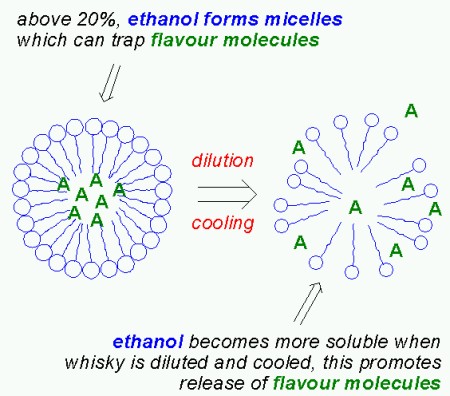
Ethanol micelles (from blog.khymos.org)
On the other hand, ethanol forms micelles trapping hydrophobic compounds at over 23% abv. Addition of water opens up these ethanol micelles and releases some of these hydrophobic compounds but also increases the surface tension of the solution. The short chain esters (fruity, solventy, glue) are usually more volatile and evaporate in proportionally larger amounts than the long chain esters (fruity, soapy). The oak solubles in turn increase the surface tension especially at high ethanol concentrations, decreasing the overall evaporation.

Effect of ethanol concentration on the maturation of cognac (Cantagrel & Galy 2003)

Cutty Sark Scotch 1977 Ad - Water of Loch Katrine
Cutty Sark ad from 1977
It probably makes a difference whether the dilution is made prior the cask filling, just before bottling or in the glass. Theoretically, the dilution before casking might produce a sweeter, cleaner and less fruity and bitter-oaky spirit. The cognac producers usually add water or lower abv spirits just a small amount at the time, probably to avoid sudden changes in ethanol-water equilibrium. Dilution before bottling might have some dimishing effect on the sugars and some volatile off-notes such as glue and acetone, while probably increasing the proportional amount of linalool-oxides and bitter woody off-notes. Dilution in the glass, especially below 23% abv would release more of the hydrophobic aromas, such as esters with fruity, but also solventy and soapy off-notes.

References and further reading
Conner JM, et al. Release of distillate flavour compounds in Scotch malt whisky. J. Sci. Food Agric., 1999; 79; 1015–1020
Conner JM, et al. Agglomeration of ethyl esters in model spirit solutions and malt whiskies. J. Sci. Food Agric., 1994; 66; 45–53
Conner JM, et al. Interactions between ethyl esters and aroma compounds in model spirit solutions. J Agric Food Chem 1994;42;2231-4
Conner JM, et al. Contributions of distillate components to disperse phase structures in model spirit solutions. J Agric Food Chem 1998;46;1292-6
Lea GH, Piggott JR. Fermented beverage production 2nd ed. Kluwer Acad 2003.
Piggott JR, et al. The influence of non-volatile constituents on the extraction of ethyl esters from brandies. J. Sci. Food Agric., 1992; 59: 477–482
Reazin GH. Chemical mechanisms of whiskey maturation. Am J Enol Vitic 1981;32;4;283-9
Ross, J. Whisky. Routledge & Kegan Paul Books 1970
Udo M. The Scottish whisky distilleries. Black&White Publishing 2006.Taylor AJ, Mottram DS. Flavour Science: Recent Developments. Woodhead Publishing 1996.

Friday, September 30, 2011

Yeasts: pedigree and properties

Compressed Mauri Pinnacle yeast (friends-of-islay.dk)
Yeasts used in beverage production mostly belong to the genus Saccharomyces. There are various species of Saccharomyces, including S.bayanus, S.cariocanus, S.cerevisiae, S.eubayanus, S.kudriavzevii, S.mikitae, S.paradoxus, S.pastorianus and in some sources S.uvarum, which is usually considered as a subspecies of S.bayanus. The nomenclature and classification of species changes almost daily and therefore is not always uniform in literature. The species can be further classified into different strains and there are currently thousands of different strains of S.cerevisiae alone. Hybridization is common between the domesticated yeasts used in alcohol production. The yeasts used in whisky industry are mostly S.cerevisiae although various secondary species have been used with it. Baker's yeast is usually S.cerevisiae, lager yeast is S.pastorianus, ale yeasts include S.cerevisiae and apparently some S.bayanus strains, rum ferments primarily on S.cerevisiae and Schizosaccharomyces (with various wild yeasts) and wine industry use mostly S.cerevisiae and/or S.bayanus together with various wild yeasts (for example Kloeckera, Saccharomycodes, Schizosaccharomyces, Hansenula, Candida, Pichia and Torulopsis).

The simple Saccharomyces yeast is a single-cell fungus, containing 16 different chromosomes and because its genome is diploid, there are 32 chromosomes containing the genome (DNA). It can reproduce by budding (producing a copy of genome and cell organs and dividing into two) or mating by spores. During the evolution of yeasts used in beverage production non- or low-spore-producing yeasts became selected, because consistency of the fermentation was preferred. Therefore the strains used in beverage industry reproduce almost exclusively by budding and therefore their genomes change mostly by spontaneos mutations and rarely by mating/breeding. In addition some yeasts produced polyploid (multiple choromosome sets) or aneuploid (multiple single choromosome or parts of it) genomes, which further improved the consistency as there are more than two copies of one chromosome in case of a harmful mutation(s) and less fertile spore production. The extra chromosomes will further split and/or integrate with the other chromosomes. Put simply: it's complicated. For example the species S.pastorianus (formerly called S.carlsbergensis, S.uvarum or S.cerevisiae var Hansen, etc) widely used in lager brewing was probably formed by hybridization of an ale yeast S.cerevisiae and a wild yeast S.eubayanus and by further mixing genetic material (parts of chromosomes) with S.bayanus, which itself is a hybrid of S.cerevisiae, S.eubayanus and S.uvarum (which is also a strain of S.bayanus species). Because of the complex choromosome structure and the restricted reproduction abilities of domesticated yeasts, systematic and predictable breeding of yeasts is very hard even with the modern genetic engineering techniques.

Proposed development of S.pastorianus and hybrids of S.bayanus (Libkind et el 2011)
Practical classification of yeast is done by its purpose (baking, ale/lager brewing, distilling) and it is common to name strains after the lab which produces it, followed by a number; for example WH301 or WL001. Various yeast labs sell probably the same (or very very similar) yeast by a different name. The yeast strains used in beverage industry can be classified further by their abilities to ferment. Important properties of an alcohol producing yeast are flocculation, attenuation, sugar utilization, ability to work in high sugar concentrations (high gravity brewing), tolerance of alcohol, temperature and various killer factors and whether they are top or bottom croppers.

Lager flocculation
Flocculation is the yeasts' ability to clump together; ale yeast flocculates on the top of the fermentation and lager yeast onto the bottom. High flocculators clump early (about 3-5 days) in the fermentation, which might lead to low attenuation, ie part of the sugars are not metabolized to alcohol. Whisky distillers usually prefer low flocculators, because flocculated yeast is more likely to stick to the heating coils or the still surface (especially when direct heated) producing burnt flavours. Low flocculators often provide better attenuation (sugar utilization) and therefore higher alcohol yields. Filtering the wash before the distillation could be an option when using medium-high flocculators, but it is not apparently used in Scotland. The "on the lees" (ie wash containing the yeast cells) distillation is considered to enhance spirit flavour in both grain and wine spirits, most likely by increased fatty acid ester and methylketone concentrations producing oily, rancio and fruity aromas


Wort contains various sugars, mostly maltose and its oligosaccharides (maltotriose, maltotetraose, maltopentaose etc), but also glucose, fructose and sucrose. The oligo- and disaccharides (glucose, fructose, sucrose, maltose) are preferred by the yeast (figure 1) and transported inside the cell by diffusion, but maltotriose utilization depends on the yeast's ability to transport maltotriose into the cell by a spesific enzyme. Effective maltotriose uptake of a whisky yeast is important for optimal alcohol yield. Apparently most whisky yeasts (and brewer's yeasts) used contain several genes for maltotriose tranport enzymes, probably result from several hybridizations and chromosomal changes.

Figure 1. Sugar utilization in all-malt wort (IBD Blue book on yeast)

Alcohol tolerance of yeast depends on the strain and the species. Most domesticated or cultured beverage yeasts tolerate over 10% ABV ethanol concentrations as most non-saccharomyces wild yeasts stop working effectively in 1-5% ABV and die in about 10% ABV as some yeasts used for industrial fuel alcohol production can go up to 23% ABV. In whisky fermentations the factor limiting the final alcohol yield is usually the amount of sugars in the wort as whisky yeast attenuation is usually very good and the primary yeasts tolerate well the 5-8% ABV of a whisky fermentation.

The killer factors are toxins that yeasts produce against other yeast strains. Strains also develop tolerance for these toxins and there are many toxins in wild yeast fermentations, too. Brewer's and distiller's yeasts are usually quite tolerant to the most common killer factors and produce some killer factors themselves, depending on the strain. Anyway a wild yeast producing a killer toxin, which is not tolerated by the primary distiller's yeast used, might ruin the whole batch by producing a stuck fermentation or an inappropriate flavour profile.

Scotch malt whisky fermentations are not usually temperature controlled (apart from the starting temperature, which is adjusted to the ambient temperature), despite practically all lager brewers and most wine producers use temperature controlled fermetors. Yeast metabolism produces lots of heat, especially when anaerobically producing alcohol. Therefore whisky yeast must tolerate different temperatures, usually from 18-20C to over 33C. Typical whisky distillery yeasts tolerate about 32-34C depending on the ethanol concentration and although some other distilling strains can cope with up to 46C (a Finnish vodka strain), most distillers yeasts produce the best alcohol yield at 20-30C. Flavour compound formation is affected quite heavily by the fermentation temperatures; higher temperature fermentations produce less esters and more higher alcohols.

The most used whisky distiller's yeast in the latter part of the 20th century was a S.cerevisiae strain called DCL M, M-strain, Quest M, Rasse M, M-1, D1 or WH301 manufactured formerly by DCL Yeast ltd and now mostly by Kerry Biosciences (Kerry Group bought Quest Ingredients in 1998). The M-strain was introduced to Scotch whisky distilleries by DCL in 1952, but a similar Rasse M was used widely in German distilleries at least from the 1930s. The name has remained the same although the properties of the strain have changed considerably from the 1930s and there most likely is some variation between different yeast manufactures despite the same name. The M-strain is a intraspecies hybrid of S.cerevisiae (as S.cerevisiae covers the former S.diastaticus species). The first Scottish pure strain whisky yeast was developed in the mid-1920s and before the WW II DCL had pure cultures of "standard" DCL-whisky yeast, DCL S.C. (probably for sugar cane fermentations) and DCL L-3 (probably a variety of the standard DCL). Whether they were used widely in distilleries is not documented, but probably they were used in DCL grain distilleries and in some malt distilleries within a reliable transport route in adjunction with a local brewer's or baker's yeast. There is some evidence that the first pure-culture distilling yeasts were being tried in Keith already in the 1870s, but apparently they were never used in larger scale.

In continental Europe pure yeast cultures were more widely used and there were spesific strains for grain/malt worts (Rasse M, Rasse XII) and rye wort (R-strain) and even a raspberry-flavour producing strain "A". Also Fleischmann and Brown-Forman in the US had developed their own distiller's strains by the 1940s. The yeast strains of European, Asian and American distillers seem to be quite different at least by their genetics (see pic below), but there is no scientific data available for differences in spirit quality or flavour. The most similar beer yeasts compared to current Scottish whisky yeasts are probably some Belgian trappist and German hefeweisen yeasts, which are low flocculators, high attenuators, very alcohol tolerant and often produce smoky-spicy aromas associated with 4-vinyl-guaiacol production typical for S.cerevisiae var diastaticus, which is considered to have contributed strongly to the development of the M-strain from the ale-type S.cerevisiae.
Neighbour-joining tree of 63
S. cerevisiae strains (Schacherer 2009)

The M-strain ruled the Scottish whisky industry from 1960s to 1980s, although many distilleries used ale brewer's and/or baker's yeasts in adjunction with it. Before WW II most distilleries propagated their yeast on site, but during 1950s the production was largely outsourced to yeast factories and breweries. The availability of cheap (used/surplus) ale yeast diminished as lager became more popular in UK and as there were claims that using brewer's yeast dimished the alcohol yield, many distilleries started using pure cultures in the 1980s. As said before, the properties of the M-strain probably changed considerably during the latter part of 20th century, primary goals being higher alcohol yields and the preservation of traditional (or neutral) flavour profile.

Cream, compressed and dried yeast
Another significant development was the development of active dry yeast (ADY or instant dry yeast IDY) during the WW II to provide longer shelf life by basically drying the yeast into small pellets rather than just a big clump. This enabled the transportation of yeast into remote locations of Scotland, too. Some Scottish malt distilleries still use dried (95% solids) or more often compressed (25-28%) bag yeast. Cream yeast (17-23% solids) was introduced in 1983 to provide easy delivery by tank trucks and automated pitching, which was important and practical for bigger plants.

The MX-strain developed in the 1990s is a bit faster fermenter and produces a very similar flavour profile compared to the M, according to the manufacturer Kerry Group. The MX is faster and more efficient especially in high gravity worts which are preferred because of the savings in heating and water costs. Another common malt whisky yeast is Pinnacle by Mauri, which is an ethanol tolerant baker's yeast (S.cerevisiae) and actually slightly faster than MX, reaching peak fermentation speed about 1 hour earlier (at 15hours of fermentation) than MX. The grain distilleries use mostly cream yeast of undisclosed strain, produced by British Fermentation Products (BFP) or Anchor Yeast. In the table below you can find information about the yeast strain used by some Scottish distillers.


MMXMAURIBREWER'S + DISTILLER'SANCHOR/BFP
AultmoreBowmore 25% (+Mauri)AberlourBen Nevis (50/50)Auchentoshan (+Mauri)
Blair AtholBruichladdichArdbegBalblairDaftmill
Bruichladdich (+Mauri)BunnahabhainAuchentoshan (+Anchor)BenromachGrain distilleries
BunnahabhainCraigellachie (+Mauri)BenrinnesCardhu

Glengoyne (+MX)Glengoyne(+M)Bowmore 75% (+MX)Glenburgie

Glen ScotiaLagavulin (+Mauri)Bruichladdich (+M)Glenmorangie (5dist, 2brew)

Highland ParkSpeyside (+M)Caol IlaImperial

Lagavulin (+Mauri)

Craigellachie (+MX)Jura

Macallan (+Mauri+brewers)

DalwhinnieLongmorn

Speyside (+MX)

GlenfiddichMacallan (+M+Mauri)


Lagavulin (+M)Miltonduff


LaphroaigOban


Macallan (+M+brewers)Speyburn


Strathmill (+brewers)Strathmill (+Mauri)

Yeasts used by some Scottish whisky distilleries (Udo 2006)

The use of brewer's yeast as a secondary yeast strain produces more sulphury compounds into the wash and less fatty acid esters, especially when using dry ale yeasts. As brewer's yeast attenuates or even dies earlier than distiller's strain, the use of secondary strain increases the growth of lactic acid bacteria (LAB) towards the end of fermentation, which in turn lowers the pH of the wash altering the distillation process and produces specific flavours depending on the bacteria strain. One LAB strain might produce for example vinyl-guaiacol (smoky-spicy), as another produces damascenone (floral). Practically all the LAB growth results in more esters into the new-make, especially hexanoate and octanoate and decreased ethanol yield.

Because Scottish distillers at the present time use very similar primary yeasts, the selection of the strain of distiller's yeast is a minor factor in terms of flavour profile, at least when compared with other aspects of fermentation, such as original wort gravity, fermentation time and temperature and the material and microflora of washbacks.

In the future the whisky industry is looking to develop yeast strains suitable for higher gravity worts, shorter fermentation times and better utilization of maltotetraoses and -pentoses. Hopefully the flavour issues are also considered in the process and different strains are studied for improved flavour profiles.

REFERENCES AND FURTHER READING:
Bryce JH et al (ed). Distilled spirits: Production, technology and innovation. Nottingham Univ Press 2008
Dunn B, Sherlock G. Reconstruction of the genome origins and evolution of the hybrid lager yeast S.pastorianus. Genome Res 2008;18;1610-1623
Gray WD. Studies on the alcohol tolerance of yeasts. J Bacteriol 1941;42(5);561-574
Hansen R et al. Proteomic analysis of a distilling strain of Saccharomyces cerevisiae during industrial grain fermentation. Appl Microbiol Biotech 2006;72;116-125
Landry CR et al. Ecological and evolutionary genomics of S.cerevisiae. Molec Ecol 2006;15;575-591
Libkind D et al. Microbe domestication and the identification of the wild genetic stock of lager-brewing yeast. PNAS 2011;108;35;14539-14544
Piggott JR et al (ed). The science and technology of whiskies. Longman 1989
Pretorius IS et al. Designer Yeasts for the Fermentation Industry, Food Tech Biotech 2003;41(1);3–10
Querol A, Fleet GH (ed). The Yeast Handbook. Springer-Verlag Berlin 2006
Russell I (ed). Whisky, technology, production and marketing. Academic Press 2003
Udo M. The Scottish Whisky Distilleries. Black & White 2006
Saerens SMG et al. Genetic improvement of brewer’s yeast: current state, perspectives and limits. Appl Microbiol Biotech 2010;86;1195-1212
Schacherer J et al. Comprehensive polymorphism survey elucidates population structure of Saccharomyces cerevisiae. Nature 2009;458;342-346
Sipiczki M. Interspecies hybridization and recombination in Saccharomyces wine yeasts. FEMS Yeast 2008;8;996-1007
Suomalainen, H & Lehtonen, P. The production of aroma compounds by yeast. J Inst Brew 1978;85;149-156
Walker GM, Hughes PS (ed). Distilled spirits, new horizons: energy, environment and enlightenment. Nottingham Univ Press, 2010
White C, Zainasheff J. Yeast. Brewers Association 2010