Tuesday, August 30, 2011

Analysis of Michael Jackson's tasting notes

Michael Jackson
Michael Jackson (27.3.1942-30.8.2007) was the most influential beer and whisky writer of his time. He pioneered the writing of whisky tasting notes and also wrote many ground-breaking books on whisky manufacture and drinking culture. In the first edition of his most famous book, The Malt Whisky Companion (1989), he assessed 250 whiskies from 120 distilleries, a huge effort at the time. Based on his work Lapointe and Legendre (1994) studied the similarity of different whiskies. A total of 68 descriptors used five or more times in the book for describing basic malt whiskies aged circa 10 years were included in a matrix analysis to produce the dendrogram below to examine the similarities of different distilleries. Colour, nose, body, palate and finish descriptors were included. Some of the connections are quite expected, but for an average Scotch enthusiasist some are at the first glance somewhat compelling. That is probably because the descriptors are not scaled in any way and therefore the smoky notes in for example Aberfeldy and Glenugie are statistically just as strong as the smoky notes in Laphroaig. Also the amount of colouring, the cask-types and the maturation time of whiskies compared vary considerably. Anyway, despite these shortcomings, there is a highly significant correlation between the tasting notes and the geographic locations of the distilleries, especially in the 12 subgroups named from A to L. IMHO the dendrogram works pretty well in terms of grouping different styles of Scotch whiskies as well and at least is an eye-opener for some unpredicted similarities.
Lapointe 1994

The most common descriptors for each group are listed in the table below:


color nose body palate finish
A full gold fruity, salty medium oily, salty, sherry dry
B amber sweet, sherry medium, smooth dry, sweet long
C pale gold sweet, salty medium to full, oily sweet, spicy big, long, spicy
D pale gold fruity, grassy oily sweet, fruity sweet, quick
E pale wyne, gold fruity, peaty light sweet, spicy fruity
F gold aromatic medium, smooth, light sweet sweet
G gold, full gold grassy smooth, light grassy dry
H white wyne, pale sweet smooth, light sweet, dry, fruity, smoky dry, light
I gold, full gold dry, peaty medium, light, firm dry, smoky, sweet salty
J full gold dry, peaty, sherry light to medium, round sweet dry
K gold, full gold sweet, dry, peaty medium to full sweet, dry dry, long
L full gold aromatic, peaty medium sweet, smoky smoky


...and the best whiskies of each subgroup are listed here:

average best in basic malts pts best in book (1st ed) pts
A 75,3 Laphroaig 10 86 Laphroaig 15 89
B 80,0 Highland Park 12 90 Macallan 25 95
C 78,5 Talisker 10 90 Talisker 10 90
D 69,5 Auchentoshan 10 85 Auchentoshan 18 86
E 74,8 Bladnoch 8 85 Bladnoch GM1975 86
F 76,5 Springbank Cad15 88 Springbank Cad21 92
G 79,1 Cragganmore 12 90 Cragganmore 12 90
H 69,2 Bruichladdich 10 76 Glenfiddich 30 86
I 79,9 Longrow 14 90 Lagavulin 16 95
J 72,8 Linkwood 12 83 Linkwood GM25 87
K 74,0 Dallas Dhu GM1971 85 Dallas Dhu GM1971 85
L 73,3 Lochnagar 12 80 Lochnagar NAS 83

An interesting fact in MJ's tasting notes is that there is a significant correlation between colour, body, palate and nose, but the finish notes do not correlate with the classification derived from the other descriptions. As expected the correlation between the nose and the palate is extremely strong, but there is also a very strong correlation between the colour and the body (texture) of whisky, which might support the hypothesis that added caramel colouring affects the body (or mouthfeel) of whiskies.

Legendre 2004


REFERENCES AND FURTHER READING:
Jackson M: The whole bibliography.
Lapointe FJ, Legendre P. A classification of pure malt Scotch whiskies. Appl Statist 1994;43;1;237-257
Legendre P, Lapointe FJ. Assessing congruence among distance matrices: single-malt Scotch whiskies revisited. Aust N Z J Stat 2004;46;615-629
Mantel N. The detection of disease clustering and a generalized regression approach. Cancer Res 1967;27;209-220
Sokal RR, Rohlf FJ. The comparison of dendrograms by objective methods. Taxon, 1962;11;33-40
Ward JH. Hierarchical grouping to optimize an objective function. J Am Statist Ass 1963;58;236-244

Friday, August 12, 2011

Yeast in the 1800s

Pic from sandcreekbrewing.com
Yeast is a crucial element in all alcohol production. It converts sugars to alcohol and CO2 and its metabolism also produces a variety of flavour compounds. Yeast has been used in distilling probably from the beginning, although its importance was not fully appreciated until the late 19th century. Early distillers used beer yeast, wine lees and sometimes fruits or juices to improve fermentation and at least some re-use of distilling yeast has been done in the 1700s. In the process more alcohol tolerant and temperature resistant yest strains have been evolved and/or selected. Some distillers (and some wine makers) in the continental Europe used fermentation sticks, for example branches of hazel, which were used to stir the wort. In the process the stick was covered with yeast and acted as an inoculator for the next batch. During the 1700s the Scottish distillers sold considerable amounts of excess yeast from the fermentations to bakers, but also bought ale yeast from breweries.


Bass brewery fermentations, late 19th century
In the 1823 Excise Act the distillers were given substantial reductions on taxes to persuade them to apply for a legal licence. At the same time the yeast trade was handed over to brewers as the law was (at least interpreted) to prohibit the distillers to remove any excess yeast during fermentation. As the wort destined for distilling was not traditionally boiled, its contamination with bacteriae and wild yeasts was inevitable and therefore the yeast slurry at the end of the fermentation was not very healthy or pure and  the re-use of distilling yeast was not popular. Porter yeast was preferred by many distillers, because it tolerated high gravity worts and temperature fluctuations and was believed to produce heavier style of spirit and better alcohol yields. Propagating yeast for several batches from starters acquired from the breweries was probably the method of choice for many distillers and the starter was replaced with fresh brewers' yeast as it contaminated or lost viability.

In the continental Europe distillers collected their excess yeast in the process and in 1847 the Vienna Process (or Mautner process) was invented to produce great amounts of yeast from corn based fermentations. Basically this was done with acidic, high gravity-high temperature brewing and top-cropping the excess yeast with nets. The yeast was further processed by partial drying with nets and starch, which improved the stability and eased the transportation.

As the yeast production of UK brewers was not sufficient for the increased bakery industry and the distillers were not allowed to sell their yeast, the British yeast industry became controlled by the Germans, French, Dutch and Belgians. Brewers' yeast produced bitter bread, because of hops, contaminant bacteriae and the properties of the yeast strains used,  and therefore imported yeast was preferred in bakeries. There were various methods to remove the bitterness from the ale yeast, but they increased the cost of manufacturing, which was already much more than in the big grain distilleries. The UK Distillers used mostly domestic porter or ale yeast, although some bakers' yeast and imported yeast was also used, especially during the summer breaks of the breweries. In 1860 distillers were allowed to collect yeast of a total amount of 2,5% of the volume of wash and in 1880 this was increased to 10%, probably to diminish the role of "German yeast monopoly". Dr William S. Squire patented his efficient yeast manufacturing process in the UK and offered rights to the Distillers Company Limited (DCL) in 1881. Experimental yeast manufacturing started first in Cameron Bridge and Kirkliston grain distilleries during 1882 and in 1885 a larger scale industrial production was started in Cameron Bridge. Alfred Barnard described The Cameron Bridge Yeast House in 1887: 

"Near the works, and standing in a small park, is a handsome building which we at first took for a church, but on enquiry we learned that it was the Yeast House, erected by the Company for the manufacture of French yeast, a large quantity of which finds its way to Glasgow and London, where its fine quality is much appreciated, and yields a large revenue."

The grain distillery Glenochil (DCL) did also produce yeast at the time of Barnard's visit (although probably not yet by the Squire's method): "The Company manufacture an enormous quantity of what is called German Yeast, considered superior to that manufactured on the Continent, and which commands a good price in the market." 

In the Cambus distillery (DCL) there were plans to start yeast production: "Alongside the Water-wheel House entrance, across the lade, is a large building fitted up with machinery for making German Yeast, where about two tons can be produced weekly, but at that time of our visit this department was silent." 

Bo'ness in Linlithgow owned by J.Calder & Co.  operated according to their own methods imported from Germany and were more open about their process than the DCL: "Under the principal Tun Room is the patent Yeast House, where a large an remunerative business is carried on. Here the yeast from the fermenting backs is collected into three tanks. Afterwards these yeast skimmings are pumped into accordion shaped iron press- a German patent- containing twelve leaves or intersections, which are covered inside with linen cloth of various textures, forming separate divisions, through which the yeast is driven y great pressure. The dough-like material, which exudes from the last intersection, is then collected and passed through a fine sieve, whilst the liquid expressed or squeezed therefrom runs into tank. The yeast material left in the sieve, which looks like flour cakes, is afterwards weighed out in 7, 14, and 28 lbs, and pressed into conical bags and shipped off to England and Germany."

The  DCL yeast business was not fully engaged or even appreciated in 1887, producing just over 5% of the total profits of DCL, but with its wide distiribution network the DCL gained practically a domestic monopoly over the yeast in the 1890s and the foreign imports declined from 14,2 tons to 6,5 tons in 1887-1901 and stopped completely before the WW I. In 1894 production was started in Carsebridge and Glenochil. DCL made good profits in the yeast trade (up to 35% of total profits in 1894-1895) and the trade partly helped it through the Pattison crisis at  the turn of the century. In 1922 DCL had acquired all the yeast producing grain distilleries and controlled the yeast industry as German imports were down after the war.

The role of yeast in fermentation was surprisingly poorly understood until the late 1800s. Fermentation was believed to occur chemically, in another words sugars and water would turn into alcohol and CO2 in the presence of sufficient heat and air; yeast was considered as a byproduct. The Theory and Practice of Brewing by Michael Comburne (1762) describes fermentation as follows:

"The sensible internal motion of the particles of a mixture, by the
continuance of this motion particles are gradually removed from their former situation, and after some visible separation, joined together in a different order and arrangement so as to constitute a newcompound...vegetable fermentation is the act of which oils and earth,naturally tenacious, by the interposition of salts and heat, are so much attenuated and divided, as to be made invisible with, and to be suspended in, an homogeneous pellucid fluid...the acid particles of the air, which insinuate temselves into the wort, act on the oils, and excite a motion and effervescence, which is the cause of the heat. As the internal motion goes on, the particles of the wort become more pungent and spiritous, become more fine and active: some of the more volatile ones fly off, hence the dangerous vapour called gas. The pressure of external air, from the very first of its fermenting, not only occasions the particles of wort to arrange themselves in their due order, but also by the weight and action of that element, grinds and reduces them into smaller parts. That this operation persists even after the liquor becomes fine is evident, for every fretting is a continuance of fermentation. It would seem that the more minutely the parts are reduced, the more pungency will appear, and the easier their passage be in the human frame. Lastly, in the final state of all, the active particles being entirely evaporated, a pellicle forms on the surface, seeds deposit from the air, and a moss grows." "Yeast is needed to excite the separation and new arrangement on which the perfection of the products depends, and prevent the accidents to be apprehended from worts' disposition to ferment spontaneously through slow absorbtion of air from the atmosphere." "Yeast provides bladders of the coarser oils of wort, filled with air and ready to start the motion."

A French scientist Antoine Lavoisier described the fermentation process quite accurately in 1789 as "grape must=>carbonic acid+alcohol" and in 1815 the yield of alcohol from sugar was estimated almost precisely by Joseph Gay-Lussac. Many scientists (Christian Erxleben 1815 was probably the first) of the early 19th century proposed that yeast was a living organism and that fermentation was "of some vegetal or animal origin" and as the microscopes improved, three scientists described yeast cells almost simultaneously but independently (Cagniard-Latour, Friedrich Kützing and Theodor Schwann, 1837). Schwann wrote that


"wine fermentation must be a decomposition that occurs when sugar-fungus uses sugar and nitrogenous substances for growth, during which, those elements not so used are preferentially converted to alcohol".

Saccharomyces cerevisiae
This "vitalist" theory of fermentation was strongly opposed by chemists and it was until 1879 when Louis Pasteur confirmed and described the fermentation process by yeasts. Shortly after that in 1883 the first pure yeast culture (a lager yeast Saccharomyces carlsbergesis, later S.uvarum, S.cerevisiae and S.pastorianus) was isolated in the Carlsberg brewery by Emil Christian Hansen. At about the same time truly sterile laboratories and agar plates were introduced which made possible to isolate and transport pure yeast strains. 

After these findings, the the era of biotechnology really started and in the 1900s more efficient and pure yeast strains were developed. In the UK the yeast biotechnology was slower to start as breweries were conservative about pure strains and lager brewing. The DCL started to actively to develop a pure yeast strain for (grain) whisky distilling and yeast production in 1911, as they learned that The Berlin Distillers' Association had already developed a successful strain, which they used in all their distilleries. Several cultures were grown and considered, but the first suitable strain was developed not until the mid 1920s. As the whisky industry was declining and the trade of industrial alcohol increased the emphasis was heavily on alcohol yield. More about yeast strains and their influence on brewing and flavours in the following posts...

REFERENCES AND FURTHER READING: 
Barnett JA. Beginnings of microbiology and biochemistry. Microbiology 2003;149;557-567
Comburne, M. The theory and practice of brewing. Haberkorn 1762

Fitzgerald M. Industrial combination in England. Ayer publishing 1927.
Udo M. The Scottish whisky distilleries. Black&White Publishing 2006.
Weir R. The history of the Distillers Company 1877-1939. Clarendon Press 1995.
Weir R. Science marketing and foreign competition in the yeast trade 1860-1918. Business History 1991;33;4;43-67
White C. Yeast, the practical guide to beer fermentation. Brewers Association 2010.

Monday, July 11, 2011

Flavour wheels

Classification of odors is a hard task. There are no generally accepted descriptors for odors and there are no measurable and defined primary odors. Cultural differences may be enormous because the smells can be perceived, learned and memorized as objects resembling something, often an another sensation by for example sight or sound or even as feelings or memories. The olfactory sensation is processed quite roughly in the subconscious brain and therefore it is harder to concentrate on details, unlike for example sight or hearing.

Various attempts have been made to classify odors. The western method has mostly tried to describe odors by naming them after familiar objects or groups of objects (lemon, fruity, flowery, spicy etc.). The Asian cultures seem to perceive and classify smells often more aestetically or subjectively (assessed by man or god). In Indian hindu and buddhist traditions the classifications of odors were simply good/bad and even/uneven (although this might also be translated faint/strong). A hindu might further divide odors into more descriptive sweet, pungent, diffusive, compact, smooth, rough and pure wehreas a buddhist might separate root-, stalk-, branch-, leaf-, flower- and fruit-odors. Most meats are often described as bad odourants in India, especially when raw, this is probably due to the strong vegetarian culture present in India.

One of the early written western classifications was made by the Swedish botanist Carl von Linne. His odores medicamentorum (1752) lists seven primary odors: Aromaticos (aromatic), fragrantes (fragrant), ambrocacos (ambrosial, musky), alliaceos (onion, garlic), hircinos (hircine, goaty), tetros (repulsive), naufeofos (nauseous). Zweibakker (1895) added another two odors: ethereal (fruity) and empyrheumatic (burnt). Henning (1915) contructed this into a prism, representing the links between different groups. For examples of cultural variation see the odor classifications of Serer Ndut tribe from Senegal and Sua Indians of Brazil in the tables below. 

Odor Example
Urinous Europeans,horses,dogs,cats,plants used as diuretics,squash leaves
Rotten cadavers, pigs, ducks, camels, creeping plants
Milky/Fishy nursing women,neighbourhood tribes,goats,cows,antelopes,jackals,fish,frogs
Acidic spiritual beings, donkeys, tomatoes, trees, roots
Fragrant Seret Ndut, Bambara (friendly tribe), flowers, limes, peanuts, onions
Table1. The odor classification of Serer Ndut in Senegal.


Odor Example
Bland adult men,small mammals,small birds,fish,innocuous plants
Pungent old men,old women,large mammals,macaw,amphibians,medicinal plants
Strong adult women,children,carnivorous mammals,birds,harmful plants
Table2. The odor classification of Sua Indians in Brazil.


Many odor classifications might seem quite strange for someone from a different culture (although it would be great to see some whisky tasting notes by a Serer Ndut). But as you learn that onion essence is a popular compound of perfume in Africa and consider that fish and milk probably turn sour and rancid in the heat practically instantly, maybe some logic starts to emerge. But the bottom line is that there are no really universal, constant and non-culture related descriptors or classifications for smells.


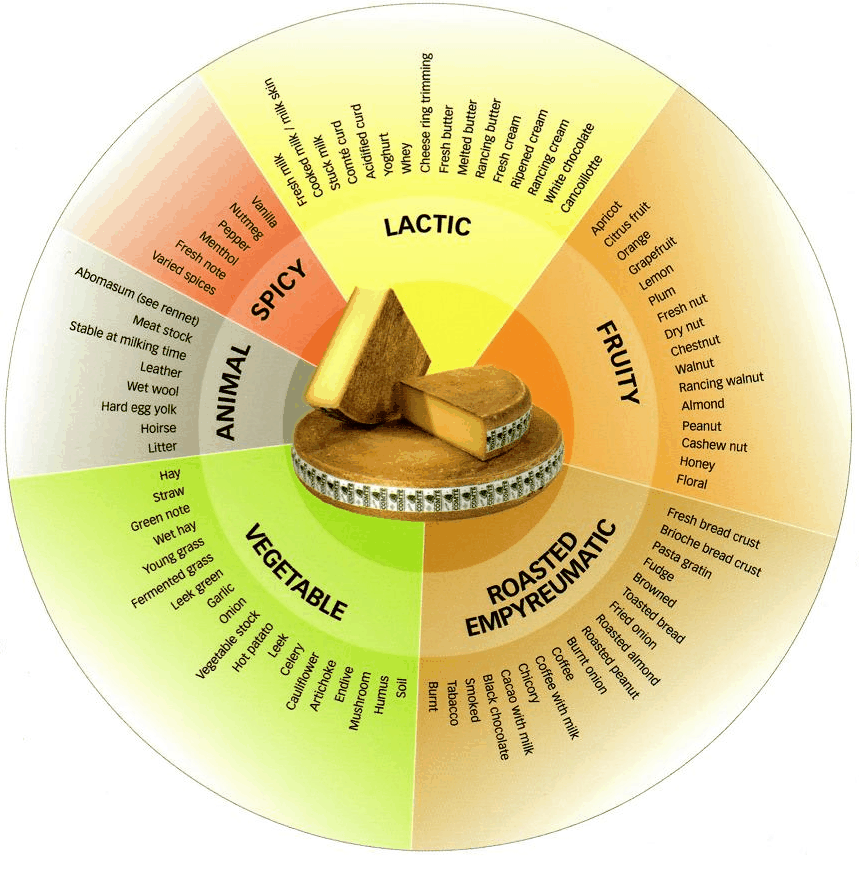
A common method of classification in the late 1900s was a wheel, basically developed from the Linné-system by adding classes and simplificated from the 3D-model of Henning to one (simple circle) or two dimensional (circle with tiers). The flavour wheels have a lot in common as they are descriptive systems constructed by people from similar cultural background (educated Europeans / Americans) and probably because many have most likely been developed from the succesful wine wheel by Ann C. Noble (1990). The wheels detailed according to their use, but basic principle is often quite similar. Most wheels concentrate on the smell, but many have at least some basic taste descriptors included although none seems to list umami; for example an Asian whisky wheel would probably be quite different providing perhaps umami, soy and more than one subcategory of spices. Trigeminal activity (camphor, burning sensation) is quite usually covered in the wheels, but mouthfeel, viscosity and texture are noted surprisingly seldom. Some wheels have apparently been made from the production point of view, such as the Dewar whisky wheel and to some extent the early version of Scotch Whisky Research Institute wheel. Probably the most detailed whisky flavour wheels used are the Revised Scotch Whisky Flavour Wheel for Industrial Purposes and the Whiskymag wheel. Below you'll find some other wheels for beer, chocolate, tequila, olive oil, cigars, cheese, bodyodor and off-odors.

Wine wheel (Ann C Noble)

The Dewar whisky wheel

SWRI wheel


SWRI revised wheel

Whiskymag wheel

Macallan wheel

Coffee wheel

Fragrance wheel by Michael Edwards

Chocolate wheel


Olive oil wheel
Cigar wheel
Comté cheese wheel


REFERENCES AND FURTHER READING:
Classen C et al. Aroma: The cultural history of smell. Routledge, 1994
Lawless HT. Exploration of fragrance categories and ambiguous odors
using multidimensional scaling and cluster analysis. Chem Senses
1989;14:349– 60
von Linné C. Dissertatio medica odores medicamentorum exhibens. 1752
McHugh J. The classification of smells and the order of senses in Indian religious traditions. Numen 2007;54;374-419

Saturday, June 11, 2011

Lavender in whisky. A conspiracy of French women, British brewers, Peruvian distillers and hot condensers?

Lavender
The flowery perfumy notes in whisky have been widely discussed in various forums for years. In short, some whisky drinkers have experienced very strong off-notes of lavender soap in several whiskies. Especially the flowery notes of Bowmore and Glen Garioch distilled in the early 1980s have been noted.

Lavandula angustifolia
Lavender (Lavandula) is a genus of flowering plants common in mediterranean region. There are ~39 species of lavender; the most common are Lavandula angustifolia (English lavender, common lavender, narrow leaf lavender), Lavandula stoechas (French/Spanish lavender, topped lavender), Lavandula dentata (French lavender) and Lavendula latifolia (spike lavender, broad leaf lavender, Portuguese lavender) . To make things complicated the English lavender is not native to England but to western mediterranean; the French lavender (L.dentata) is native to Spain, Canary islands and Madeira. Most of the cultivated French lavender is either L.angustifolia or a more productive hybrid of L.angustifolia and L.latifolia called lavandin (Lavandula x intermedia or L.hybrida).

The odor active compounds in lavender essential oil are primarily terpenes and their oxygenated derivatives. The essential oil of L.angustifolia is the most appreciated, described as lavender, lime tree, coriander and flowers. Lavandin (L.x intermedia) oil is much cheaper, but the odor has more soap, camphor, turpentine, artificial fruit, fat and eucalyptus. L.latifolia essential oil is even harsher with more camphor, menthol and eucalyptus. In fact coriander essential oil is closer to L.angustifolia oil than the oil of L.latifolia. In table below are percentages of odor compounds found in typical essential oils of L.angustifolia, L.latifolia and lavandin (L.x intermedia). Linalool (aka β-linalool, linalyl alcohol, linaloyl oxide, p-linalool, allo-ocimenol, 2,6-dimethyl-2,7-octadien-6-ol, licareol, coriandrol) and its derivatives are responsible for the flowery lavender scent. Often linalool is added to lavandin oil and other perfumes to soften the odor. Up to 80% of perfumed hygiene products (soaps, shampoos, perfumes etc) contain linalool, often added as a fragrance. The odor treshold for linalool is usually very low, about 0,8-7,4 ppb, depending on the stereoisomer structure. Usually oxidation of linalool compounds adds to the odor.


L.angustifoliaL.latifoliaL.x intermedia
linalool31320
linalyl acetate16425
camphor33211
1,8-cineol(eucalyptol)na39na 
Table1. Essential oil compounds from different lavenders. 

Monoterpene metabolism by yeasts (King 2000)
Let's assume that linalool (and/or linalyl acetate) is responsible for the lavender aroma in some whiskies. Why would some distillates contain more linalool than others?

Linalool is produced by various plants, especially by lavender and most herbs such as mints, coriander, laurels and cinnamon. Hops used in beers (Cascade hops especially) are also quite rich in linalool and sometimes hops impart a flowery odor to finished beer, especially if the hops are added after the boiling. Many brewers yeasts also affect the metabolism of monoterpenes (see picture above). Beer is usually boiled in mashing, which diminishes the linalool content considerably via evaporation (This is probably why hopped beer on a frying pan smells of lavender, see Dave's e-pistle). However, in distillery mashing the wort is not boiled and the linalool in a distillery wort would be carried into the distillate if hopped wort was used in distillation (I know, this is just about as likely as the urban legend about scented soap used in distillation).

Another possible source for linalool in wort is yeast or fungi. Distiller's yeast does not usually produce significant amounts of linalool, but brewer's yeast (both lager and ale) and some lactic acid bacteriae (Kluyveromyces lactis) do and additionally there are some mutations of Saccharomyces that produce over ten times more linalool and geraniol than ordinary fermentation yeasts. These yeasts have been used in brandy fermentations and probably in production of aromatized wines such as sweet muscat. Whether this kind of yeast strain might have been used in one or two Scotch whisky distilleries in the 1980s is extremely unlikely, but brewer's yeast has been used in many distilleries along with the distiller's yeast. Linalool concentration of wort increases as the fermentation time gets longer. Too long fermentations with brewer's yeast would probably add considerably to the linalool content of the wort. A sporadic yeast mutation, a contaminant wild yeast strain, excessive lactic bacteria growth (due to prolonged fermentation time) or a fungal infection in wort would also produce too much linalool.

Optimal condenser cooling for maximum linalool and ethanol in Pisco distilling. Continuous line=optimal, dotted line=traditional. IAF=initial aromatic fraction of heart, SNF=second neutral fraction of heart (Osorio et al 2005)

Distillation affects the linalool concentrations of the spirit. It is possible that overheating the still and burning the wash might convert some other terpenes to linalool. The amount of reflux and condenser temperature is probably even more important. To understand a bit more about linalool and distillation we should investigate pisco brandy. Pisco is a wine brandy distilled in Peru and Chile. It is batch distilled from muscat wine in ~1500l copper stills (not too different from Scotch malt whisky stills). The pisco distillers try to produce very floral spirit with lots of monoterpenes, especially linalool, which is considered a quality marker for an aromatic high-end pisco together with geraniol and nerol. Pink muscat and muscat of alexandria grapes are very rich in linalool and therefore used as a component in the wine blend, but usually also cheaper and less fragrant muscat varieties and pedro ximénez grapes are used to increase ethanol-yield. Pisco contains about ten times more linalool than the average cognac. Ester- and aldehyde- concentrations are also quite high resulting to very fragrant, floral and fruity spirit. The distillation practice and especially the cooling of the condenser is critical in producing linalool-rich spirit; usually the heads fraction is distilled without cooling the condenser, apparently to get rid of the methanol and other high volatiles quite fast without losing much linalool. The boiling point of linalool is 199°C, but since it is poorly soluble in water, it distills quite early in the run along with the alcohols. Linalool is rich in the early stages of the heart run, decreasing slightly towards the tails. Cooling the condenser fast after the heads fraction and allowing much less cooling at the middle of the heart run produces more linalool, although towards the end of the spirit run the cooling is increased to prevent the tails (especially octanoic acid) getting into the spirit.

This might support Dave Broom's speculation about the two-part condensers not working properly in the distillation. If there was an inadequate amount of cooling water in circulation of the condenser, the cooling rate and the reflux at the first part of the heart would be fine, but later in the cut the cooling rate would drop too much. This would probably produce more linalool and other monoterpenes, but also early tails. If a distiller in this case would cut the heart early to avoid the tails in the spirit, the resulting heart fraction would probably be very rich in linalool. Alternatively, if the tails cut was made by timing the run or by the ABV% (opposed to smelling), it would probably become very feinty (and floral).
Pisco

The casks might also be to blame. Fungal infection in the caskwood might be a source for monoterpenes, probably in a winery supplying the casks, as spirit (bourbon or scotch) would likely kill most fungi. Muscat wine casks are not a likely option for excess linalool and pisco is not traditionally matured in oak.

So: IF there was some excess linalool in the wash AND IF the condensers were cooled inadequately in the latter part of the spirit run, there MIGHT be excessive linalool in the spirit producing heavy aroma of lavender. The source of linalool might be hops, an  odd yeast strain, brewer's yeast used together with too long fermentation times (my guess) or a fungal infection of the wort. The two-part condensers installed in early 1980s and not working (or used) properly might account for the distillation/cooling part of the problem.

Now, please do not shoot me for this speculation as this is most certainly not science, but merely (mis?-)educated guesswork. Any criticism and conversation on this FWP-phenomenon is very welcome. And for the record: I am apparently not too sensitive to the lavender smell in the Bowmores of 1980s nor in perfumes or flowers. I do get some lavender notes in the 1980s Bowmores but nothing too offensive.
Bowmore spirit still condenser (from WhiskyStory)

REFERENCES AND FURTHER READING
Broom D. Lavender lament. 2005
Colonna-Ceccaldi, B. Use of terpene-producing yeasts in brandy production. Nottingham Univ Press 2010.
Daferera DF, et al. Characterization of essential oils from lamiaceae species by FTRS. J Agric Food Chem 2002;50;5503-5507
Da Porto C, et al. Flavour compounds of Lavandula angustifolia L. to use in food manufacturing. Food Chem 2009;112;1072-1078
Diéguez SC, et al. Approaches to spirit aroma: contribution of some aromatic compounds to the primary aroma in samples of orujo spirits. J Agric Food Chem 2003;51;7385-7390
Ferrari G et al. Determination of key odorant compounds in freshly distilled cognac using GC-O, GC-MS and sensory evaluation. J Agric Food Chem 2004;52;5670-5676
King A, Dickinson JR. Biotransformation of monoterpene alcohols by saccharomyces cerevisiae, torulaspora delbrueckii and kluyveromyces lactis. Yeast 2000;16;499-506
King A, Dickinson JR. Biotransformation of hop aroma terpenoids by ale and lager yeasts. FEMS Yeast Res 2003;3;53-62
Kishimoto T et al. Comparison of the odor-active compounds in unhopped beer and beers hopped with different hop varieties. J Agric Food Chem 2006;54;8855-8861
Lea GH, Piggott JR. Fermented beverage production 2nd ed. Kluwer Acad 2003.
Lillo M et al. Chemical markers for tracking the sensory contribution of production stages in muscat wine distillates. J Food Sci 2005;70;7;432-441
Osorio D et al. Wine distillates: practical operating recipe formulation for stills. J Agric Food Chem 2005;53;6426-6331
Piggott JR, Paterson A (ed). Understanding natural flavors. Blackie academic&professional 1994
Strehle KR et al. Quality control of commercially available essential oils by means of raman spectroscopy. J Agric Food Chem 2006;54;7020-7026
Takoi K et al. Biotransformation of hop-derived monoterpene alcohols by lager yeast and their contribution to the flavor of hopped beer. J Agric Food Chem 2010;58;5050-5058